

DR3 protein: A bidirectional immune regulatory hub in the tumor necrosis factor receptor superfamily
Author: Senior Product Manager of UA Views:16 


This article focuses on the molecular characteristics and biological functions of death receptor 3 (DR3/TNFRSF25), systematically elaborating its molecular mechanism as a type I transmembrane glycoprotein that specifically binds the ligand TL1A through its extracellular cysteine-rich domain and recruits the adaptor protein TRADD through its intracellular death domain to activate downstream NF-κB and MAPK signaling pathways, analyzing the bidirectional immunoregulatory role of DR3 in maintaining regulatory T cell homeostasis and promoting pathogenic Th17 differentiation, and exploring the multifaceted therapeutic potential of DR3 in autoimmune diseases, transplant rejection, inflammatory bowel disease, and tumor immunity.
- Recent Advances
- Product Information
Recent Advances
DR3 Protein: A Bidirectional Immune Regulatory Hub in the TNF Receptor Superfamily
Summary: This article focuses on the molecular characteristics and biological functions of death receptor 3 (DR3/TNFRSF25), systematically elaborating on its molecular mechanism as a type I transmembrane glycoprotein that specifically binds its ligand TL1A through its extracellular cysteine-rich domain and recruits the adaptor protein TRADD through its intracellular death domain to activate downstream NF-κB and MAPK signaling pathways. It analyzes the bidirectional immune regulatory role of DR3 in maintaining regulatory T cell homeostasis and promoting pathogenic Th17 differentiation, and discusses the multifaceted therapeutic potential of DR3 in autoimmune diseases, transplant rejection, inflammatory bowel disease, and tumor immunity.
I. Molecular Structure and Signal Transduction Mechanism of DR3.
DR3 (TNFRSF25) is a member of the tumor necrosis factor receptor superfamily and is a type I transmembrane glycoprotein. Its molecular structure possesses two key functional regions: the extracellular cysteine-rich domain, which is responsible for specifically binding its unique ligand TL1A (TNFSF15); and the intracellular death domain, which can recruit the adaptor protein TRADD, thereby activating downstream NF-κB and MAPK signaling pathways. This structural combination of "extracellular specific ligand recognition and intracellular death domain signal initiation" enables DR3 to possess both the signal transduction characteristics of the death receptor family and the immune regulatory functions of a co-stimulatory receptor. TRADD, as the core adaptor molecule for DR3 signal transduction, can divert receptor activation signals to the NF-κB pathway and the MAPK pathway, respectively regulating diverse biological effects such as cell survival, inflammatory cytokine expression, and cellular stress responses.
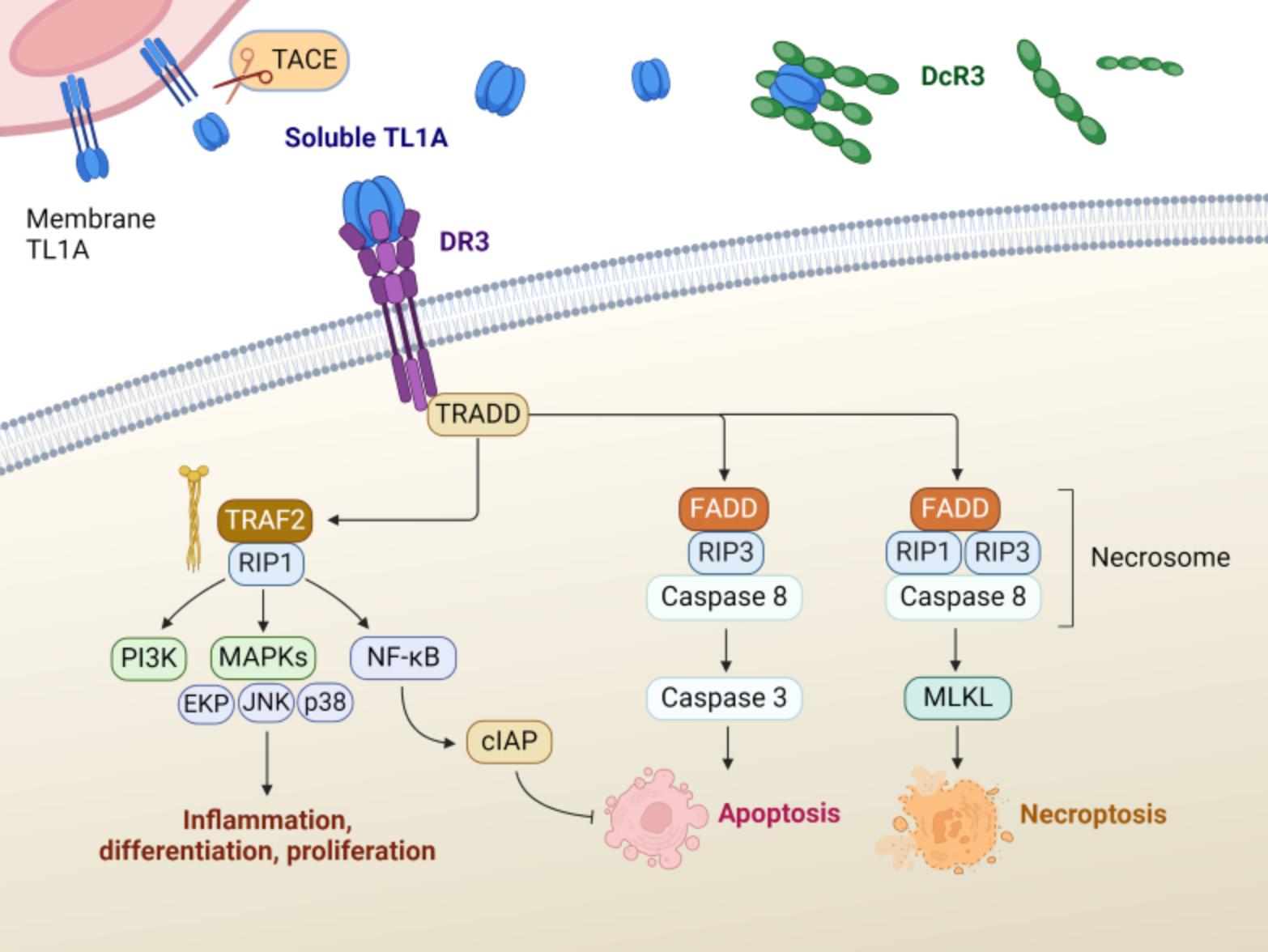
II. Bidirectional Immune Regulatory Functions of DR3.
At the functional level, DR3 exerts bidirectional immune regulatory effects. On one hand, DR3 maintains the homeostasis of Foxp3 regulatory T cells, thereby limiting excessive inflammatory responses. Regulatory T cells are the core cell population for immune tolerance and inflammation resolution, and DR3 signaling plays an important supporting role in the maintenance and functional stability of the Treg pool. On the other hand, DR3 simultaneously promotes pathogenic Th17 cell differentiation and induces fibroblast activation, participating in the development of intestinal fibrosis. Th17 cells are key effector cells in various autoimmune diseases, and fibroblast activation is a core step in tissue fibrosis. This coexistence of bidirectional functions on the same receptor makes DR3 a highly context-dependent functional node in the immune regulatory network—its ultimate effect depends on the immune microenvironment, ligand concentration, and target cell type.
III. Genetic Polymorphisms of the DR3 Ligand and Disease Susceptibility.
Genetic polymorphisms in TNFSF15, the gene encoding the DR3 ligand, have been confirmed to be closely associated with susceptibility to Crohn's disease and rheumatoid arthritis. This genetic association provides direct genetic evidence for the central role of the DR3/TL1A signaling axis in the pathogenesis of human autoimmune diseases. Crohn's disease is an important subtype of inflammatory bowel disease, characterized by chronic intestinal inflammation and fibrotic strictures, and DR3 signaling, by promoting Th17 differentiation and fibroblast activation, precisely encompasses these two key pathological processes. The association with rheumatoid arthritis further suggests the potential involvement of DR3 signaling in synovial inflammation and bone destruction. These genetic findings provide a human genetics basis for drug development targeting the DR3/TL1A axis.
IV. Therapeutic Strategies of DR3 in Autoimmune Diseases, Transplantation, and Inflammatory Bowel Disease.
At the clinical translation level, DR3 therapeutic strategies exhibit a distinct direction-dependent pattern. DR3 agonists are being developed for the treatment of autoimmune diseases and the prevention of graft-versus-host disease—by activating DR3 signaling to expand Foxp3 regulatory T cells, enhancing immune tolerance, thereby suppressing excessive autoreactive immune responses and transplant rejection. In contrast, DR3 blocking antibodies show therapeutic promise in inflammatory bowel disease and fibrotic complications—by blocking DR3/TL1A signaling, inhibiting pathogenic Th17 differentiation and fibroblast activation, thereby reducing intestinal inflammation and fibrotic progression. This development landscape of parallel "agonism" and "blockade" is a direct manifestation of DR3's bidirectional immune regulatory functions in drug design.
V. Significance of DR3 in Tumor Immunity and Its Positioning as a Multifaceted Therapeutic Target.
In the field of tumor immunity, the enrichment of DR3 regulatory T cells in the tumor microenvironment is associated with immune evasion and poor prognosis. This finding suggests that DR3 signaling may promote tumor progression by maintaining the immunosuppressive function of Tregs in the tumor microenvironment. Therefore, in the context of tumor therapy, DR3 blocking strategies may help weaken Treg-mediated immunosuppression and restore anti-tumor immune responses. Taken together, DR3 has become a multifaceted therapeutic target spanning multiple fields including autoimmune diseases, transplant immunology, oncology, and infectious diseases, and the selection of its therapeutic strategy must be based on the immunopathological characteristics of the specific disease and the direction of the net effect of DR3 signaling in that disease.
VI. Conclusion.
In basic research and drug development related to DR3, high-quality recombinant DR3 protein is a core tool for elucidating its binding mechanism with TL1A and evaluating the activity of targeted drugs. To meet the needs of DR3 functional research and drug screening, UA provides DR3/TNFRSF25 His Tag Protein, Human. This product is suitable for applications such as binding activity analysis of DR3 with its ligand TL1A, in vitro screening and evaluation of DR3 agonist and blocking antibodies, mechanistic studies of DR3-mediated NF-κB and MAPK signaling pathways, and the development of therapeutic strategies for autoimmune diseases, inflammatory bowel disease, and tumor immunotherapy.
As a unique member of the tumor necrosis factor receptor superfamily that possesses both a death domain and co-stimulatory functions, DR3, by virtue of its molecular mechanism of specific binding of its extracellular cysteine-rich domain to TL1A, recruitment of TRADD by its intracellular death domain to activate NF-κB and MAPK pathways, and its bidirectional immune regulatory role between maintaining Treg homeostasis and promoting Th17 differentiation, has become a multifaceted therapeutic target spanning multiple fields including autoimmune diseases, transplant immunology, inflammatory bowel disease, and oncology. The genetic association of its ligand gene TNFSF15 with Crohn's disease and rheumatoid arthritis, as well as the correlation between DR3+ Treg enrichment in the tumor microenvironment and immune evasion, further expand the clinical translational value of DR3. DR3/TNFRSF25 His Tag Protein, Human provides reliable tool support for in-depth analysis of the DR3 signaling network and the development of related therapeutic strategies, and will continue to drive innovative exploration in the field of immunotherapy.
This article is reviewed and published by the technical expert team of UA
Disclaimer: This article partially utilizes artificial intelligence assistance in its creation. If any content involves copyright or intellectual property issues, please let us know and we promise to verify and remove it as soon as possible.
Purchase recombinant protein, choose 
UA protein focuses on providing various protein reagents, raw materials, and services required for drug research and development, cell therapy, gene therapy, and basic scientific research, including drug target proteins, immune checkpoint proteins, cytokines, tool enzymes, customized protein expression, and full-length transmembrane protein development. Nanjing Univ is committed to providing customers with high-quality products and professional services, and building a High-tech Biological Enterprise with International Competitiveness.
Target proteins | membrane proteins | cytokines | enzymes | viral antigens | protein customization
Nanjing UNIV Biotechnology Co., Ltd. Email:order@ua-bio.com Phone:+86-25-56221161

Product Information

Link:





©2021-2026 all rights reserved UNIV Biotechnology Co.,Ltd.
Privacy Policy
网站备案号 苏ICP备2025207586号-2 浙公网安备33010202004867号
 Business license (three certificates in one)
Tel:+86-25-56221161
E-mail:order@ua-bio.com
All products sold on this website shall not be used for clinical diagnosis or treatment of humans or animals, and shall only be used for non-medical purposes such as industrial or scientific research.