




Regulatory mechanism of deubiquitinase UBP12/13 in plant growth and development


Ubiquitination and deubiquitination are two key protein modification processes in the growth and development of plants. Ubiquitination can cause protein degradation, translocation or change in activity, while the removal of ubiquitin on proteins is completed by deubiquitinases (DUBs).
- Recent Advances
Regulatory mechanism of deubiquitinase UBP12/13 in plant growth and development
Ubiquitination and deubiquitination are two key protein modification processes in the growth and development of plants. Ubiquitination can cause protein degradation, translocation or change in activity, while the removal of ubiquitin on proteins is completed by deubiquitinases (DUBs). In Arabidopsis, there are about 50 DUBs, of which UBP12 and UBP13 are two members that have been studied more deeply. They are not only involved in plant immunity, but also play an important role in growth and development.
The effect of UBP12/13 on plant growth and development
Studies have shown that UBP12 and UBP13 are involved in regulating the stability of multiple proteins and downstream gene expression, such as GI, ZTL, TOC1, MYC2, etc. These proteins play a key role in the growth and development of plants. For example, mutations in UBP12 and UBP13 can lead to early flowering and reduced rhythmic cycles, reduced rosette leaf numbers, and double mutants can even cause embryonic lethality. This indicates that UBP12 and UBP13 have important regulatory functions in plant growth and development.
Relationship between UBP12/13 and proteases DA1, DAR1, and DAR2
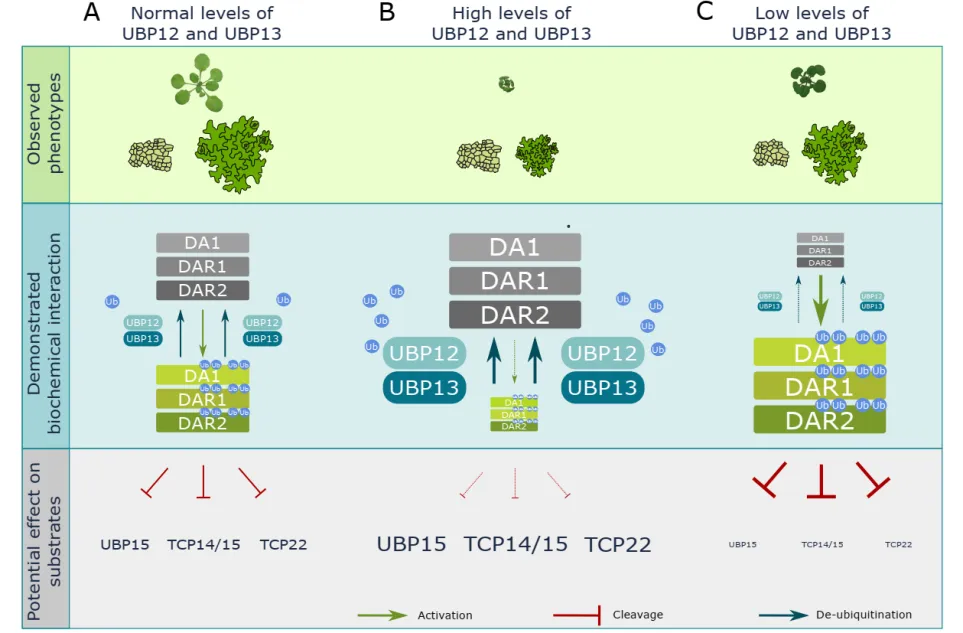
Recent studies have revealed that UBP12 and UBP13 regulate plant growth and development by binding to and deubiquitinating downstream proteases DA1, DAR1, and DAR2, reducing their enzyme activity. Proteases DA1, DAR1, and DAR2 negatively regulate plant leaf development, while two E3 ubiquitin ligases BB and DA2 can activate DA1, DAR1, and DAR2 through monoubiquitination, prompting them to degrade regulatory factors UBP15, TCP14, TCP15, and TCP22 in the growth and development pathway. This "activation-inhibition" regulatory balance mechanism is essential for the normal growth and development of plants.
The role of UBP12/13 in plant immunity
In addition to their role in growth and development, UBP12 and UBP13 are also involved in plant immune responses. They negatively regulate plant immunity by regulating the stability of salicylic acid (SA) receptors NPR3 and NPR4. In the absence of pathogen attack, NPR3 and NPR4 are unstable and degraded by the 26S proteasome, while the increase in cellular SA levels after pathogen infection inhibits the degradation of NPR3/NPR4. UBP12 and UBP13 negatively regulate plant immunity by removing ubiquitin from NPR3/NPR4 and protecting them from degradation.
Role of UBP12/13 in plant hormone signal transduction
UBP12 and UBP13 are also involved in plant hormone signal transduction. For example, they indirectly affect auxin signal transduction by regulating the activity of proteases DA1, DAR1, and DAR2. In addition, UBP12 and UBP13 are also involved in regulating the signal transduction of other plant hormones, such as the ABA signaling pathway.
Summary
As deubiquitinating enzymes, UBP12 and UBP13 play an important role in plant growth and development, plant immunity, and hormone signal transduction. They participate in the regulation of plant growth and development processes by finely regulating the activity of proteases DA1, DAR1, and DAR2. At the same time, UBP12 and UBP13 also negatively regulate plant immunity by regulating the stability of salicylic acid receptors NPR3 and NPR4. These studies provide a new perspective for understanding the molecular mechanisms of plant growth and development, and provide theoretical support for the breeding of high-yield, stress-resistant and high-quality new crop varieties.
This article is reviewed and published by the technical expert team of UA
Disclaimer: This article partially utilizes artificial intelligence assistance in its creation. If any content involves copyright or intellectual property issues, please let us know and we promise to verify and remove it as soon as possible.
Purchase recombinant protein, choose Nanjing UA-Bio
UA protein focuses on providing various protein reagents, raw materials, and services required for drug research and development, cell therapy, gene therapy, and basic scientific research, including drug target proteins, immune checkpoint proteins, cytokines, tool enzymes, customized protein expression, and full-length transmembrane protein development. Youai is committed to providing customers with high-quality products and professional services, and building a High-tech Biological Enterprise with International Competitiveness.







 Business license (three certificates in one)