




MHC Multimers: Central Hub and Activation Mechanism in DNA Vaccine-Induced Immune Response


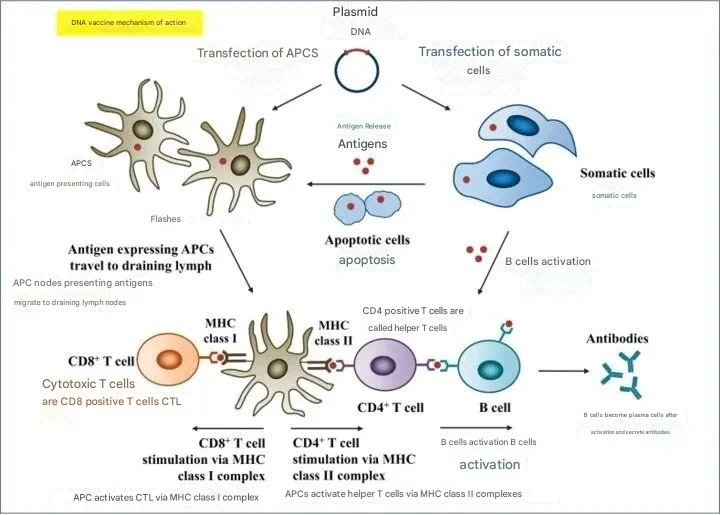
Vaccine-encoded endogenous antigenic proteins undergo covalent ubiquitination in the cytosol, followed by proteasomal degradation into 8-12 amino acid antigenic peptides. These peptide fragments are selectively transported into the endoplasmic reticulum lumen via the Transporter associated with Antigen Processing (TAP), where they assemble with newly synthesized MHC class I molecules to form stable peptide-MHC-I complexes. This complex is subsequently trafficked through the Golgi apparatus to the cell membrane surface, enabling activation of CD8+ cytotoxic T lymphocytes (CTLs). Upon recognition, these CTLs initiate specific cytotoxic immune responses to eliminate infected or tumor cells.
- Recent Advances
- Product Information
-
MHC Class I Cross-Presentation Pathway
-
Endogenous antigenic proteins encoded by the vaccine covalently bind to ubiquitin in the cytosol and are degraded by proteasomes into antigenic peptides. These peptides are transported into the endoplasmic reticulum via TAP, forming a stable complex with MHC class I molecules. After being transported to the cell membrane by the Golgi apparatus, this complex activates CD8+ cytotoxic T lymphocytes (CTLs), triggering an immune response against infected or cancerous cells.
-
-
MHC Class II Dedicated Presentation Pathway
-
Some antigenic proteins are phagocytosed by antigen-presenting cells (APCs) and enter the endosomal-lysosomal system. Here, they are hydrolyzed by cathepsins to form antigenic peptides. These peptides bind to newly synthesized MHC class II molecules in endosomes under acidic conditions. The resulting complex is transported to the cell membrane and recognized by CD4+ helper T cells (Th cells), initiating Th cell activation and the secretion of cytokines like IL-2 and IFN-γ. This process induces B cell differentiation and antibody class switching, forming a humoral immune response.
-
-
Direct B Cell Presentation Pathway
-
Under specific conditions, antigenic peptides can directly activate B cells without T cell help. When the antigen concentration reaches a threshold, B cells internalize the antigen via BCR receptors. After processing, the antigenic peptide is presented on MHC class II molecules, forming a "dual recognition" signal. This triggers autonomous B cell activation, leading to their differentiation into plasma cells and the secretion of specific antibodies, complementing the rapid humoral immune response.
-

-
Scientific and Technological Bottlenecks
-
Antigen Target Optimization: Choosing between full-length spike protein and receptor-binding domain involves trade-offs between broad immune responses and precision targeting, requiring structural vaccinology to balance immunogenicity and broad protection.
-
ADE Risk Mitigation: Historical data show suboptimal antibody responses may enhance infection via Fc receptor-mediated endocytosis. A multidimensional monitoring system, especially for vulnerable populations, is needed.
-
Unknown Immune Durability: Data only confirms antibody levels up to 12 months post-vaccination. The longevity of memory B cells and tissue-resident memory T cells remains unclear, and single-dose strategies need validation for sustained immune memory.
-
-
Industrialization Implementation Barriers
-
Vaccine Development Economics: Vaccine development is capital-intensive (over $1 billion per candidate) with high phase III trial participant requirements (30,000 - 50,000 subjects). Historical success rates from preclinical to approval are below 10%, creating sustainability challenges for small biotechs.
-
Global Equity Dilemma: Risk-stratified vaccination strategies require seroepidemiological surveys to identify susceptible populations. Current global health governance struggles with cross-border data sharing, and initiatives like the G7's "vaccine allocation index" remain untested.
-
| Disease Category | Product Name | Antigen | Sequence | MHC | Position | Product Number |
|---|---|---|---|---|---|---|
| EBV | HLA-A*0201/YLELLVWRL-PE Labelled Tetramer | EBV.LMP1 | YLELLVWRL | HLA-A*0201 | 125-133 | UA089001 |
| EBV | HLA-A*0201/YLQQNWTL-PE Labelled Tetramer | EBV.LMP1 | YLQQNWTL | HLA-A*0201 | 159-167 | UA089003 |
| EBV | H-2Db(b)/RAHY-NIVTF-PE Labelled Tetramer | HPV16.E7 | RAHYNIVTF | H-2Db | 49-57 | UA089002 |
| HPV | H-2K(b)/EVYDFA-FRQL-PE Labelled Tetramer | HPV16.E6 | EVYDFARDL | H-2Kb | 48-57 | UA089004 |
| HPV | HLA-A*0201/KLP-DLCTL-PE Labelled Tetramer | HPV18.E6 | KLPDCTL | HLA-A*0201 | 13-21 | UA089005 |
| HPV | HLA-A*0201/KLTNT-GLYQL-PE Labelled Tetramer | HPV18.E6 | KLTNTGLYNL | HLA-A*0201 | 92-101 | UA089006 |
| HPV | HLA-A*0201/TLODIVIHL-PE Labelled Tetramer | HPV18.E7 | TLODIVIHL | HLA-A*0201 | 7~15 | UA089007 |
| HPV | HLA-A*0201/QFLNTL-FV-PE Labelled Tetramer | HPV18.E7 | QFLNTLFSV | HLA-A*0201 | 88-97 | UA089008 |
| HPV | HLA-A*1101/GVNHQLPAR-PE Labelled Tetramer | HPV18.E7 | GVNHQLPAR | HLA-A*1101 | 43-52 | UA089009 |
| Influenza A Virus | H-2D(b)/ASNENMETM-PE Labelled Tetramer | Flu.NP | ASNENMETM | H-2Db | 366-374 | UA089010 |
| Influenza A Virus | H-2K(d)/TYQR-TRALY-PE Labelled Tetramer | Flu.NP | TYQRTRALY | H-2Kd | 147-155 | UA089011 |
| Influenza A Virus | H-2D(b)/ASNEN-MDTM-PE Labelled Tetramer | Flu.NP | ASNENMDTM | H-2Db | 366-374 | UA089012 |
| LCMV | H-2D(b)/KAVYNFATM-PE Labelled Tetramer | GP 33 | KAVYNFATM | H-2Db | 33-41 | UA089013 |
| LCMV | H-2D(b)/FQPGQGFVK-PE Labelled Tetramer | LCMV NP | FQPGQGFVK | H-2Db | 396-404 | UA089014 |
| Tumor-related | HLA-A*1101/VVGADGVK-PE Labelled Tetramer | KRAS | VVGADGVK | HLA-A*1101 | 7~16 | UA089015 |
| Tumor-related | HLA-A*1101/VVGAGVGK-PE Labelled Tetramer | KRAS | VVGAGVGK | HLA-A*1101 | 7~16 | UA089016 |
| Tumor-related | HLA-A*0201/KLVVGAGV-PE Labelled Tetramer | KRAS | KLVVGAGV | HLA-A*0201 | 5~14 | UA089017 |
| Tumor-related | HLA-A*0201/SLLMWITQC-PE Labelled Tetramer | NY-ESO1 | SLLMWITQC | HLA-A*0201 | 157-165 | UA089018 |
| Melanoma | HLA-A*0201/LMWITQCFL-PE Labelled Tetramer | NY-ESO2 | LMWITQCFL | HLA-A*0201 | 159-167 | UA089019 |
| Melanoma | H-2Db(b)/MMFPNA-P1-PE Labelled Tetramer | WT1 | RMFPNAPL | H-2Db | 126-134 | UA089020 |
| Melanoma | HLA-A*0201/CMTWV-PE Labelled Tetramer | WT2 | CMTWVNMDM | HLA-A*0201 | 235-243 | UA089021 |
| Melanoma | HLA-A*1101/KTCQRKSF-PE Labelled Tetramer | WT3 | KTCQRKSF | HLA-A*1101 | 386-394 | UA089022 |
| Ovarian Cancer | H-2K(b)/SINFEKL-PE Labelled Tetramer | OVA | SINFEKL | H-2Kb | 257-264 | UA089023 |
This article is reviewed and published by the technical expert team of UA
Disclaimer: This article partially utilizes artificial intelligence assistance in its creation. If any content involves copyright or intellectual property issues, please let us know and we promise to verify and remove it as soon as possible.
Purchase recombinant protein, choose Nanjing UA-Bio
UA protein focuses on providing various protein reagents, raw materials, and services required for drug research and development, cell therapy, gene therapy, and basic scientific research, including drug target proteins, immune checkpoint proteins, cytokines, tool enzymes, customized protein expression, and full-length transmembrane protein development. Youai is committed to providing customers with high-quality products and professional services, and building a High-tech Biological Enterprise with International Competitiveness.







 Business license (three certificates in one)