




Quantitative Assessment of Antigen Peptide-MHC Binding Affinity and High-Throughput ELISA Screening Platform for Population Adaptability


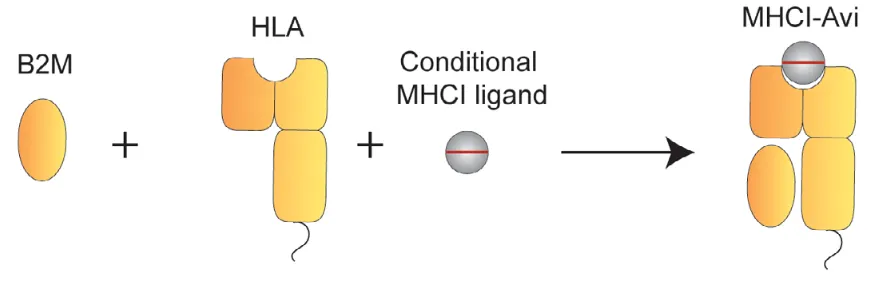
This technical platform offers precise evaluation services for the binding affinity between antigenic peptides and HLA-I molecules, enabling efficient screening of antigenic epitopes with HLA-I-restricted presentation potential. The technological system has been maturely applied in the following domains: 1) Development of immunotherapy targets for tumors (e.g., tumor neoantigen screening), 2) Personalized tumor vaccine preparation (including custom synthesis of MHC-I multimers), and 3) Vaccine research for infectious diseases (e.g., monitoring of virus-specific T cell immune responses).
- Recent Advances
- Product Information
-
Tumor Neoantigen Screening: Quantify HLA class I presentation efficiency of tumor mutation-derived peptides to predict immunogenicity, aiding in the selection of personalized tumor-specific neoantigens. Combined with patient HLA typing data, it helps analyze antigen presentation defects in tumor immune evasion.
-
Tumor Vaccine Target Evaluation: Construct a high-throughput screening platform covering common HLA alleles to assess peptide library cross-reactivity and optimize epitope affinity, guiding rational design and immunogenicity enhancement of tumor peptide vaccines.
-
TCR-T Preclinical Target Validation: Establish clinical-grade MHC multimer production processes based on validated antigenic peptide-MHC complexes, supporting the entire workflow from single-cell sequencing data to functional TCR screening, accelerating in vitro expansion and affinity maturation of antigen-specific T cells.
-
Viral Antigen Peptide Screening: Monitor antigenic drift in viral variants to build HLA-restricted epitope databases, providing critical epitope information for broadly protective vaccine design and assessing the impact of viral escape mutations on T cell responses.
-
Vaccine Immunity Assessment: Evaluate antigen-specific T cell frequency and functional phenotypes post-vaccination to establish an immune response quality assessment system, linking in vitro data to in vivo protection and guiding vaccine dosing and scheduling optimization.
-
Autoimmune Antigen Screening: Analyze abnormal antigen presentation spectra of HLA risk alleles linked to autoimmune diseases, identifying pathogenic T cell-specific self-antigen epitopes for disease classification and targeted immunotherapy.
-
Organ Transplant Antigen Selection: Develop HLA mismatched antigen epitope prediction algorithms for donors and recipients, establish an indirect recognition epitope library related to transplant rejection, and support strategies for immunologically inert donor organ modification and recipient-specific desensitization.
-
Antigen Peptide Screening Mode: Evaluate high-throughput binding of peptides to a single HLA allele. This mode rapidly identifies HLA-binding tumor neoantigens, viral epitopes, and autoimmunity-related antigens. Services include peptide libraries (≥50 sequences), standard HLA monomers, and assay kits, with results within 72 hours. Ideal for oncology target libraries, viral escape monitoring, and autoimmune disease research.
-
HLA Compatibility Mode: Map antigenic peptides to HLA alleles across a broad population spectrum. Using microarray chip technology to test 48 common alleles, this mode calculates epitope recognition rates in specific HLA-positive populations. It supports vaccine design and guides region-specific or personalized immunotherapy strategies.
-
Complex Validation Mode: Validate and optimize pMHC complex production processes described in literature or patents. Services include:
-
HLA heavy chain/B2M mutant binding assays.
-
Folding buffer optimization via pH and salt gradient screening.
-
Purification tag efficiency evaluation.
-
Stability testing at 4℃ and 37℃.
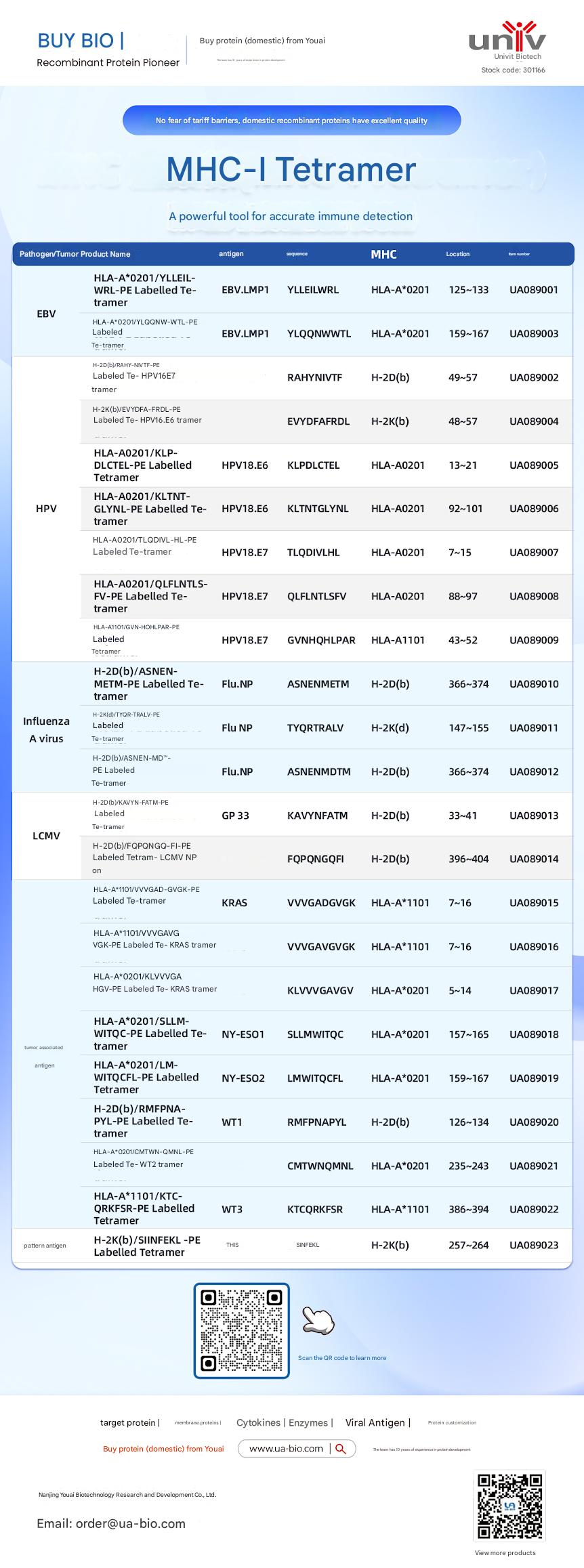
| Disease Category | Product Name | Antigen | Sequence | MHC | Position | Product Number |
|---|---|---|---|---|---|---|
| EBV | HLA-A*0201/YLELLVWRL-PE Labelled Tetramer | EBV.LMP1 | YLELLVWRL | HLA-A*0201 | 125-133 | UA089001 |
| EBV | HLA-A*0201/YLQQNWTL-PE Labelled Tetramer | EBV.LMP1 | YLQQNWTL | HLA-A*0201 | 159-167 | UA089003 |
| EBV | H-2Db(b)/RAHY-NIVTF-PE Labelled Tetramer | HPV16.E7 | RAHYNIVTF | H-2Db | 49-57 | UA089002 |
| HPV | H-2K(b)/EVYDFA-FRQL-PE Labelled Tetramer | HPV16.E6 | EVYDFARDL | H-2Kb | 48-57 | UA089004 |
| HPV | HLA-A*0201/KLP-DLCTL-PE Labelled Tetramer | HPV18.E6 | KLPDCTL | HLA-A*0201 | 13-21 | UA089005 |
| HPV | HLA-A*0201/KLTNT-GLYQL-PE Labelled Tetramer | HPV18.E6 | KLTNTGLYNL | HLA-A*0201 | 92-101 | UA089006 |
| HPV | HLA-A*0201/TLODIVIHL-PE Labelled Tetramer | HPV18.E7 | TLODIVIHL | HLA-A*0201 | 7~15 | UA089007 |
| HPV | HLA-A*0201/QFLNTL-FV-PE Labelled Tetramer | HPV18.E7 | QFLNTLFSV | HLA-A*0201 | 88-97 | UA089008 |
| HPV | HLA-A*1101/GVNHQLPAR-PE Labelled Tetramer | HPV18.E7 | GVNHQLPAR | HLA-A*1101 | 43-52 | UA089009 |
| Influenza A Virus | H-2D(b)/ASNENMETM-PE Labelled Tetramer | Flu.NP | ASNENMETM | H-2Db | 366-374 | UA089010 |
| Influenza A Virus | H-2K(d)/TYQR-TRALY-PE Labelled Tetramer | Flu.NP | TYQRTRALY | H-2Kd | 147-155 | UA089011 |
| Influenza A Virus | H-2D(b)/ASNEN-MDTM-PE Labelled Tetramer | Flu.NP | ASNENMDTM | H-2Db | 366-374 | UA089012 |
| LCMV | H-2D(b)/KAVYNFATM-PE Labelled Tetramer | GP 33 | KAVYNFATM | H-2Db | 33-41 | UA089013 |
| LCMV | H-2D(b)/FQPGQGFVK-PE Labelled Tetramer | LCMV NP | FQPGQGFVK | H-2Db | 396-404 | UA089014 |
| Tumor-related | HLA-A*1101/VVGADGVK-PE Labelled Tetramer | KRAS | VVGADGVK | HLA-A*1101 | 7~16 | UA089015 |
| Tumor-related | HLA-A*1101/VVGAGVGK-PE Labelled Tetramer | KRAS | VVGAGVGK | HLA-A*1101 | 7~16 | UA089016 |
| Tumor-related | HLA-A*0201/KLVVGAGV-PE Labelled Tetramer | KRAS | KLVVGAGV | HLA-A*0201 | 5~14 | UA089017 |
| Tumor-related | HLA-A*0201/SLLMWITQC-PE Labelled Tetramer | NY-ESO1 | SLLMWITQC | HLA-A*0201 | 157-165 | UA089018 |
| Melanoma | HLA-A*0201/LMWITQCFL-PE Labelled Tetramer | NY-ESO2 | LMWITQCFL | HLA-A*0201 | 159-167 | UA089019 |
| Melanoma | H-2Db(b)/MMFPNA-P1-PE Labelled Tetramer | WT1 | RMFPNAPL | H-2Db | 126-134 | UA089020 |
| Melanoma | HLA-A*0201/CMTWV-PE Labelled Tetramer | WT2 | CMTWVNMDM | HLA-A*0201 | 235-243 | UA089021 |
| Melanoma | HLA-A*1101/KTCQRKSF-PE Labelled Tetramer | WT3 | KTCQRKSF | HLA-A*1101 | 386-394 | UA089022 |
| Ovarian Cancer | H-2K(b)/SINFEKL-PE Labelled Tetramer | OVA | SINFEKL | H-2Kb | 257-264 | UA089023 |
This article is reviewed and published by the technical expert team of UA
Disclaimer: This article partially utilizes artificial intelligence assistance in its creation. If any content involves copyright or intellectual property issues, please let us know and we promise to verify and remove it as soon as possible.
Purchase recombinant protein, choose Nanjing UA-Bio
UA protein focuses on providing various protein reagents, raw materials, and services required for drug research and development, cell therapy, gene therapy, and basic scientific research, including drug target proteins, immune checkpoint proteins, cytokines, tool enzymes, customized protein expression, and full-length transmembrane protein development. Youai is committed to providing customers with high-quality products and professional services, and building a High-tech Biological Enterprise with International Competitiveness.







 Business license (three certificates in one)