




MHC Tetramer: The 'T Cell GPS' of Immunology


The core of MHC tetramers lies in their unique molecular architecture. MHC molecules, responsible for presenting antigenic peptides to T cells in the immune system, are engineered into tetrameric structures through the biotin-streptavidin system. This design significantly enhances the binding affinity and stability of MHC-peptide complexes with T cell receptors (TCRs), addressing the limitations of traditional MHC-peptide monomers with low affinity and rapid dissociation rates.
- Recent Advances
- Product Information
- Reference
MHC Tetramer
In the field of immunological research, precise identification and quantification of antigen-specific T cells represent the core of unraveling immune response mechanisms and developing novel vaccines and immunotherapeutic strategies. Since its inception in 1996, MHC tetramer technology has emerged as the 'gold standard' in immune monitoring and therapy due to its high sensitivity, specificity, and single-cell analytical capabilities, bringing revolutionary breakthroughs to immunological studies.
Technological Principles: Innovative Design of Tetrameric Structures
The core of MHC tetramers lies in their unique molecular architecture. MHC molecules, responsible for presenting antigenic peptides to T cells in the immune system, are engineered into tetrameric structures through the biotin-streptavidin system. This design significantly enhances the binding affinity and stability of MHC-peptide complexes with T cell receptors (TCRs), addressing the limitations of traditional MHC-peptide monomers with low affinity and rapid dissociation rates. Each MHC molecule in the tetramer structure can bind to TCRs on T cell surfaces, forming multivalent interactions that enable precise detection of low-frequency antigen-specific T cells.
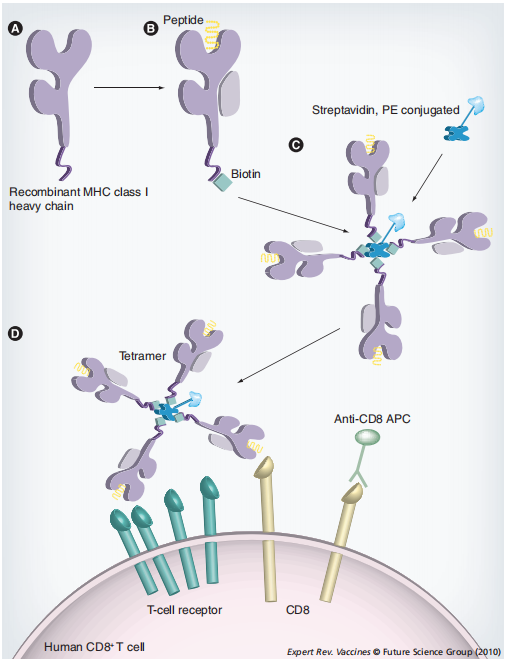
Construction of MHC tetramers typically involves the following steps: antigen peptide preparation → biotinylation → tetramerization → fluorescent labeling
Advantages of MHC Tetramers
Compared to traditional T cell detection methods like ELISPOT and intracellular cytokine staining (ICS), MHC tetramers offer distinct advantages:
High Specificity: Direct and precise identification of antigen-peptide-specific CD8⁺ T cells via TCR recognition
High Sensitivity: Demonstrated through extensive experimental data with strong affinity and minimal background noise
Operational Simplicity: Eliminates the need for T cell stimulation with antigenic peptides or expansion cultures
Excellent Reproducibility: Consistently reliable and repeatable detection results
From Basic Research to Clinical Translation
MHC tetramer technology demonstrates broad application value across multiple fields, serving as the 'Swiss Army knife' of immunological research.
Onco-Immunotherapy
In cancer immunotherapy, MHC tetramers are used to identify and isolate tumor-specific T cells, providing critical data for personalized treatment approaches. Applications include neoantigen/epitope peptide vaccines, DC vaccines, CTL cell infusions, and TCR-T therapies. For example, in melanoma neoantigen vaccine research, MHC tetramers helped screen T cell-activating antigenic peptides. Combined with single-cell sequencing analysis of T cell gene expression profiles pre- and post-vaccination, the study demonstrated robust T cell responses and clinical safety/efficacy of personalized neoantigen vaccines.
Infectious Disease Research
MHC tetramers play significant roles in studying infectious diseases including SARS-CoV-2, influenza, cytomegalovirus, HIV, EBV, and HPV. Researchers used the technology to analyze antigen-specific CD8+ T cells in nasal mucosa tissues of infected individuals, revealing immune response mechanisms of tissue-resident T cells. The technology also aids HIV and influenza epitope screening, providing crucial evidence for vaccine development.
Autoimmune Diseases
In autoimmune conditions (diabetes, allergies, rheumatoid arthritis), MHC tetramers enable precise localization of pathogenic T cells. For instance, in type 1 diabetes research, the technology identified autoreactive T cells targeting pancreatic β-cells, opening possibilities for targeted therapeutic strategies.
Transplantation Immunology
In organ transplantation, MHC tetramers monitor immune responses in recipients and assess rejection risks. By quantifying donor-specific T cell frequencies and phenotypes, clinicians can optimize immunosuppressive regimens and improve transplant success rates.
Market Outlook: Core Tool for Immune Monitoring and Therapy
With advancements in immunological research and personalized medicine, demand for MHC tetramer technology continues to grow. Market research projects the global MHC tetramer market to reach $20.49 million by 2031, with a 7.9% CAGR. North America leads with its strong pharmaceutical R&D capabilities, while the Asia-Pacific region exhibits the fastest growth due to large population bases and increasing research investments.
Future Directions: Innovations in Multiplex Detection, Automation, and Computational Analysis
Development priorities include multiplex detection capabilities for simultaneous analysis of multiple T cell specificities in single samples, enabling comprehensive immune response profiling. Automation technologies will standardize workflows, increase throughput, reduce inter-laboratory variability, and enhance reproducibility. Computational analysis advancements will help researchers process large datasets generated from MHC tetramer experiments, facilitating deeper insights into immune system dynamics and vaccine efficacy.
Hot-Selling MHC-I Tetramer Products (For complete listings, please contact us):
|
Pathogen/Tumor |
Product Name |
Antigen |
Sequence |
MHC |
Location |
Catalog Number |
|
EBV |
HLA-A*0201/YLLEILWRL-PE Labelled Tetramer |
EBV.LMP1 |
YLLEILWRL |
HLA-A*0201 |
125~133 |
UA089001 |
|
HLA-A*0201/YLQQNWWTL-PE Labelled Tetramer |
EBV.LMP1 |
YLQQNWWTL |
HLA-A*0201 |
159~167 |
UA089003 |
|
|
HPV |
H-2D(b)/RAHYNIVTF-PE Labelled Tetramer |
HPV16E7 |
RAHYNIVTF |
H-2D(b) |
49~57 |
UA089002 |
|
H-2K(b)/EVYDFAFRDL-PE Labelled Tetramer |
HPV16.E6 |
EVYDFAFRDL |
H-2K(b) |
48~57 |
UA089004 |
|
|
HLA-A0201/KLPDLCTEL-PE Labelled Tetramer |
HPV18.E6 |
KLPDLCTEL |
HLA-A0201 |
13~21 |
UA089005 |
|
|
HLA-A0201/KLTNTGLYNL-PE Labelled Tetramer |
HPV18.E6 |
KLTNTGLYNL |
HLA-A0201 |
92~101 |
UA089006 |
|
|
HLA-A0201/TLQDIVLHL-PE Labelled Tetramer |
HPV18.E7 |
TLQDIVLHL |
HLA-A0201 |
7~15 |
UA089007 |
|
|
HLA-A0201/QLFLNTLSFV-PE Labelled Tetramer |
HPV18.E7 |
QLFLNTLSFV |
HLA-A0201 |
88~97 |
UA089008 |
|
|
HLA-A1101/GVNHQHLPAR-PE Labelled Tetramer |
HPV18.E7 |
GVNHQHLPAR |
HLA-A1101 |
43~52 |
UA089009 |
|
|
Influenza A virus |
H-2D(b)/ASNENMETM-PE Labelled Tetramer |
Flu.NP |
ASNENMETM |
H-2D(b) |
366~374 |
UA089010 |
|
H-2K(d)/TYQRTRALV-PE Labelled Tetramer |
Flu NP |
TYQRTRALV |
H-2K(d) |
147~155 |
UA089011 |
|
|
H-2D(b)/ASNENMDTM-PE Labelled Tetramer |
Flu.NP |
ASNENMDTM |
H-2D(b) |
366~374 |
UA089012 |
|
|
LCMV |
H-2D(b)/KAVYNFATM-PE Labelled Tetramer |
GP 33 |
KAVYNFATM |
H-2D(b) |
33~41 |
UA089013 |
|
H-2D(b)/FQPQNGQFI-PE Labelled Tetramer |
LCMV NP |
FQPQNGQFI |
H-2D(b) |
396~404 |
UA089014 |
|
|
tumor-associated antigen |
HLA-A*1101/VVVGADGVGK-PE Labelled Tetramer |
KRAS |
VVVGADGVGK |
HLA-A*1101 |
7~16 |
UA089015 |
|
HLA-A*1101/VVVGAVGVGK-PE Labelled Tetramer |
KRAS |
VVVGAVGVGK |
HLA-A*1101 |
7~16 |
UA089016 |
|
|
HLA-A*0201/KLVVVGAVGV-PE Labelled Tetramer |
KRAS |
KLVVVGAVGV |
HLA-A*0201 |
5~14 |
UA089017 |
|
|
HLA-A*0201/SLLMWITQC-PE Labelled Tetramer |
NY-ESO1 |
SLLMWITQC |
HLA-A*0201 |
157~165 |
UA089018 |
|
|
HLA-A*0201/LMWITQCFL-PE Labelled Tetramer |
NY-ESO2 |
LMWITQCFL |
HLA-A*0201 |
159~167 |
UA089019 |
|
|
H-2D(b)/RMFPNAPYL-PE Labelled Tetramer |
WT1 |
RMFPNAPYL |
H-2D(b) |
126~134 |
UA089020 |
|
|
HLA-A*0201/CMTWNQMNL-PE Labelled Tetramer |
WT2 |
CMTWNQMNL |
HLA-A*0201 |
235~243 |
UA089021 |
|
|
HLA-A*1101/KTCQRKFSR-PE Labelled Tetramer |
WT3 |
KTCQRKFSR |
HLA-A*1101 |
386~394 |
UA089022 |
|
|
pattern antigen |
H-2K(b)/SIINFEKL -PE Labelled Tetramer |
OVA |
SIINFEKL |
H-2K(b) |
257~264 |
UA089023 |

Scan QR code for more details~
References:
- Donahoe SM, Moretto WJ, Samuel RV et al. Direct measurement of CD8+T cell responses in macaques infected with simian immunodeficiency virus. Virology (2000).
- Bakker AH, Hoppes R, Linnemann C et al.Conditional MHC class I ligands and peptide exchange technology for the human MHC gene products HLA-A1, -A3, -A11, and -B7. Proc. Natl Acad. Sci. USA(2008).
- Stuart Sims; Christian B. Willberg; Paul Klenerman. MHC–peptide tetramers for the analysis ofantigen-specific T cells. Expert Review of Vaccines(2010).
- Asbjørn Christophersen. Peptide-MHC class I and class II tetramers: From flowto mass cytometry. HLA(2019).
This article is reviewed and published by the technical expert team of UA
Disclaimer: This article partially utilizes artificial intelligence assistance in its creation. If any content involves copyright or intellectual property issues, please let us know and we promise to verify and remove it as soon as possible.
Purchase recombinant protein, choose Nanjing UA-Bio
UA protein focuses on providing various protein reagents, raw materials, and services required for drug research and development, cell therapy, gene therapy, and basic scientific research, including drug target proteins, immune checkpoint proteins, cytokines, tool enzymes, customized protein expression, and full-length transmembrane protein development. Youai is committed to providing customers with high-quality products and professional services, and building a High-tech Biological Enterprise with International Competitiveness.

- Donahoe SM, Moretto WJ, Samuel RV et al. Direct measurement of CD8+T cell responses in macaques infected with simian immunodeficiency virus. Virology (2000).
- Bakker AH, Hoppes R, Linnemann C et al.Conditional MHC class I ligands and peptide exchange technology for the human MHC gene products HLA-A1, -A3, -A11, and -B7. Proc. Natl Acad. Sci. USA(2008).
- Stuart Sims; Christian B. Willberg; Paul Klenerman. MHC–peptide tetramers for the analysis ofantigen-specific T cells. Expert Review of Vaccines(2010).
- Asbjørn Christophersen. Peptide-MHC class I and class II tetramers: From flowto mass cytometry. HLA(2019).






 Business license (three certificates in one)