




"Signal Light" in Urine: EphA2 Brings New Hope to Bladder Cancer Diagnosis


In the long journey of fighting cancer, scientists have been looking for "signal lights" that can detect cancer cells early. Recently, a study from Kazutoshi Fujita's research group at Osaka University in Japan has brought us new hope: they found that EphA2 protein on urine extracellular vesicles (uEVs) can be used as a new biomarker to help us diagnose bladder cancer early.
- Recent Advances
- Product Information
"Signal Light" in Urine: EphA2 Brings New Hope to Bladder Cancer Diagnosis
In the long journey of fighting cancer, scientists have been looking for "signal lights" that can detect cancer cells early. Recently, a study from Kazutoshi Fujita's research group at Osaka University in Japan has brought us new hope: they found that EphA2 protein on urine extracellular vesicles (uEVs) can be used as a new biomarker to help us diagnose bladder cancer early.
Bladder cancer: a global health challenge
Bladder cancer is one of the most common cancers in the world and an important cause of cancer-related deaths. Early detection and treatment of bladder cancer are crucial to improving patients' prognosis. However, the current commonly used cystoscopy in clinical practice is costly and invasive, while urine cytology has poor sensitivity and the interpretation of results is easily affected by subjective factors. Therefore, finding a non-invasive and accurate new biomarker is of great significance for the early diagnosis of bladder cancer.
Urinary extracellular vesicles: potential "signal lights"
Extracellular vesicles (EVs) are tiny vesicles secreted by cells into body fluids. They play an important role in intercellular communication and carry biologically active molecules of parent cells, including nucleic acids, proteins, and lipids. Urine, as a non-invasively collected body fluid, is considered a suitable sample for detecting bladder cancer. Urinary extracellular vesicles (uEVs) are rich in proteins that may become potential biomarkers for bladder cancer.
EphA2: "Signal Light" in Urine
In this study, scientists screened potential protein markers from urine extracellular vesicles of 49 bladder cancer patients and 48 non-bladder cancer patients using a shotgun proteomics approach. After targeted proteomics validation, they found that EphA2 protein was significantly upregulated in urine extracellular vesicles of bladder cancer patients, while there was no such change in patients with non-malignant hematuria. Further analysis showed that the expression difference of EphA2 protein between bladder cancer group and non-bladder cancer group (including healthy controls and patients with non-malignant hematuria) was statistically significant (P = 0.01).
ELISA test: a bridge from laboratory to clinic
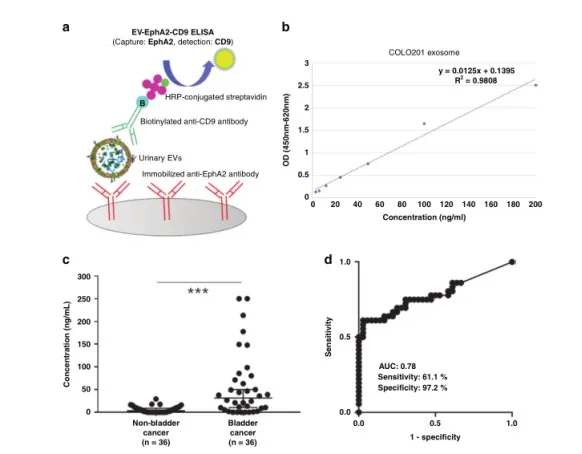
In order to apply this discovery to the clinic, the researchers developed an enzyme-linked immunosorbent assay (ELISA) test method with EphA2 as the target protein. They analyzed 72 clinical samples (urine samples from 36 bladder cancer patients and 36 non-bladder cancer patients). The results showed that the area under the curve (AUC) value of uEV-EphA2 for bladder cancer diagnosis was 0.79, with a sensitivity of 77.6% and a specificity of 72.9%. This result suggests that uEV-EphA2 can be used as a potential diagnostic marker for bladder cancer.
Future Outlook
This study not only provides a new non-invasive method for the early diagnosis of bladder cancer, but also lays the foundation for future research and clinical applications. With further validation and optimization, EphA2 is expected to become a standard diagnostic tool for bladder cancer. In addition, this study also revealed the biological function of EphA2 in the development of bladder cancer, providing the possibility for the development of new treatment strategies.
On the road to cancer diagnosis, every new discovery is an important step forward. As a new biomarker on urine extracellular vesicles, EphA2 has lit a new "signal light" for us. In the future, as more research is carried out, we have reason to believe that this non-invasive detection method will bring more hope and help to bladder cancer patients.
This article is reviewed and published by the technical expert team of UA
Disclaimer: This article partially utilizes artificial intelligence assistance in its creation. If any content involves copyright or intellectual property issues, please let us know and we promise to verify and remove it as soon as possible.
Purchase recombinant protein, choose Nanjing UA-Bio
UA protein focuses on providing various protein reagents, raw materials, and services required for drug research and development, cell therapy, gene therapy, and basic scientific research, including drug target proteins, immune checkpoint proteins, cytokines, tool enzymes, customized protein expression, and full-length transmembrane protein development. Youai is committed to providing customers with high-quality products and professional services, and building a High-tech Biological Enterprise with International Competitiveness.







 Business license (three certificates in one)