





- Recent Advances
- Product Information
USP7: New hope for anti-tumor drugs and breakthroughs in allosteric small molecules
In the long journey of cancer treatment, scientists have been looking for "weapons" that can accurately strike tumor cells. In recent years, a target called USP7 has attracted widespread attention. USP7, also known as HAUSP, is a deubiquitinase (DUBs), which plays a key role in regulating protein stability in cells. However, although USP7 is a highly promising anti-tumor drug target, traditional drug development has always faced the bottleneck of target selectivity. Until recently, a breakthrough study brought new hope-the discovery of the first allosteric small molecule targeting USP7.
USP7: Key anti-tumor target
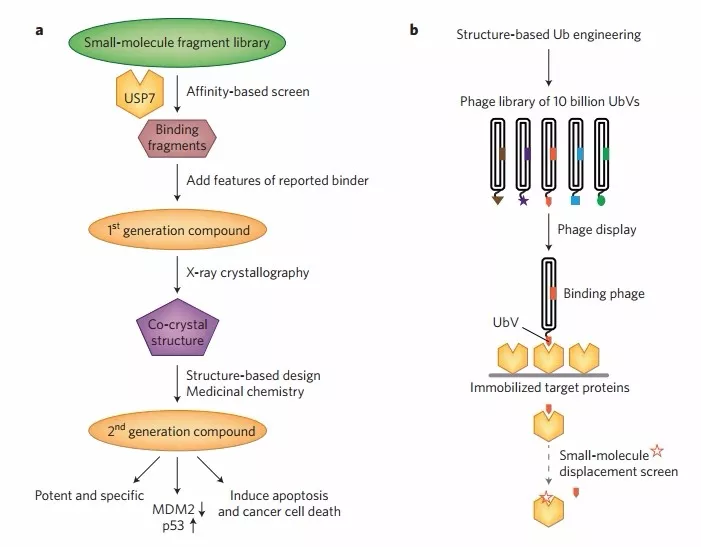
USP7 belongs to the deubiquitinase family. Its main job is to remove ubiquitin chains on proteins, thereby regulating protein stability and function. In cells, USP7 can stabilize a variety of proteins closely related to cancer occurrence, such as MDM2. MDM2 is an important negative regulator that can inhibit the activity of p53 protein, which is an important "tumor monitor" in cells and can initiate apoptosis programs to prevent the proliferation of cancer cells. Therefore, by inhibiting the activity of USP7, the degradation of MDM2 can be promoted, the function of p53 protein can be restored, and thus apoptosis of tumor cells can be induced, achieving an anti-tumor effect.
The dilemma of traditional drug development
Although the anti-tumor potential of USP7 has long been confirmed, the road to drug development is not smooth. Members of the deubiquitinase family are highly conserved at traditional binding sites, which means that small molecule drugs developed for these sites often lack sufficient target selectivity. In other words, these drugs not only inhibit USP7, but may also accidentally injure other family members, leading to serious side effects. In the past decade, despite the continuous efforts of scientists to develop some more effective and selective USP7 inhibitors, they have never been able to break through this bottleneck.
Breakthrough of allosteric small molecules
Just when people were almost at a deadlock, the research of Gavory et al. brought new hope. They adopted a new strategy-structure-based drug design, and successfully discovered the first allosteric small molecule targeting USP7 by combining the first-generation inhibitors and molecular fragment libraries. The action site of this small molecule is located in the allosteric binding site of USP7, far away from the traditional catalytic site. This ingenious design enables the small molecule to selectively interact with USP7 in cell experiments without interacting with other family proteins. The experimental results are exciting: in in vitro tests on 38 human deubiquitinases, 63 other proteases and 49 representative kinases, the compound showed extremely high selectivity for the USP7 target.
The secret of the allosteric inhibition mechanism
The success of this allosteric small molecule stems from its unique inhibition mechanism. When the USP7 protein functions, its conformation changes, and this allosteric small molecule uses this changed conformation to exert its effect. Although its specific allosteric inhibition mechanism still needs further enzymatic experiments and crystal structure studies of USP7 proteins in different states to clarify, this discovery has opened up a new path for the drug development of USP7.
Future Outlook
The discovery of USP7 allosteric inhibitors not only brings new hope for the development of anti-tumor drugs, but also provides new ideas for the drug development of other protein families with highly conserved binding sites. In the deubiquitinase family, the conservation of traditional substrate sites has always been a difficult problem for drug development, and the success of allosteric small molecules shows that by exploring other binding sites of proteins, more selective and active drugs may be found. In the future, with the discovery and in-depth research of more allosteric inhibitors, we are expected to develop more precise and efficient anti-tumor drugs and bring more good news to cancer patients.
The story of USP7 continues, and the breakthrough of allosteric small molecules is just the beginning. On the road of scientific exploration, every small progress may bring about huge changes. Let us look forward to more innovative drugs to move from the laboratory to the clinic to protect human health.
This article is reviewed and published by the technical expert team of UA
Disclaimer: This article partially utilizes artificial intelligence assistance in its creation. If any content involves copyright or intellectual property issues, please let us know and we promise to verify and remove it as soon as possible.
Purchase recombinant protein, choose Nanjing UA-Bio
UA protein focuses on providing various protein reagents, raw materials, and services required for drug research and development, cell therapy, gene therapy, and basic scientific research, including drug target proteins, immune checkpoint proteins, cytokines, tool enzymes, customized protein expression, and full-length transmembrane protein development. Youai is committed to providing customers with high-quality products and professional services, and building a High-tech Biological Enterprise with International Competitiveness.







 Business license (three certificates in one)