




Deoxyribonuclease I: The "Scissor Hand" of the DNA World


In the microscopic biological world, there is a magical "Scissor Hand" - deoxyribonuclease I (DNase I), which plays an indispensable role in the stage of life science. Today, let us walk into the world of DNase I and unveil its mysterious veil.
- Recent Advances
- Product Information
Deoxyribonuclease I: The "Scissor Hand" of the DNA World
In the microscopic biological world, there is a magical "Scissor Hand" - deoxyribonuclease I (DNase I), which plays an indispensable role in the stage of life science. Today, let us walk into the world of DNase I and unveil its mysterious veil.
DNase I is a nuclease whose main job is to "cut" DNA. It is like a pair of sharp scissors that can break down single-stranded or double-stranded DNA into smaller fragments, such as single deoxynucleotides or short oligonucleotides. Interestingly, although it is generally considered to cut DNA non-specifically, it is more "interested" in certain specific DNA sequences, such as purine-pyrimidine sequences, and is easier to start. However, when it faces heterogeneous double-stranded DNA, all four bases will be cut, and it will not be particularly "biased" to a certain base.
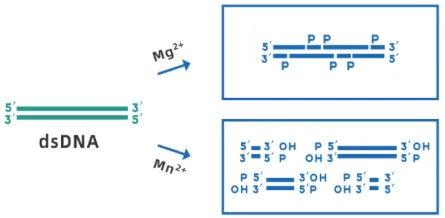
The activity of DNase I requires the support of calcium ions, and it can also be activated by magnesium ions or divalent manganese ions. In the presence of magnesium ions, it will randomly cut double-stranded DNA; in the presence of divalent manganese ions, it will cut the DNA double strands at the same site, forming a flat end or a sticky end with 1-2 nucleotides protruding. It is like it can adjust its "cutting method" according to different "tools" (metal ions).
So, is DNase I only interested in double-stranded DNA? In fact, it can also "deal with" single-stranded DNA (ssDNA) and DNA in RNA-DNA hybrids, but the activity will be greatly reduced. For example, its specific activity for ssDNA is about 500 times lower than that for double-stranded DNA, and its activity for RNA-DNA hybrids is less than 2% of double-stranded DNA. However, as long as the concentration is high enough, it can also complete the task.
DNase I has a wide range of uses. In the laboratory, it can help us prepare RNA samples without DNA, which is very important for some experiments that require pure RNA. For example, in the second-strand synthesis reaction of cDNA, it can remove excess DNA to make the reaction smoother. Before the RT-PCR reaction, it can remove possible genomic DNA contamination in RNA samples to ensure the accuracy of experimental results. In addition, it can remove the DNA template after in vitro RNA transcription, creating conditions for subsequent experiments.
DNase I is also a powerful tool for studying DNA-protein interactions. Through DNase I footprinting technology, we can accurately find the binding sites of proteins on DNA. When protein binds to DNA, it protects this part of DNA from being cut by DNase I, just like leaving a "footprint" on DNA. By analyzing these "footprints", we can understand how proteins interact with DNA.
In the study of apoptosis, DNase I is also very useful. It can partially shear genomic DNA as a positive control to help us better understand the changes in DNA during apoptosis. In addition, it can also be used to study the degree of chromatin openness, helping us understand the transcriptional activity of genes.
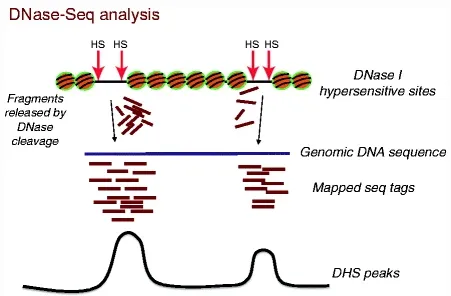
In genomic research, the discovery of DNase I hypersensitive sites (DHS) provides us with valuable clues.
When a gene is in a transcriptionally active state, chromatin is more sensitive to DNase I degradation, and these sensitive sites are DHS. By studying DHS, we can find sequences in the genome associated with active chromatin, so as to better understand the regulatory mechanism of genes.
In recent years, single-cell DNase-seq (scDNase-seq) technology has brought the application of DNase I to a new level. It can analyze the chromatin of a single cell, helping us identify DHSs across the entire genome, and providing a powerful tool for studying cell heterogeneity and gene regulation.
In addition, in situ DNase Hi-C technology uses DNase I to replace restriction endonucleases for chromatin fragmentation, greatly improving the efficiency and resolution of chromatin interaction research, allowing us to comprehensively map the whole genome chromatin interaction map.
In short, DNase I is like a magical "scissor hand", flexibly displaying its "cutting" skills in the world of DNA. It not only helps scientists solve many experimental problems, but also provides important tools and methods for life science research. In the future, with the continuous advancement of technology, DNase I will also unleash more potential and contribute greater strength to human exploration of the mysteries of life.
This article is reviewed and published by the technical expert team of UA
Disclaimer: This article partially utilizes artificial intelligence assistance in its creation. If any content involves copyright or intellectual property issues, please let us know and we promise to verify and remove it as soon as possible.
Purchase recombinant protein, choose Nanjing UA-Bio
UA protein focuses on providing various protein reagents, raw materials, and services required for drug research and development, cell therapy, gene therapy, and basic scientific research, including drug target proteins, immune checkpoint proteins, cytokines, tool enzymes, customized protein expression, and full-length transmembrane protein development. Youai is committed to providing customers with high-quality products and professional services, and building a High-tech Biological Enterprise with International Competitiveness.







 Business license (three certificates in one)