




Erythropoietin (EPO): The "Hidden Pusher" in Cancer Immunotherapy


In the battlefield of cancer treatment, immunotherapy was once regarded as a revolutionary breakthrough, especially checkpoint inhibitors targeting the PD-1/PD-L1 pathway, which brought hope to many patients.
- Recent Advances
- Product Information
Erythropoietin (EPO): The "Hidden Pusher" in Cancer Immunotherapy
In the battlefield of cancer treatment, immunotherapy was once regarded as a revolutionary breakthrough, especially checkpoint inhibitors targeting the PD-1/PD-L1 pathway, which brought hope to many patients. However, clinical practice has found that this treatment is not ideal for most patients, especially those with so-called "cold tumors". Cold tumors are like "black holes" of the immune system, lacking T cells that can effectively attack tumors, but full of cells that suppress immune responses. Recently, a study by Engleman's team at Stanford University revealed a surprising discovery: erythropoietin (EPO) secreted by tumor cells may be a key factor in cold tumor immunosuppression.
1. EPO: From anemia treatment to the "dark side" of cancer immunity
Erythropoietin (EPO) is a hormone secreted by the kidneys, and its main function is to stimulate the bone marrow to produce red blood cells. Clinically, recombinant human EPO is widely used to treat anemia, especially in patients with chemotherapy or chronic kidney disease. However, past studies have found that cancer patients may have a shorter survival after receiving exogenous EPO treatment. This phenomenon has been puzzling scientists until recent studies revealed the "dark side" of EPO in tumor immunity.
2. The direct association between EPO and cold tumors
The Engleman team constructed two spontaneous liver cancer mouse models through gene editing: one is a "hot tumor" enriched with T cells, and the other is a "cold tumor" lacking T cells. The study found that plasma EPO levels were significantly increased in the cold tumor model, and this increase was not associated with anemia. Further clinical data confirmed that patients with high expression of EPO in liver cancer tissue had a lower overall survival rate, poorer tumor differentiation, and more common vascular invasion. These findings suggest that EPO secreted by tumor cells themselves may be the "behind-the-scenes promoter" of cold tumor immunosuppression.
3. How does EPO shield T cell attacks?
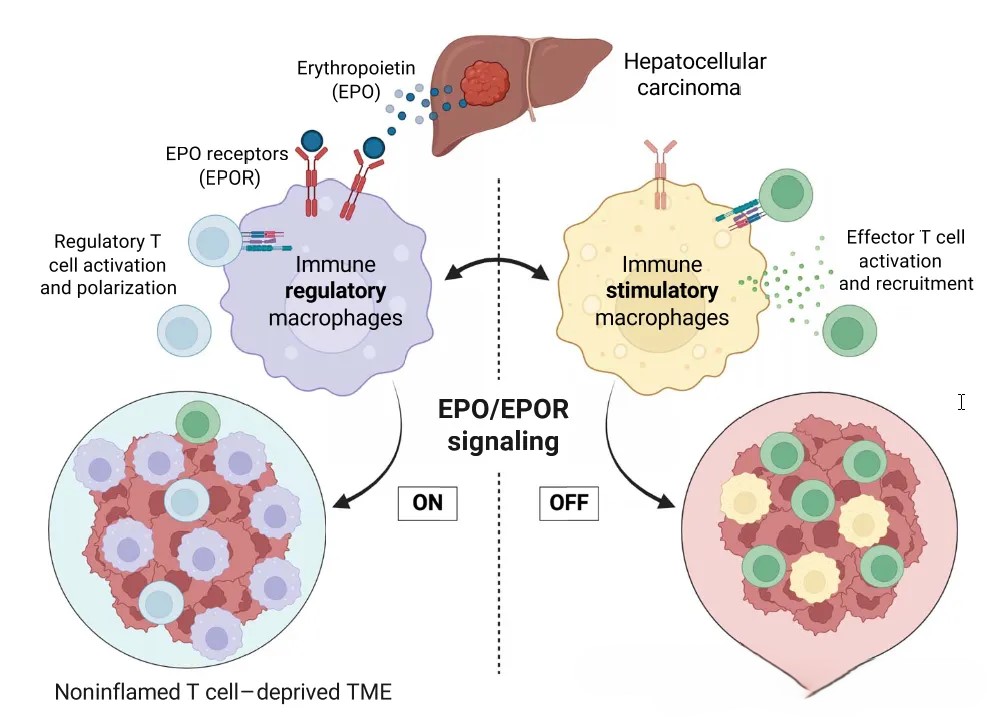
The traditional receptor for EPO (EPOR) is believed to be mainly expressed in erythroid progenitor cells. However, recent studies have found that EPOR is also present in macrophages, endothelial cells, and even neurons. Engleman's team found that macrophages in cold tumors highly express EPOR, while hot tumors do not. Tumor-derived EPO changes the functional state of macrophages by binding to EPOR of macrophages, preventing them from differentiating into a pro-inflammatory phenotype and driving them to transform into an immunosuppressive phenotype.
Further mechanistic studies have shown that EPO activates the NRF2 pathway, leading to a large consumption of iron in macrophages, making it impossible for the cells to present antigens to T cells, while secreting inhibitory cytokines (such as IL-10 and TGF-β). In addition, EPO-activated macrophages also induce the expansion of regulatory T cells (Treg) to form an immunosuppressive network. In short, tumors "brainwash" macrophages into "traitors" of the immune system by secreting EPO, turning the tumor microenvironment into a "desert" of T cells.
4. How does blocking EPO signals reverse cold tumors?
The Engleman team verified the core role of the EPO/EPOR axis through gene knockout experiments. Studies have found that knocking out EPO in tumor cells or EPOR in macrophages can turn cold tumors into hot tumors, significantly increase T cell infiltration, inhibit tumor growth, and prolong mouse survival. In addition, targeted knockdown of EPOR expression by siRNA or treatment with NRF2 inhibitors can effectively reverse the immunosuppressive phenotype of macrophages. More encouragingly, after blocking the EPO signal, cold tumors that were originally unresponsive to PD-1 inhibitors showed significant synergistic therapeutic effects.
5. Potential and Challenges of EPO as a Therapeutic Target
The research of the Engleman team not only revealed the core role of EPO in tumor immune escape, but also provided a new target for reversing immunosuppression. Analysis found that high EPO expression was associated with poor prognosis in a variety of solid tumors (such as pancreatic cancer, lung cancer, and breast cancer). This suggests that EPO/EPOR inhibitors may become a universal immunotherapy drug, especially for patients with cold tumors. However, the use of existing anti-anemia drugs (such as recombinant EPO) in cancer patients requires careful risk assessment.
Potential therapies targeting the EPO/EPOR axis include monoclonal antibodies, small molecule inhibitors, and combination therapy. Monoclonal antibodies can target tumor-derived EPO or macrophage EPOR, while small molecule inhibitors can block EPOR downstream signals (such as the NRF2 pathway). Combination therapy can be used with PD-1 inhibitors to break the dual immunosuppression mechanism.
6. Conclusion
The research of the Engleman team revealed for the first time the core role of EPO in tumor immune escape, which not only explained the key mechanism of cold tumor formation, but also provided a new target for reversing immunosuppression. In the future, by precisely intervening in the EPO/EPOR axis, we hope to transform "cold" tumors into "hot" tumors, allowing more patients to benefit from immunotherapy. As the researchers said: "Immunotherapy should not rely solely on the activity of T cells themselves. Reshaping the tumor microenvironment may be the key to opening the door to cure."
This article is reviewed and published by the technical expert team of UA
Disclaimer: This article partially utilizes artificial intelligence assistance in its creation. If any content involves copyright or intellectual property issues, please let us know and we promise to verify and remove it as soon as possible.
Purchase recombinant protein, choose Nanjing UA-Bio
UA protein focuses on providing various protein reagents, raw materials, and services required for drug research and development, cell therapy, gene therapy, and basic scientific research, including drug target proteins, immune checkpoint proteins, cytokines, tool enzymes, customized protein expression, and full-length transmembrane protein development. Youai is committed to providing customers with high-quality products and professional services, and building a High-tech Biological Enterprise with International Competitiveness.







 Business license (three certificates in one)