




Ephrin-A5: A "double-edged sword" for prostate cancer metastasis


In the vast ocean of cancer research, scientists are constantly exploring the secrets of cancer cell metastasis. Recently, a study published in the journal Cell Death & Disease revealed a new mechanism of prostate cancer metastasis and discovered a potential metastasis marker, Ephrin-A5. This discovery brings new hope for the diagnosis and treatment of prostate cancer.
- Recent Advances
- Product Information
Ephrin-A5: A "double-edged sword" for prostate cancer metastasis
In the vast ocean of cancer research, scientists are constantly exploring the secrets of cancer cell metastasis. Recently, a study published in the journal Cell Death & Disease revealed a new mechanism of prostate cancer metastasis and discovered a potential metastasis marker, Ephrin-A5. This discovery brings new hope for the diagnosis and treatment of prostate cancer.
1. The mystery of prostate cancer metastasis
Prostate cancer is one of the most common cancers in men, and its metastatic lesions often herald the deterioration of the disease and the difficulty of treatment. The metastasis of cancer cells is a complex process involving multiple links such as cell proliferation, migration, invasion, and intercellular signaling. Although scientists have conducted a lot of research on the metastasis mechanism of prostate cancer, there are still many unresolved issues. For example, why do some prostate cancer cells metastasize rapidly while others do not? How to predict the risk of prostate cancer metastasis in advance?
2. The discovery and role of Ephrin-A5
Ephrin-A5 is a cell surface protein that is widely present in a variety of tissues. It plays an important role in cell adhesion, signaling, and tissue development. However, recent studies have found that Ephrin-A5 also plays a complex role in cancer. In prostate cancer, the expression level of Ephrin-A5 is closely related to the invasiveness and metastatic ability of the tumor. Interestingly, Ephrin-A5 can both inhibit and promote tumor metastasis, depending on which molecules it interacts with.
3. Ephrin-A5 and prostate cancer metastasis
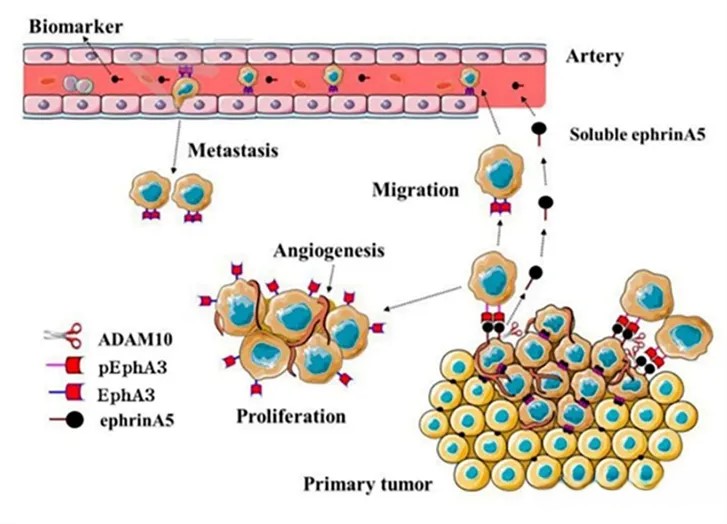
In the above study, scientists found that an enzyme called ADAM10 can specifically hydrolyze Ephrin-A5 and release its soluble extracellular domain into the extracellular medium. This process not only changes the cell surface distribution of Ephrin-A5, but also affects its interaction with the EphA3 receptor. EphA3 is a receptor that interacts with Ephrin-A5, and its function shows a complex duality in prostate cancer cells.
Studies have found that in some prostate cancer cell lines, overexpression of EphA3 inhibits tumor metastasis, while in other cell lines, overexpression of EphA3 promotes tumor metastasis. This difference may be related to the expression level and distribution of Ephrin-A5. When ADAM10 hydrolyzes Ephrin-A5, the intact Ephrin-A5 protein on the cell surface is reduced, resulting in a weakening of the tumor metastasis inhibitory effect of EphA3 and an enhancement of its tumor metastasis promoting effect. This process is similar to a "double-edged sword" and plays opposite roles under different conditions.
4. The potential of Ephrin-A5 as a metastasis marker
In addition to revealing the mechanism of action of Ephrin-A5 in prostate cancer metastasis, the study also found that the level of Ephrin-A5 in serum can be used as a potential marker for prostate cancer metastasis. In patients with metastatic prostate cancer, the level of serum Ephrin-A5 was significantly higher than that in non-metastatic patients. Through ROC curve analysis, the researchers found that the area under the curve (AUC) of serum Ephrin-A5 as a metastasis marker was 0.843, with a sensitivity of 93.5% and a specificity of 75%. This means that by detecting the level of Ephrin-A5 in serum, doctors can more accurately predict the risk of metastasis in prostate cancer patients, thereby formulating more personalized treatment plans for patients.
5. Future Outlook
The discovery of Ephrin-A5 provides a new perspective for the study and treatment of prostate cancer. Future research needs to further explore the molecular mechanism of the interaction between Ephrin-A5 and EphA3, and how to inhibit the metastasis of prostate cancer by regulating this mechanism. In addition, the clinical application value of serum Ephrin-A5 as a metastasis marker also needs to be verified in a larger patient population.
Although the metastasis mechanism of prostate cancer remains complex, the study of Ephrin-A5 has brought us new hope. By gaining a deeper understanding of the role of Ephrin-A5 in prostate cancer, scientists are expected to develop more effective diagnostic tools and treatments, bringing more survival opportunities to prostate cancer patients.
This article is reviewed and published by the technical expert team of UA
Disclaimer: This article partially utilizes artificial intelligence assistance in its creation. If any content involves copyright or intellectual property issues, please let us know and we promise to verify and remove it as soon as possible.
Purchase recombinant protein, choose Nanjing UA-Bio
UA protein focuses on providing various protein reagents, raw materials, and services required for drug research and development, cell therapy, gene therapy, and basic scientific research, including drug target proteins, immune checkpoint proteins, cytokines, tool enzymes, customized protein expression, and full-length transmembrane protein development. Youai is committed to providing customers with high-quality products and professional services, and building a High-tech Biological Enterprise with International Competitiveness.







 Business license (three certificates in one)