




EphA2: The key "messenger" for pancreatic cancer resistance transmission


In the battlefield of cancer treatment, pancreatic cancer (PC) has always been one of the most difficult fortresses to conquer. It is not only highly invasive and metastatic, but also highly resistant to treatment, which makes the patient's survival rate extremely low.
- Recent Advances
- Product Information
EphA2: The key "messenger" for pancreatic cancer resistance transmission
In the battlefield of cancer treatment, pancreatic cancer (PC) has always been one of the most difficult fortresses to conquer. It is not only highly invasive and metastatic, but also highly resistant to treatment, which makes the patient's survival rate extremely low. In recent years, scientists have discovered a protein called EphA2 in their research, which plays a key role in the transmission of pancreatic cancer resistance, bringing new hope for cancer treatment.
1. The problem of drug resistance in pancreatic cancer
Pancreatic cancer is an extremely dangerous malignant tumor and is extremely difficult to treat. Most patients are in the late stage when diagnosed, and the chance of surgical resection is very small. Even in resectable cases, the recurrence rate after surgery is extremely high. At present, gemcitabine (GEM) and its combined chemotherapy regimen are the standard treatments for pancreatic cancer, but its response rate is only 24%, and the median overall survival time is only 5.7 months. Even with the more radical FOLFIRINOX regimen, the median overall survival time can only be extended to 11 months, and the side effects are serious. Drug resistance is considered one of the main reasons for the failure of pancreatic cancer treatment, which makes the development of more effective treatments a top priority.
2. Discovery and role of EphA2
EphA2 (Ephrin type A receptor 2) is a cell surface receptor that is widely present in many cell types. It plays an important role in cell adhesion, migration and signal transduction. In recent years, scientists have found that EphA2 is overexpressed in many cancers and is closely related to treatment resistance. In pancreatic cancer, the expression level of EphA2 is significantly higher than that in normal tissues, and its high expression is closely related to the poor prognosis of patients.
3. EphA2 and drug resistance transmission
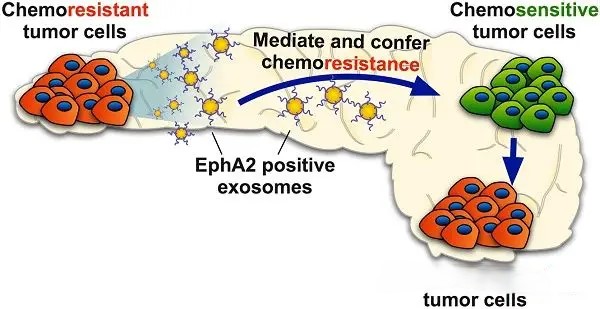
A study published by Professor Ye Hu of Arizona State University and Professor Zhen Zhao of Weill Cornell Medical College revealed the unique role of EphA2 in the transmission of pancreatic cancer resistance. The study found that exosomes (a type of tiny vesicles secreted by cells) from resistant pancreatic cancer cells can transmit drug resistance to sensitive cancer cells, and EphA2 is a key mediator of this process.
Exosomes are important mediators of intercellular communication. They can carry biological molecules such as proteins and nucleic acids and affect the phenotype of recipient cells. In this study, scientists found that
EphA2 is rich in exosomes secreted by drug-resistant pancreatic cancer cells. After these exosomes are taken up by sensitive cancer cells, they can significantly enhance their drug resistance. This finding shows that EphA2 not only plays a role in the drug resistance of individual cancer cells, but can also transfer drug resistance between cancer cells through exosomes, thereby exacerbating the overall drug resistance of tumors.
4. The potential of EphA2 as a therapeutic target
The discovery of EphA2 provides new ideas for the treatment of pancreatic cancer. Due to the key role of EphA2 in the transmission of drug resistance, inhibiting the function of EphA2 may become an effective therapeutic strategy. In recent years, research on inhibitors of EphA2 has made significant progress. For example, some studies have shown that by inhibiting the activity of EphA2, the sensitivity of pancreatic cancer cells to chemotherapy drugs can be significantly enhanced, thereby improving the therapeutic effect.
In addition, EphA2 may also be used as a biomarker to predict drug resistance in patients with pancreatic cancer. By detecting the level of EphA2 in patients, doctors can determine the patient's response to treatment in advance, thereby developing a personalized treatment plan for the patient. This precision medicine strategy is expected to significantly improve the survival rate and quality of life of pancreatic cancer patients.
5.Future Outlook
Although the role of EphA2 in the transmission of pancreatic cancer resistance has been preliminarily confirmed, related research is still ongoing. Future research needs to further explore the expression level and functional differences of EphA2 in different pancreatic cancer patients to verify its clinical application value as a biomarker and therapeutic target. In addition, scientists also need to develop more effective EphA2 inhibitors and verify their safety and effectiveness in clinical trials.
The discovery of EphA2 has brought new hope for the treatment of pancreatic cancer. By gaining a deeper understanding of the mechanism of action of EphA2 in the transmission of resistance, scientists are expected to develop more effective treatments and bring more survival opportunities to pancreatic cancer patients.
This article is reviewed and published by the technical expert team of UA
Disclaimer: This article partially utilizes artificial intelligence assistance in its creation. If any content involves copyright or intellectual property issues, please let us know and we promise to verify and remove it as soon as possible.
Purchase recombinant protein, choose Nanjing UA-Bio
UA protein focuses on providing various protein reagents, raw materials, and services required for drug research and development, cell therapy, gene therapy, and basic scientific research, including drug target proteins, immune checkpoint proteins, cytokines, tool enzymes, customized protein expression, and full-length transmembrane protein development. Youai is committed to providing customers with high-quality products and professional services, and building a High-tech Biological Enterprise with International Competitiveness.







 Business license (three certificates in one)