




GM-CSF neutralization strategy: Frontier exploration of immunotherapy toxicity regulation


Granulocyte-macrophage colony-stimulating factor (GM-CSF), as a key regulator of myeloid cell proliferation and differentiation, plays a dual role in immune response: on the one hand, it promotes the maturation of neutrophils and macrophages and enhances the body's ability to resist infection; on the other hand, its overexpression can trigger a cascade of inflammatory responses, leading to serious side effects such as cytokine storm (CRS) and neurotoxicity. In recent years, the GM-CSF neutralization strategy has shown significant potential in the field of immunotherapy toxicity regulation and has become an important direction to break through the safety bottleneck of existing therapies.
- Recent Advances
- Product Information
GM-CSF neutralization strategy: Frontier exploration of immunotherapy toxicity regulation
Granulocyte-macrophage colony-stimulating factor (GM-CSF), as a key regulator of myeloid cell proliferation and differentiation, plays a dual role in immune response: on the one hand, it promotes the maturation of neutrophils and macrophages and enhances the body's ability to resist infection; on the other hand, its overexpression can trigger a cascade of inflammatory responses, leading to serious side effects such as cytokine storm (CRS) and neurotoxicity. In recent years, the GM-CSF neutralization strategy has shown significant potential in the field of immunotherapy toxicity regulation and has become an important direction to break through the safety bottleneck of existing therapies.
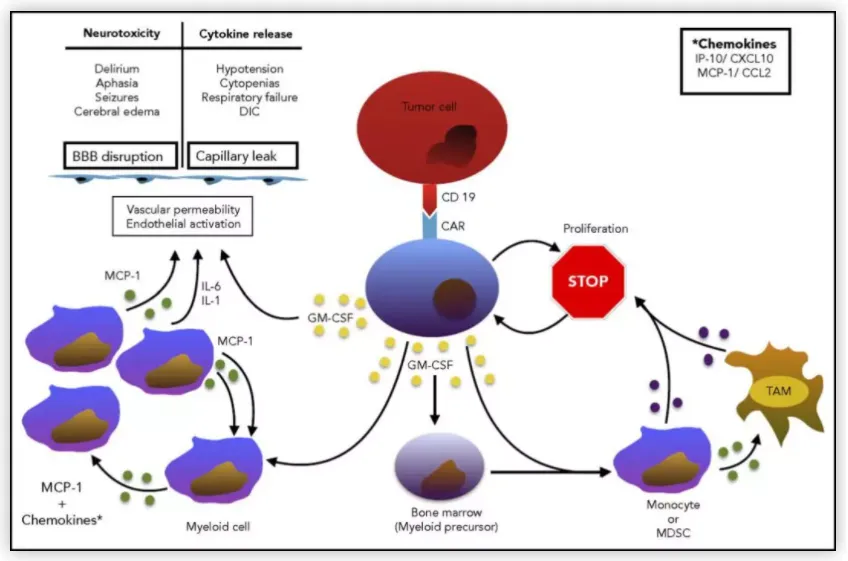
GM-CSF immune regulation mechanism and toxicity association
GM-CSF activates the JAK-STAT signaling pathway by binding to myeloid cell surface receptors (GM-CSFR), inducing the proliferation and activation of myeloid-derived suppressor cells (MDSC) and tumor-associated macrophages (TAM). In chimeric antigen receptor T cell (CAR-T) therapy, GM-CSF secretion is a key upstream trigger of CRS and neurotoxicity (NT). Studies have shown that after CAR-T cells bind to tumor antigens, they can release inflammatory factors such as GM-CSF, activate myeloid cells to produce cytokines such as TNF-α and IL-6, form a positive feedback loop, and aggravate systemic inflammatory response. In addition, GM-CSF can directly induce the recruitment of MDSC and TAM. These cells inhibit T cell proliferation and effector function by secreting immunosuppressive molecules (such as IDO and Arg-1), forming a "efficacy-toxicity" paradox: while enhancing anti-tumor immunity, it also aggravates tissue damage.
Molecular mechanism and clinical transformation of GM-CSF neutralization strategy
GM-CSF neutralization strategy inhibits myeloid cell-mediated inflammatory cascade by blocking the GM-CSF/GM-CSFR signaling axis. Anti-GM-CSF monoclonal antibodies can specifically bind to GM-CSF, block its binding to receptors, and thus inhibit the activation and proliferation of MDSC and TAM. Animal experiments have shown that GM-CSF neutralization can significantly reduce the serum IL-6 level of CRS model animals, reduce pulmonary edema and liver damage, and retain the anti-tumor activity of CAR-T cells. The core advantage of this strategy lies in its targeting: it only interferes with GM-CSF-mediated myeloid cell activation without directly inhibiting the proliferation or cytotoxic function of CAR-T cells.
Technical Challenges and Optimization Directions
Although the GM-CSF neutralization strategy has shown significant efficacy, its clinical application still faces challenges. First, the immunomodulatory effect of GM-CSF under physiological conditions needs to be precisely balanced, and excessive neutralization may lead to a decrease in anti-infection ability. Therefore, the development of antibodies or gene editing tools with half-life regulation capabilities (such as CRISPR-Cas9-mediated GM-CSF gene knockout) has become the key. Secondly, the synergistic effect of GM-CSF neutralization and other immunotherapies needs to be further explored. For example, the combination of GM-CSF neutralizing antibodies and immune checkpoint inhibitors in CAR-T therapy may enhance anti-tumor immune responses by reshaping the myeloid cell composition in the tumor microenvironment (TME). In addition, the application of GM-CSF neutralization strategy in infectious diseases (such as COVID-19) is also worthy of attention: GM-CSF levels are positively correlated with the severity of acute respiratory distress syndrome (ARDS) in COVID-19 patients, and neutralizing GM-CSF may become a new way to alleviate lung inflammation in critically ill patients.
Future Outlook
GM-CSF neutralization strategy provides a new paradigm for the regulation of immunotherapy toxicity. By precisely blocking the GM-CSF signaling pathway, the incidence of CRS and neurotoxicity can be significantly reduced without weakening the anti-tumor efficacy. Future research needs to focus on: ① Developing long-acting, low-immunogenic GM-CSF neutralizing antibodies or gene editing tools; ② Exploring the combined application of GM-CSF neutralization with other immunotherapies to optimize the efficacy/toxicity balance; ③ Analyzing the dynamic regulatory mechanism of GM-CSF in TME to provide a basis for personalized treatment. With the continuous breakthrough of technology, GM-CSF neutralization strategy is expected to become a core component of the next generation of immunotherapy, promoting the treatment of tumors and infectious diseases into the era of "precision regulation".
This article is reviewed and published by the technical expert team of UA
Disclaimer: This article partially utilizes artificial intelligence assistance in its creation. If any content involves copyright or intellectual property issues, please let us know and we promise to verify and remove it as soon as possible.
Purchase recombinant protein, choose Nanjing UA-Bio
UA protein focuses on providing various protein reagents, raw materials, and services required for drug research and development, cell therapy, gene therapy, and basic scientific research, including drug target proteins, immune checkpoint proteins, cytokines, tool enzymes, customized protein expression, and full-length transmembrane protein development. Youai is committed to providing customers with high-quality products and professional services, and building a High-tech Biological Enterprise with International Competitiveness.







 Business license (three certificates in one)