




Target analysis | Potential of IL-1RRP (IL-1 Receptor Related Protein) in tumor therapy


In recent years, studies have found that IL-1 receptor related protein (IL-1RRP) is abnormally expressed in various malignant tumors and participates in regulating the inflammatory response and tumor progression of the tumor microenvironment (TME), making it a highly promising therapeutic target. IL-1RRP is an important member of the IL-1 receptor superfamily, involved in regulating the signal transduction of cytokines such as IL-1, IL-33, and IL-36, which play a pro tumor role in various cancers.
- Recent Advances
- Product Information
- Reference
Introduction
Cancer remains one of the leading causes of death worldwide. Despite significant advancements in oncology treatments, such as chimeric antigen receptor T-cell (CAR-T) therapy and antibody-drug conjugates (ADCs), tumor heterogeneity and drug resistance continue to pose major challenges. Therefore, identifying novel tumor-specific targets and developing innovative therapeutic strategies is crucial. Recent studies have revealed that IL-1 receptor-related protein (IL-1RRP) is aberrantly expressed in multiple malignancies and plays a key role in regulating tumor microenvironment (TME) inflammation and cancer progression, making it a promising therapeutic target.
IL-1RRP is a critical member of the IL-1 receptor superfamily, involved in signal transduction pathways mediated by cytokines such as IL-1, IL-33, and IL-36, all of which exhibit pro-tumorigenic effects. Research indicates that IL-1RRP is significantly upregulated in hematologic malignancies (e.g., acute myeloid leukemia, chronic myeloid leukemia) and solid tumors (e.g., pancreatic, colorectal, and breast cancers). Currently, multiple therapeutic approaches targeting IL-1RRP—including monoclonal antibodies, CAR-T cell therapy, and small-molecule inhibitors—are under development, with some already in clinical trials.
The IL-1 Superfamily and Its Receptor System
The IL-1 superfamily comprises 11 cytokines, 5 receptors, and 5 co-receptors, which play pivotal roles in inflammation, immune regulation, and tumorigenesis. Based on their co-receptor dependencies, the IL-1 superfamily can be divided into four subgroups:
IL-1 Subfamily: Includes IL-1α, IL-1β, and their receptors (IL-1RI/IL-1RII), which require IL-1RRP for signal transduction.
IL-33 Subfamily: IL-33 binds to the ST2 (IL-1RL1) receptor and recruits IL-1RRP to activate downstream signaling.
IL-36 Subfamily: Consists of IL-36α, IL-36β, and IL-36γ, whose signaling depends on IL-1RRP.
IL-18 Subfamily: IL-18 and IL-37 signal through IL-18Rα/IL-18Rβ and do not require IL-1RRP.
As a co-receptor, IL-1RRP plays a central role in the signaling pathways of IL-1, IL-33, and IL-36. Its dysregulated activation can promote tumor cell proliferation, invasion, and immune evasion.
Structure and Signaling Mechanism of IL-1RRP
IL-1RRP is a type I transmembrane protein with the following domains:
Extracellular region: Composed of three immunoglobulin-like domains (D1-D3), which interact with IL-1 family receptors (e.g., IL-1RI, ST2, IL-36R) to form functional complexes.
Transmembrane domain: Anchors the protein to the cell membrane.
Intracellular region: Contains a Toll/IL-1 receptor (TIR) domain that recruits adaptor proteins (e.g., MyD88, IRAKs, TRAF6) to activate NF-κB and MAPK pathways.
IL-1RRP has several splice variants, including:
Membrane-bound form (mIL-1RRP): Primarily involved in inflammatory and oncogenic signaling.
Soluble form (sIL-1RRP): Acts as a decoy receptor to inhibit IL-1 signaling.
IL-1RRPβ (AcPb): Features an extended C-terminal domain and may regulate neuroimmune interactions.
Signal transduction process:
IL-1 family cytokines (e.g., IL-1β, IL-33) first bind to their primary receptors (e.g., IL-1RI or ST2).
The receptor complex recruits IL-1RRP to form a functional signaling unit.
Intracellular TIR domains dimerize, recruiting adaptor molecules (MyD88, IRAK4) to activate NF-κB and MAPK pathways, leading to the release of pro-inflammatory cytokines (e.g., IL-6, TNF-α).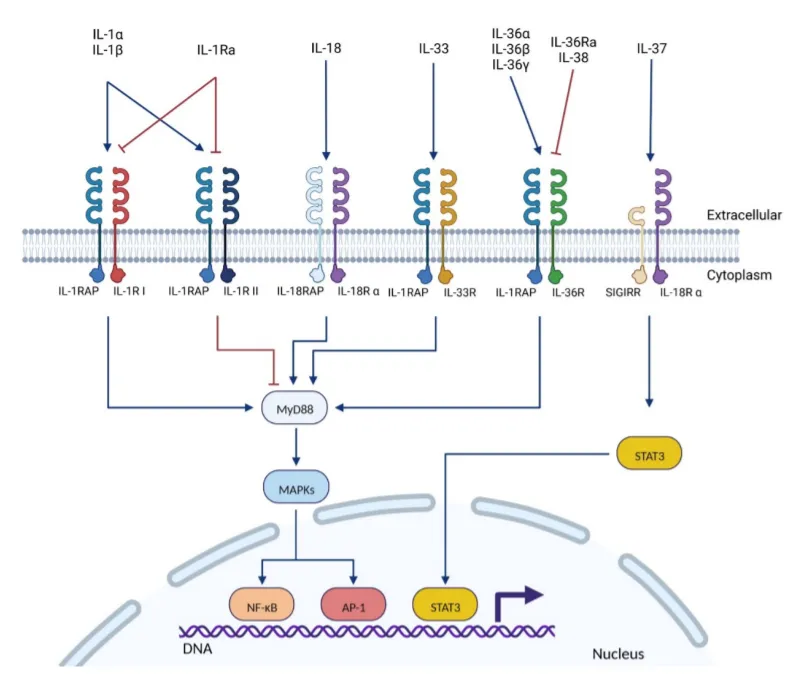
Expression and Function of IL-1RRP in Cancer
1. Hematologic Malignancies
Chronic Myeloid Leukemia (CML): IL-1RRP is highly expressed in CML stem cells, promoting survival and drug resistance.
Acute Myeloid Leukemia (AML): Knockdown of IL-1RRP suppresses AML colony formation and induces apoptosis, highlighting its therapeutic potential.
2. Solid Tumors
Pancreatic Ductal Adenocarcinoma (PDAC): 81% of PDAC patients exhibit IL-1RRP overexpression; its silencing inhibits tumor proliferation and induces cell cycle arrest.
Ewing Sarcoma: Elevated IL-1RRP mRNA and protein levels correlate with tumor aggressiveness.
Other Cancers: Non-small cell lung cancer (NSCLC), triple-negative breast cancer (TNBC), and gastric adenocarcinoma also show IL-1RRP upregulation.
3. Pro-Tumorigenic Mechanisms
Proliferation: Drives tumor growth via ERK/MAPK signaling.
Invasion: Regulates matrix metalloproteinases (MMPs) to facilitate metastasis.
Immune Evasion: Activates myeloid cells in the TME to suppress anti-tumor immunity.
Role of IL-1RRP in the Tumor Microenvironment (TME)
Inflammatory responses in the TME are key drivers of cancer progression. IL-1RRP modulates the TME through:
Macrophage Polarization: The IL-1β/IL-1RRP axis promotes M2 macrophage differentiation, inhibiting T-cell function.
Th17 Cell Differentiation: IL-1RRP-dependent signaling expands Th17 cells, which secrete IL-17 to stimulate angiogenesis.
Neutrophil Recruitment: IL-1RRP activates the CXCL8/CXCR2 axis to recruit tumor-associated neutrophils (TANs).
Fibroblast Activation: Cancer-associated fibroblasts (CAFs) utilize IL-1RRP signaling to remodel the extracellular matrix.
Therapeutic Strategies Targeting IL-1RRP
Current approaches include:
1. Monoclonal Antibodies
Nadunolimab (CAN04): Developed by Cantargia, this antibody blocks IL-1RRP and induces antibody-dependent cellular cytotoxicity (ADCC). Early-phase trials (NCT03267316) demonstrate good tolerability.
Other Antibodies: IL-1RRP antagonists can suppress IL-1/IL-33 signaling, reducing TME inflammation.
2. CAR-T Cell Therapy
Anti-IL-1RRP CAR-T cells (NCT02842320) are being evaluated for hematologic and solid tumors.
3. Small-Molecule Inhibitors
Agents targeting downstream signaling molecules (e.g., IRAK4, MyD88) are in preclinical development.
Future Perspectives
As a core co-receptor in IL-1 signaling, IL-1RRP plays multifaceted roles in tumorigenesis, immune evasion, and TME regulation. Advances in understanding its molecular mechanisms may lead to novel therapies for refractory cancers. Future research should focus on elucidating its context-dependent functions across cancer types and optimizing combination strategies (e.g., with immune checkpoint inhibitors). Progress in this field holds great promise for precision oncology.
This article is reviewed and published by the technical expert team of UA
Disclaimer: This article partially utilizes artificial intelligence assistance in its creation. If any content involves copyright or intellectual property issues, please let us know and we promise to verify and remove it as soon as possible.
Purchase recombinant protein, choose Nanjing UA-Bio
UA protein focuses on providing various protein reagents, raw materials, and services required for drug research and development, cell therapy, gene therapy, and basic scientific research, including drug target proteins, immune checkpoint proteins, cytokines, tool enzymes, customized protein expression, and full-length transmembrane protein development. Youai is committed to providing customers with high-quality products and professional services, and building a High-tech Biological Enterprise with International Competitiveness.

1. IL-1RAP, a Key Therapeutic Target in Cancer. Int J Mol Sci.2022 Dec; 23(23): 14918.






 Business license (three certificates in one)