




The mechanism and research progress of IL-21 in immune regulation and autoimmune diseases


IL-21 is a four alpha helix cytokine composed of 133 amino acids, belonging to the gamma chain cytokine family (gamma c family). The family members include IL-2, IL-4, IL-7, IL-9, IL-15, and IL-21, all of which utilize a common gamma chain (γ c, CD132) as a receptor signaling subunit. Structurally, IL-21 contains four conserved alpha helical domains (A, B, C, D) that bind to receptors through specific spatial conformations.
- Recent Advances
- Product Information
Research Advances on the Role and Mechanisms of IL-21 in Immunoregulation and Autoimmune Diseases
Molecular Structure and Signaling Mechanisms of IL-21
Structural Characteristics
IL-21 is a four-α-helix bundle cytokine composed of 133 amino acids, belonging to the common gamma-chain (γc) cytokine family, which includes IL-2, IL-4, IL-7, IL-9, IL-15, and IL-21. These members all utilize the shared γ-chain (CD132) as a receptor signaling subunit. Structurally, IL-21 contains four conserved α-helical domains (A, B, C, D) that interact with receptors through specific spatial conformations. Crystallographic analyses reveal that IL-21 binds to the IL-21 receptor (IL-21R) via its helix D while simultaneously interacting with the γc subunit through helix A, forming a stable signaling complex.
Receptor System and Signaling Pathways
The IL-21 receptor system consists of the specific IL-21R and the common γ-chain. IL-21R is a type I transmembrane protein whose extracellular region contains two fibronectin type III domains and an immunoglobulin-like domain. Upon IL-21 binding, receptor dimerization occurs, activating downstream signaling pathways. Janus kinase 1 (JAK1) constitutively associates with the intracellular domain of IL-21R, while JAK3 binds to the γc subunit. Ligand binding triggers their mutual activation and phosphorylation.
Activated JAK kinases further phosphorylate tyrosine residues on the receptor's intracellular domain, creating docking sites for signal transducer and activator of transcription (STAT) proteins. IL-21 primarily activates STAT3 while also capable of activating STAT1 and STAT5. These activated STAT proteins form homo- or heterodimers that translocate to the nucleus to regulate target gene expression. Notably, IL-21-induced gene expression profiles are cell-type specific, upregulating plasma cell differentiation-related genes like Blimp-1 and IRF4 in B cells while promoting transcription factors such as Bcl-6 in T cells.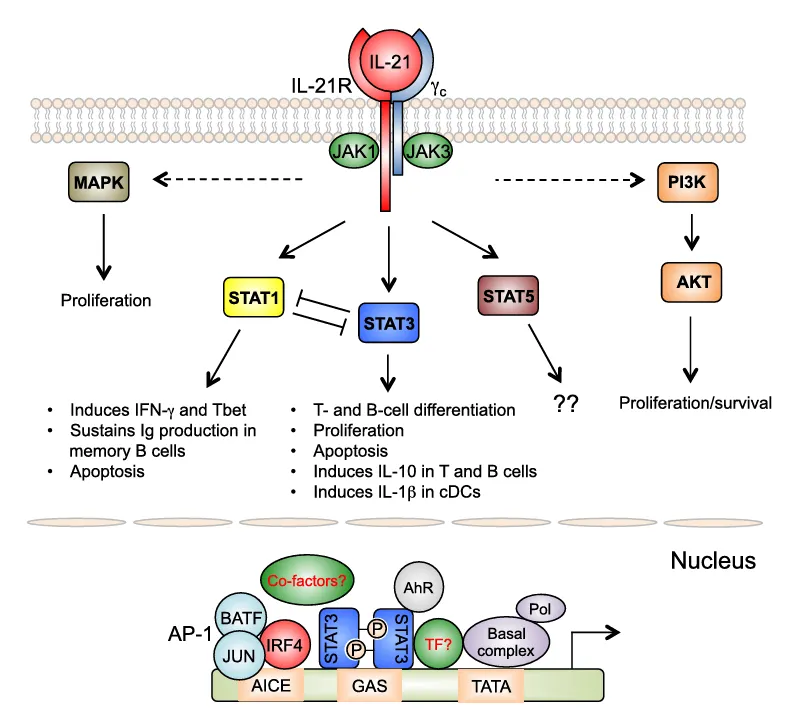
Cellular Sources and Regulatory Mechanisms of IL-21 Production
CD4⁺ T Cell Subsets
Follicular helper T (Tfh) cells represent one of the primary sources of IL-21. These cells localize in germinal centers of lymphoid follicles and characteristically express CXCR5, PD-1, and ICOS. Tfh cell differentiation and function are tightly regulated by the transcription factor Bcl-6, which directly promotes IL-21 gene transcription. During immune responses, Tfh cells provide critical helper signals to B cells through IL-21 secretion and CD40L expression, facilitating germinal center formation, antibody affinity maturation, and memory B cell generation.
Peripheral helper T (Tph) cells are a recently identified CD4⁺ T cell subset with Tfh-like characteristics. Unlike Tfh cells, Tph cells lack CXCR5 expression but highly express PD-1 and predominantly reside in inflammatory sites. These cells maintain and amplify local inflammatory responses through IL-21 production. The transcription factor complex formed by BATF and IRF4 plays a pivotal role in regulating IL-21 production in Tph cells.
Th17 cells can also produce IL-21 under specific microenvironmental conditions. Driven by RORγt, Th17 cells differentiate into effector cells secreting IL-17A, IL-17F, and IL-22. When stimulated by cytokines like IL-23, Th17 cells upregulate IL-21 expression, further enhancing their pathogenicity.
Other Immune Cell Sources
CD8⁺ T cells can acquire IL-21-producing capacity under chronic antigen stimulation. These IL-21-producing CD8⁺ T cells exhibit unique phenotypic and functional characteristics, maintaining their own survival and function through autocrine actions while modulating other immune cells via paracrine mechanisms. In tumor microenvironments, IL-21-producing CD8⁺ T cells demonstrate enhanced antitumor activity and persistence.
Innate-like lymphocytes such as natural killer T (NKT) cells and γδ T cells also represent significant sources of IL-21. Upon recognizing lipid antigens or stress molecules, these cells rapidly activate and participate in early immune defense and tissue homeostasis maintenance through IL-21 secretion. Particularly in skin and mucosal sites, IL-21 produced by these innate-like lymphocytes plays crucial roles in local immune regulation.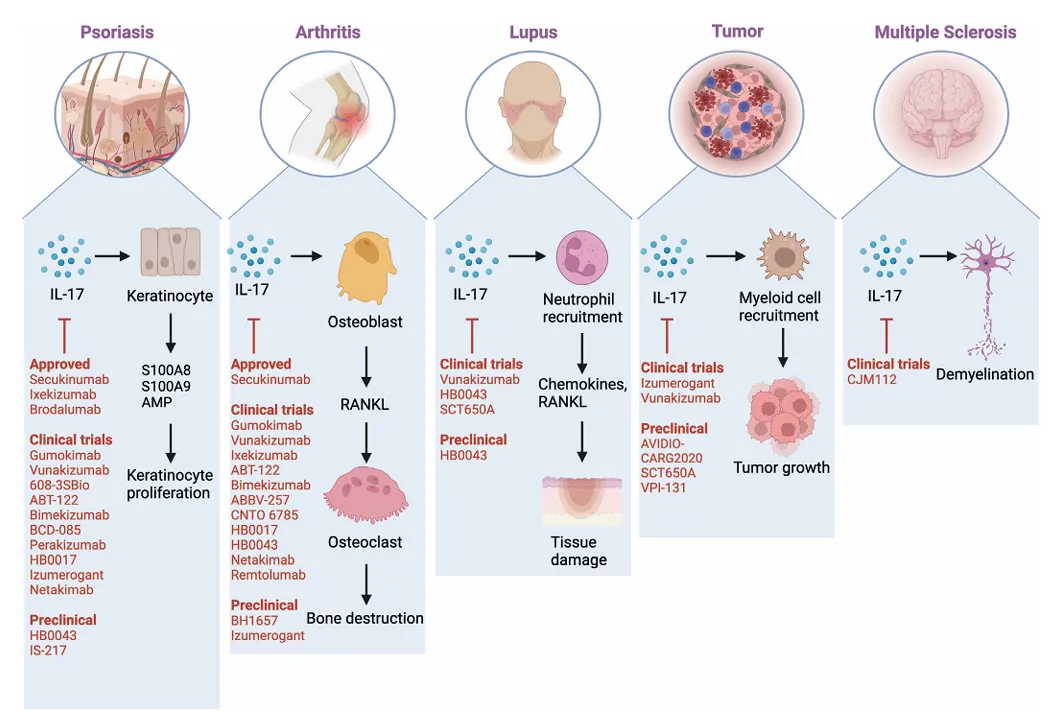
Pathological Roles of IL-21 in Autoimmune Diseases
Systemic Lupus Erythematosus (SLE)
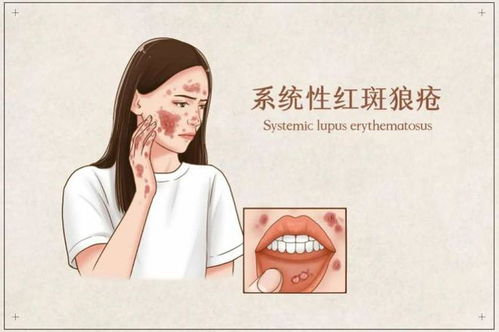
In SLE pathogenesis, IL-21 promotes disease progression through multiple mechanisms. First, IL-21 drives aberrant activation and differentiation of autoreactive B cells, facilitating production of pathogenic autoantibodies (e.g., anti-dsDNA antibodies). Second, IL-21 enhances the retention and activation of CD8⁺ tissue-resident memory T cells (Trm) in target organs like kidneys, directly contributing to tissue damage. Additionally, IL-21 forms a positive feedback loop with type I interferon signaling, further amplifying inflammatory responses. Genetic studies demonstrate significant associations between IL-21/IL-21R polymorphisms and SLE susceptibility, particularly the rs6822844 variant which closely correlates with disease risk and severity.
Rheumatoid Arthritis (RA)
RA patient synovial tissues contain abundant IL-21-producing Tph cells and IL-21R-expressing fibroblast-like synoviocytes (FLS). IL-21 promotes FLS proliferation and matrix metalloproteinase (MMP) secretion, directly participating in articular cartilage and bone destruction. Simultaneously, IL-21 synergizes with RANKL to facilitate osteoclast differentiation and activation, exacerbating osteoporosis and joint deformities. Clinical studies show positive correlations between synovial fluid IL-21 levels and joint erosion severity, with more pronounced IL-21-driven B cell activation in anti-CCP antibody-positive patients.
Type 1 Diabetes (T1D)
In T1D, IL-21 promotes infiltration and retention of autoreactive CD8⁺ T cells in pancreatic islets. These cells induce β-cell apoptosis through Fas-FasL pathways, leading to insulin secretion deficiency. Animal model studies demonstrate significantly reduced diabetes incidence and markedly attenuated insulitis in IL-21R-deficient non-obese diabetic (NOD) mice. Clinical data also reveal positive correlations between circulating IL-21-producing Tfh cell frequencies and islet autoantibody levels in T1D patients.
Clinical Prospects of IL-21-Targeted Therapies
Monoclonal Antibody Strategies
IL-21-targeting monoclonal antibodies (e.g., NNC0114-0006) have demonstrated favorable safety profiles and preliminary efficacy in clinical trials for autoimmune diseases like SLE. These antibodies effectively inhibit downstream signaling pathway activation by blocking IL-21-receptor interactions. In SLE patients, anti-IL-21 treatment significantly reduces autoantibody levels and disease activity scores, though long-term follow-up is needed to validate effects on end-organ damage.
Small-Molecule Inhibitors
JAK inhibitors exert therapeutic effects by interfering with key nodes in IL-21 signaling. JAK1/3 inhibitors like tofacitinib, already approved for RA treatment, work partly by suppressing IL-21-induced STAT3 activation. New-generation selective JAK inhibitors (e.g., upadacitinib) demonstrate higher specificity for IL-21 signaling pathways, potentially offering improved efficacy and safety.
Combination Therapy Approaches
Given IL-21's broad effects across immune cells, combination strategies targeting IL-21 alongside other pathways have garnered significant interest. For instance, in T1D, combined anti-IL-21 and GLP-1 receptor agonist treatment shows synergistic β-cell functional protection in animal models. In SLE management, theoretical synergy exists between B cell depletion therapies and IL-21 inhibition to simultaneously target autoantibody production and Tfh cell helper functions.
Conclusion and Future Perspectives
As a pleiotropic cytokine, IL-21 plays central roles in immune regulation and autoimmune pathogenesis. Elucidating IL-21 production regulation and signaling mechanisms has identified novel therapeutic targets for multiple autoimmune diseases. With continuous development and optimization of targeted agents, IL-21 pathway modulation promises to become an important strategy in autoimmune disease treatment. Future research should further clarify IL-21's precise mechanisms across disease contexts, develop more selective intervention approaches, and explore rational combination regimens to achieve more precise and effective immune modulation.
This article is reviewed and published by the technical expert team of UA
Disclaimer: This article partially utilizes artificial intelligence assistance in its creation. If any content involves copyright or intellectual property issues, please let us know and we promise to verify and remove it as soon as possible.
Purchase recombinant protein, choose Nanjing UA-Bio
UA protein focuses on providing various protein reagents, raw materials, and services required for drug research and development, cell therapy, gene therapy, and basic scientific research, including drug target proteins, immune checkpoint proteins, cytokines, tool enzymes, customized protein expression, and full-length transmembrane protein development. Youai is committed to providing customers with high-quality products and professional services, and building a High-tech Biological Enterprise with International Competitiveness.







 Business license (three certificates in one)