An In-depth Introduction to Interleukin-2 Receptor Alpha Subunit (IL-2Rα)
Introduction
The interleukin-2 receptor alpha subunit (IL-2Rα, also known as CD25) occupies a crucial position in the sophisticated regulatory network of the immune system. Since its discovery, IL-2Rα has become a focal molecule for researchers to deeply explore immune regulatory mechanisms, disease occurrence and development, as well as therapeutic strategies. In-depth research on IL-2Rα not only enhances our understanding of the normal physiological functions of the immune system but also opens up new ideas and methods for the treatment of many diseases, especially immune-related diseases and tumors.
Structural Characteristics of IL-2Rα
IL-2Rα is an important member of the type I cytokine receptor family. Its encoding gene is located in the human chromosome 10p15-10p14 region. From a structural perspective, the extracellular region of IL-2Rα contains 211 amino acid residues, among which there are two fibronectin type III domains. These two domains play an indispensable role in the specific binding of IL-2Rα to interleukin-2 (IL-2). Connecting the extracellular region and the intracellular region is a transmembrane region composed of 25 amino acid residues, while the intracellular region is relatively short, containing only 13 amino acid residues. Although the intracellular region is short, it also plays an important role in the subsequent interaction with other receptor subunits and signal transmission.
The Role of IL-2Rα in the IL-2 Receptor Complex
The IL-2 receptor is not a single molecular structure but a complex formed by different combinations of three subunits: IL-2Rα, IL-2Rβ (CD122), and IL-2Rγ (CD132). Among them, the receptor containing only IL-2Rα shows low affinity for IL-2 (dissociation constant Kd is approximately 10⁻⁸M), and this form of binding alone cannot induce signal transduction. At this time, membrane-bound or soluble IL-2Rα molecules can be regarded as IL-2 blockers or decoy receptors to a certain extent. The dimeric receptor composed of IL-2Rβ and IL-2Rγ has moderate affinity for IL-2 (Kd is approximately 10⁻⁹M) and can mediate partial signal transduction. When IL-2Rα, IL-2Rβ, and IL-2Rγ form a trimeric receptor together, the affinity for IL-2 is significantly increased to a high-affinity state (Kd is approximately 10⁻¹¹M), thereby efficiently mediating IL-2 signal transduction. In this process, the key role of IL-2Rα is to enhance the binding ability of IL-2 to the receptor complex, promoting the conversion of the moderate-affinity dimeric receptor to the high-affinity trimeric receptor, thus playing an indispensable bridging role in the response of immune cells to IL-2.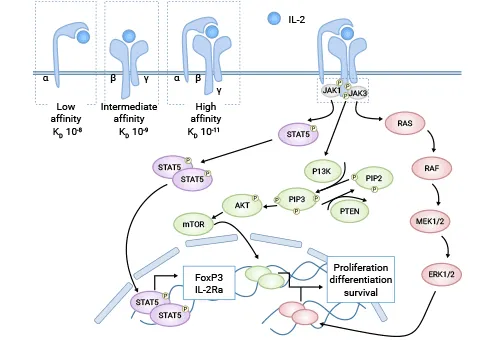
Signal Pathways Mediated by IL-2Rα
When IL-2 first interacts with IL-2Rα, it causes a conformational change in IL-2, which in turn enables IL-2 to effectively interact with IL-2Rβ and recruit IL-2Rβ. Subsequently, IL-2Rγ participates to form a high-affinity receptor complex. At this time, the receptor complex is activated, and the downstream signal transduction is mainly carried out through three signaling pathways.
The JAK-STAT pathway dominates the total signal transduction, accounting for approximately 90%. After IL-2 binds to the receptor, it promotes the heterodimerization of IL-2Rβ and IL-2Rγ, activating tyrosine kinases JAK1 and JAK3 respectively. The activated JAK1 and JAK3 phosphorylate the tyrosine residues in IL-2Rβ, and this phosphorylation process promotes the recruitment of signaling molecules such as PI3K, STAT5, or SHC1. These signaling molecules phosphorylated by JAKs further activate specific pathways, promote the nuclear translocation of transcription factors, and ultimately achieve precise regulation of target gene transcription, inducing a series of biological effects such as cell activation, differentiation, and proliferation.
The PI3K-AKT-mTOR pathway is also one of the important signaling pathways mediated by IL-2Rα. After PI3K is recruited and activated, it phosphorylates phosphatidylinositol-4,5-bisphosphate (PIP₂) to phosphatidylinositol-3,4,5-trisphosphate (PIP₃). PIP₃ can recruit and activate AKT, and the activated AKT further activates mTOR, which plays a core role in the regulation of key biological processes such as cell growth, metabolism, and protein synthesis.
The MAPK pathway is also involved. Signals mediated by IL-2Rα can activate Ras protein, which in turn activates Raf protein. Raf protein sequentially activates MEK and ERK through a phosphorylation cascade reaction. The finally activated ERK enters the nucleus, regulates a series of transcription factors, and affects biological functions such as cell proliferation, differentiation, and survival.
Expression and Function of IL-2Rα in Immune Cells
T Cells
In the T cell population, the expression of IL-2Rα shows dynamic changes. Naive T cells usually do not express or only express IL-2Rα at low levels. However, when T cells are activated by antigen stimulation and with the synergistic effect of co-stimulatory molecules (such as CD28), the expression of IL-2Rα is rapidly upregulated. For helper T cells (Th cells), the signals mediated by IL-2Rα can promote the clonal expansion of Th cells and induce their differentiation into different Th cell subsets (such as Th1, Th2, Th17, etc.). Different subsets of Th cells play unique roles in the immune response. For example, Th1 cells are mainly involved in cellular immunity, can secrete cytokines such as IFN-γ, activate macrophages, and enhance their ability to kill pathogens; Th2 cells are mainly involved in humoral immunity, and promote the activation, proliferation, and antibody production of B cells by secreting cytokines such as IL-4 and IL-5. Regulatory T cells (Treg cells), as a special subset of T cells, continuously and highly express IL-2Rα in both resting and activated states. The signals mediated by IL-2Rα are crucial for the development, survival, and maintenance of the immunosuppressive function of Treg cells. Treg cells play a key regulatory role in maintaining immune homeostasis, preventing the occurrence of autoimmune diseases, and in tumor immune escape by inhibiting the activity of other immune cells (such as effector T cells, NK cells, etc.).

NK Cells
Natural killer cells (NK cells) play an important role in the innate immune defense of the body. NK cells constitutively express moderate-affinity IL-2Rβγ dimeric receptors. After being stimulated by IL-2, NK cells can induce the expression of IL-2Rα, thereby forming high-affinity IL-2Rαβγ trimeric receptors. The signals mediated by IL-2Rα can significantly enhance the cytotoxicity of NK cells, promote their proliferation, and the secretion of cytokines (such as IFN-γ, TNF-α, etc.). These biological effects enable NK cells to play a more powerful role in antiviral infection, anti-tumor immune surveillance, and immune regulation.
Association of IL-2Rα with Diseases
Autoimmune Diseases
IL-2Rα plays an important role in the pathogenesis of autoimmune diseases such as type 1 diabetes and systemic lupus erythematosus. Taking type 1 diabetes as an example, during the occurrence and development of the disease, the immune system mistakenly attacks pancreatic β cells, leading to insufficient insulin secretion. Studies have found that the expression of IL-2Rα on the surface of T cells in patients is abnormally increased, making T cells more sensitive to IL-2. Overactivated T cells continuously attack pancreatic β cells, exacerbating the damage and functional loss of pancreatic β cells. In patients with systemic lupus erythematosus, there is also a phenomenon of dysregulated IL-2Rα expression, which leads to excessive activation of immune cells, production of a large number of autoantibodies, and thus triggers immune damage in multiple systems of the body.
Tumors
The occurrence and development of tumors are closely related to the imbalance of the immune system. In various tumors, such as NK/T cell lymphoma, tumor cells often highly express IL-2Rα. On the one hand, highly expressed IL-2Rα can promote the proliferation of tumor cells themselves. By activating downstream signaling pathways, tumor cells escape cell cycle regulation and continuously divide and proliferate; on the other hand, the highly expressed IL-2Rα on tumor cells can also interfere with the anti-tumor immune response of the body. For example, tumor cells bind to IL-2, consume IL-2 in the tumor microenvironment, making effector T cells and NK cells unable to be fully activated due to the lack of sufficient IL-2 stimulation, thereby weakening the anti-tumor immune ability of the body. In addition, in some tumors, the overexpression of IL-2Rα is also related to the development of drug resistance of tumor cells to chemotherapy drugs, further increasing the difficulty of tumor treatment.
Therapeutic Strategies Based on IL-2Rα
Immunomodulatory Therapy
In view of the key role of IL-2Rα in immune regulation, regulating the signals mediated by IL-2Rα to treat immune-related diseases has become an important research direction. For autoimmune diseases, low-dose IL-2 therapy has become a promising treatment strategy. Because low concentrations of IL-2 preferentially bind to the constitutively expressed high-affinity ternary complex receptor (IL-2Rαβγ) on Treg cells, low-dose IL-2 can selectively activate Treg cells, enhance their immunosuppressive function, thereby effectively inhibiting autoimmune responses and alleviating disease symptoms. Clinical studies have shown that after applying low-dose IL-2 therapy in patients with type 1 diabetes, the number and function of Treg cells in patients increase, the autoimmune response is inhibited to a certain extent, and the blood glucose control is improved.
Tumor Immunotherapy
In the field of tumor immunotherapy, therapeutic strategies targeting IL-2Rα aim to enhance the anti-tumor immune response of the body. One of the strategies is to design effector cell-selective IL-2 agonists. By modifying the IL-2 molecule to avoid interaction with IL-2Rα, it can selectively activate effector cells (such as NK cells and CD8⁺T cells) expressing IL-2Rβγ dimeric receptors, enhancing their anti-tumor activity. However, some clinical research results show that this method may have certain limitations because it to some extent ignores the important role of the transient upregulation and translation of IL-2Rα in tumor-specific T cells when recognizing tumor antigens. Recent studies have proposed another "α-biased" design idea, that is, designing IL-2 analogs with bias towards IL-2Rα. Such analogs can effectively and selectively activate tumor-specific T cells expressing IL-2Rα in the tumor microenvironment, while limiting the excessive activation of effector cells outside the tumor, thereby enhancing anti-tumor immunity while reducing systemic toxic reactions. In addition, anti-IL-2Rα monoclonal antibodies have also been applied in tumor treatment research. Anti-IL-2Rα monoclonal antibodies can block the signal transduction mediated by IL-2Rα by binding to the highly expressed IL-2Rα on the surface of tumor cells, inhibiting the proliferation and survival of tumor cells; at the same time, they can also recruit immune cells such as NK cells to kill tumor cells through mechanisms such as antibody-dependent cell-mediated cytotoxicity (ADCC).

Conclusion
As a key molecule in the immune system, the structure, function, and expression regulation of IL-2Rα in immune cells are closely related to various physiological and pathological processes. In-depth exploration of the biological characteristics of IL-2Rα not only greatly enriches our understanding of the fine regulatory mechanisms of the immune system but also brings new hopes and strategies for the treatment of major diseases such as autoimmune diseases and tumors. Although the current therapeutic strategies based on IL-2Rα still face many challenges in clinical application, such as drug safety, effectiveness, and individual differences, with the continuous deepening of research on IL-2Rα and the continuous innovation of related technologies, it is believed that in the near future, these therapeutic strategies will bring tangible clinical benefits to more patients and provide strong support for overcoming these diseases that seriously threaten human health.












 Business license (three certificates in one)