Interleukins and Tumors: Functions and Mechanisms of Action
In the complex regulatory network of the tumor microenvironment (TME), cytokines act as key signaling molecules mediating dynamic interactions between immune and non-immune cells, profoundly influencing tumor initiation and progression. Studies have confirmed that the tumor microenvironment promotes abnormal crosstalk between malignant cells and immune responses through adaptive evolution, and this balance plays a decisive role in the progression of solid tumors such as lung adenocarcinoma. Due to their central role in immune regulation, the interleukin (ILs) family has become a focus in tumor research. Through diverse cellular sources, specific receptor recognition, and complex signaling networks, interleukins exhibit significant pleiotropy in the tumor microenvironment, covering stages of tumor initiation, progression, and immune control, with distinct dose-dependent characteristics. This article systematically reviews the expression patterns, signaling mechanisms, and dual roles of the interleukin family in the tumor microenvironment, providing insights for understanding tumor immune regulation and developing targeted therapeutic strategies.
I. Classification of the Interleukin Family and Expression Characteristics in the Tumor Microenvironment
The interleukin family consists of structurally related but functionally distinct cytokines, divided into multiple subfamilies based on molecular structure, receptor type, and functional characteristics. Their cellular sources in the tumor microenvironment are diverse, including infiltrating immune cells (such as T cells, macrophages, natural killer cells), tumor cells themselves, and stromal cells (such as fibroblasts, endothelial cells). Their expression levels are closely related to tumor type, stage, and prognosis.
As key regulators of innate immunity, the IL-1 family often shows abnormally high expression in the tumor microenvironment. IL-1α and IL-1β are mainly secreted by activated macrophages, dendritic cells, and tumor-associated fibroblasts, transmitting signals through the IL-1R1/IL-1R3 complex; IL-33 is released by stromal cells and endothelial cells, exerting immunomodulatory effects. In the IL-18 family, IL-18 is derived from activated macrophages and dendritic cells, while IL-37 is commonly expressed in regulatory T cells (Treg) and myeloid-derived suppressor cells.
Members of the IL-2 family play a central role in adaptive immune regulation, with expression strictly dependent on cellular activation. IL-2 is mainly secreted by activated CD4⁺T cells, IL-4 primarily 来源于 Th2-type helper T cells, and IL-7 is continuously produced by stromal fibroblasts in the tumor microenvironment, providing critical signals for T cell survival. As important inflammatory mediators, the IL-6 family members: IL-6 is secreted by tumor-associated macrophages and stromal cells, with significantly increased expression in inflammation-related tumors; IL-11 is highly expressed in the microenvironment of various epithelial-derived tumors, closely associated with metastasis.
The IL-12 family exhibits distinct functional differentiation: IL-12 is produced by dendritic cells and macrophages upon pathogen stimulation, while IL-23 is constitutively expressed in myeloid cells within the tumor microenvironment, influencing tumor progression by regulating Th17 cell differentiation. IL-17A/F of the IL-17 family are mainly secreted by Th17 cells and γδT cells, associated with poor prognosis in various solid tumors; IL-25 (IL-17E) is produced by epithelial cells and mast cells, participating in Th2-type polarization of the tumor microenvironment.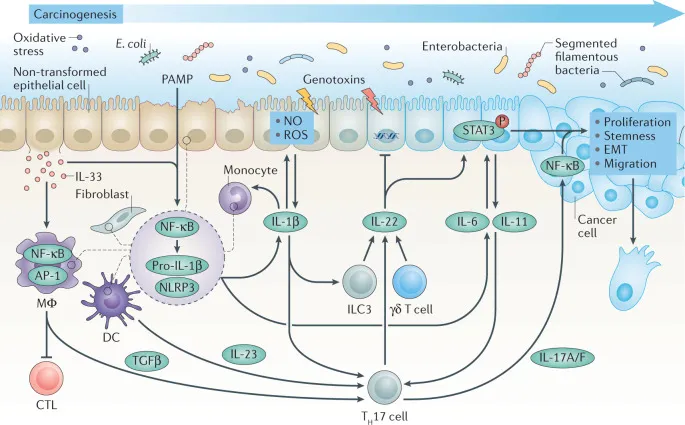
II. Dual Mechanisms of Action of Interleukins in Tumorigenesis
Interleukins exhibit significant duality in tumorigenesis: some promote tumor development by inducing inflammatory responses and inhibiting anti-tumor immunity, while others exert anti-tumor effects by activating effector immune cells and inhibiting tumor cell proliferation. This functional difference is mainly determined by the cell type they act on and the microenvironmental context.
(1) Molecular Mechanisms of Pro-tumor Effects
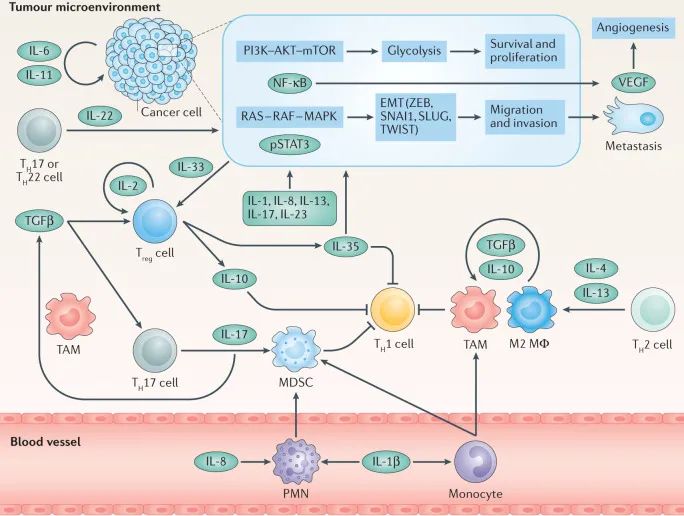
Multiple interleukins participate in tumorigenesis by inducing chronic inflammatory microenvironments, promoting tumor cell proliferation, and angiogenesis. As a typical pro-inflammatory cytokine, IL-6 activates downstream JAK/STAT3 and MAPK signaling pathways through classical (IL-6Rα/gp130) and trans (soluble IL-6Rα/gp130) signaling pathways, promoting unlimited proliferation and anti-apoptotic capacity of tumor cells, while inducing VEGF expression to accelerate tumor neovascularization. In inflammation-related tumors such as colorectal cancer and liver cancer, sustained high expression of IL-6 promotes malignant transformation of epithelial cells by maintaining chronic inflammation.
Members of the IL-17 family promote tumor progression through multiple mechanisms: IL-17A can directly act on tumor cells, activating the NF-κB signaling pathway to induce matrix metalloproteinases (MMPs) expression, enhancing tumor cell invasion and metastasis; meanwhile, it can recruit neutrophils and macrophages to form an immunosuppressive microenvironment. IL-23 specifically activates Th17 cells to promote secretion of pro-inflammatory factors such as IL-17, forming an "IL-23/IL-17" inflammatory axis that accelerates tumor angiogenesis and lymphangiogenesis in breast cancer, melanoma, etc., promoting distant metastasis.
As an "alarmin", IL-33 in the tumor microenvironment can activate mast cells and basophils to secrete Th2-type cytokines such as IL-4 and IL-13, promoting M2-type macrophage polarization to form an immunosuppressive microenvironment; it can also directly act on tumor cells to enhance their survival ability and chemoresistance. IL-20 and IL-22 of the IL-10 family activate receptor complexes on tumor cells, promoting epithelial-mesenchymal transition (EMT) to enhance migration ability, closely associated with lymph node metastasis in gastric cancer, colorectal cancer and other digestive tract tumors.
(2) Regulatory Networks of Anti-tumor Effects
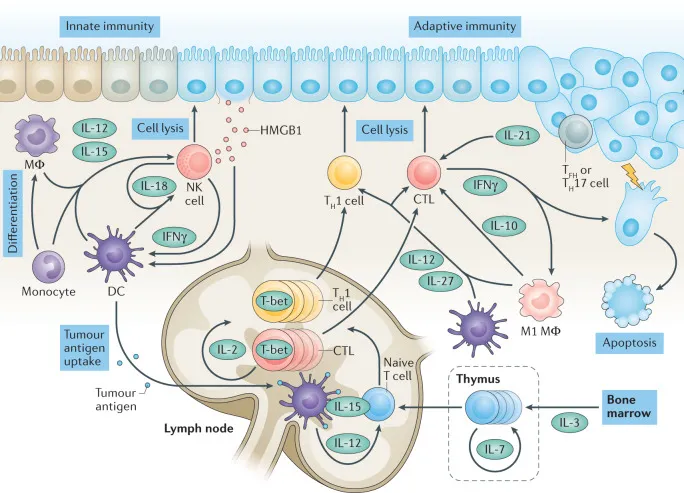
Some interleukins exert anti-tumor effects by activating adaptive immune responses and enhancing effector cell functions. As a key driver of Th1-type immune responses, IL-12 activates the STAT4 signaling pathway to induce naive T cell differentiation into Th1 cells, promotes IFN-γ secretion to enhance cytotoxic T lymphocyte (CTL) killing ability, and activates natural killer (NK) cells to enhance tumor recognition and lysis, showing significant immune-enhancing effects in various tumor models.
IL-2 binds to receptors on T cell surfaces to provide proliferation signals, promoting clonal expansion of effector T cells and enhancing NK cell cytotoxicity, playing an important role in tumor immune surveillance. IL-18 synergizes with IL-12 to induce large amounts of IFN-γ production by T cells and NK cells, enhancing anti-tumor responses and promoting memory T cell formation to maintain long-term immune memory.
IL-7 inhibits T cell apoptosis by activating PI3K/Akt, maintaining the survival and function of effector T cells; in immune checkpoint inhibitor therapy, it enhances T cell antigen response and reverses exhaustion. IL-27 induces cytotoxic differentiation of NK cells and CTLs, playing a key role in early tumor immune surveillance, with secretion levels positively correlated with the prognosis of various tumors.
III. Tumor Regulatory Roles of Typical Interleukin Family Members
Different members of the interleukin family exhibit unique functional characteristics in the tumor microenvironment, and in-depth analysis of their mechanisms provides perspectives for understanding immune regulatory networks.
The IL-1 family shows complex dual roles: IL-1α and IL-1β activate NF-κB to promote inflammatory carcinogenesis, while recruiting dendritic cells and CTLs to initiate anti-tumor immunity. High IL-1β expression is associated with poor prognosis in various tumors, and targeted monoclonal antibodies show tumor-suppressive potential in clinical trials. IL-33 mainly exerts pro-tumor effects, inhibiting immune responses by promoting Treg function and Th2 polarization, with expression levels positively correlated with tumor stage in breast cancer and lung cancer.
The IL-12 family exhibits significant functional differentiation: IL-12 induces IFN-γ production to activate adaptive immune responses, regarded as an important immune enhancer in tumor immunotherapy; IL-23 promotes tumor development by facilitating Th17 differentiation and IL-17 secretion, closely associated with angiogenesis and metastasis. As a key inhibitory cytokine secreted by Treg cells, IL-35 promotes tumor immune escape by inhibiting effector T cell proliferation and cytotoxic function, with high expression predicting poor prognosis.
IL-6 and IL-11 of the IL-6 family are important pro-cancer factors: IL-6 activates STAT3 to maintain cancer stem cell characteristics, promoting recurrence and drug resistance; IL-11 activates the gp130/STAT3 signaling axis to enhance mesenchymal transition and metastasis ability, with significantly increased expression in highly metastatic tumors such as pancreatic cancer and breast cancer. In the IL-10 family, IL-10 inhibits dendritic cell maturation and cytokine secretion to form an immunosuppressive microenvironment, while IL-24 exerts anti-tumor effects by inducing tumor cell apoptosis and autophagy, with its expression deficiency common in various malignant tumors.
IL-2 of the IL-2 family exerts anti-tumor effects by promoting T cell and NK cell growth, while maintaining Treg function and inducing activation-induced cell death (AICD) to terminate excessive immune responses, requiring precise dose regulation in tumor immunotherapy. As a key factor for T cell survival, IL-7 maintains the diversity and functional integrity of the T cell repertoire in the tumor microenvironment, with expression levels positively correlated with the therapeutic response to immune checkpoint inhibitors.
IV. Potential Application Value of Interleukins in Tumor Therapy
Due to their central role in tumor immune regulation, interleukin family members have become important potential targets for tumor therapy, and therapeutic strategies based on their functional characteristics have achieved significant progress in clinical research.
Neutralization strategies targeting pro-tumor interleukins have been validated in multiple clinical trials: monoclonal antibodies targeting the IL-6 receptor show significant efficacy in multiple myeloma treatment, effectively inhibiting tumor cell proliferation and bone damage; anti-IL-17A antibodies exhibit inhibitory effects on tumor angiogenesis and metastasis in animal models, with clinical trials in solid tumors underway. IL-1R antagonists block IL-1 family signals, showing potential in reducing tumor progression risk in inflammation-related tumors, with broad prospects in colorectal cancer, lung cancer and other tumor types.
Immune enhancement therapies based on anti-tumor interleukins have become important directions in tumor immunotherapy: recombinant IL-12 enhances Th1-type responses, showing certain efficacy in clinical trials of melanoma and kidney cancer; as the first approved cytokine therapy, IL-2 can induce durable anti-tumor responses in renal cell carcinoma and melanoma, but its clinical application is limited by systemic toxicity. T cell survival factors such as IL-7 and IL-15 are being explored to enhance the efficacy of immune checkpoint inhibitors, with preclinical studies showing reversal of T cell exhaustion and enhancement of infiltrating T cell function.
The development of combination therapy strategies has become key to improving interleukin-targeted therapy efficacy: the combination of IL-12 and PD-1/PD-L1 inhibitors shows synergistic anti-tumor effects in animal models; the combination of IL-2 and CAR-T cell therapy can enhance CAR-T cell survival and proliferation in the tumor microenvironment, improving response rates. Tumor typing based on interleukin expression profiles provides a basis for personalized immunotherapy, expected to significantly improve treatment precision and effectiveness.
Although interleukin-targeted therapy faces challenges such as off-target effects due to cytokine pleiotropy and individual response differences, with in-depth mechanism research and dosage optimization, it is expected to become an important breakthrough in tumor immunotherapy, providing new options for overcoming malignant tumors.












 Business license (three certificates in one)