As a rare oncogenic driver mechanism, NRG1 (Neuroregulin 1) fusion has attracted extensive attention in non-small cell lung cancer (NSCLC) research in recent years. NRG1 fusion promotes tumorigenesis and development by abnormally activating the epidermal growth factor receptor (EGFR) family signaling pathway, providing a new direction for precision treatment of lung cancer. This article systematically elaborates on the molecular characteristics, clinical phenotypes of patients, detection methods, signal regulation mechanisms and existing treatment strategies of NRG1 fusion in NSCLC, comprehensively analyzing the research status and clinical value of this emerging therapeutic target.
1. Molecular Characteristics and Lung Cancer Distribution of NRG1 Fusion
As an important member of the epidermal growth factor family, NRG1 is located on the short arm of chromosome 8. The encoded neuroregulin 1 plays a key regulatory role in normal tissue development, cell proliferation and differentiation by binding to HER3 (ERBB3) and HER4 (ERBB4) receptors. When the NRG1 gene fuses with other genes, it forms a fusion protein with oncogenic activity. This genomic abnormality is called NRG1 fusion, which is another important oncogenic driver event discovered after EGFR mutation and ALK fusion.
Among solid tumors, NRG1 fusion is most common in non-small cell lung cancer, especially in the adenocarcinoma subtype. More than 20 types of NRG1 fusion partner genes have been discovered so far, among which CD74-NRG1 fusion is the most common subtype in clinical practice, accounting for more than 50% of all NRG1 fusion NSCLC cases. Other relatively common fusion partners include SLC3A2, TPM3, MBD1, etc. Different fusion partners may affect the expression level, subcellular localization and signal activation intensity of fusion proteins, leading to differences in tumor biological behaviors. These fusion events occur through genomic translocation, inversion and other mechanisms, resulting in the continuous exposure of the epidermal growth factor-like domain of NRG1, thereby abnormally activating downstream signaling pathways and driving tumorigenesis.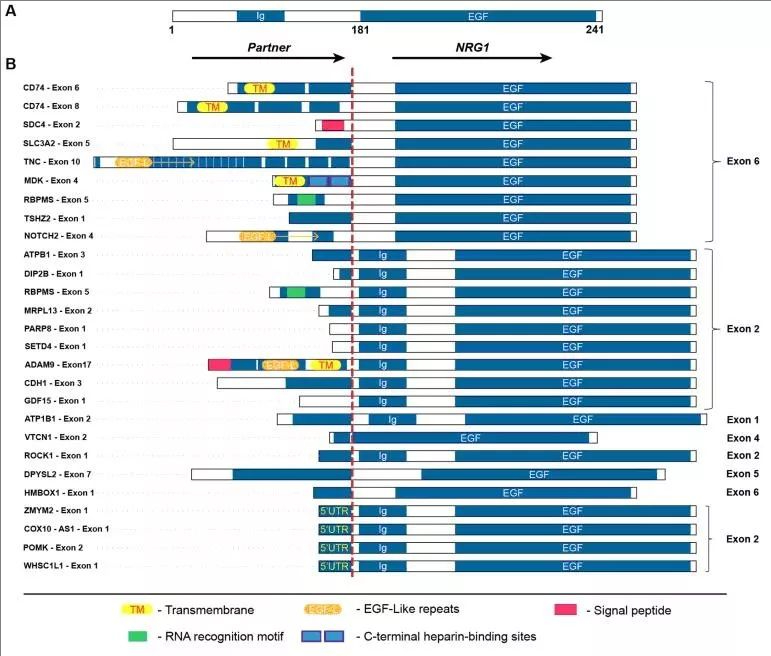
2. Clinical Characteristics of Patients with NRG1 Fusion NSCLC
The overall incidence of NRG1 fusion in non-small cell lung cancer is relatively low, accounting for about 0.3% of all NSCLC cases, but the incidence increases significantly in specific subtypes. In lung adenocarcinoma patients, the incidence of NRG1 fusion is about 1.7%, while in the special subtype of invasive mucinous lung adenocarcinoma (IMA), the incidence can be as high as 7%-10%, becoming an important molecular characteristic of this subtype. Multicenter clinical research data show that among 117 patients with NRG1 fusion NSCLC, 95% have adenocarcinoma pathological type, and 75% of them are diagnosed as invasive mucinous lung adenocarcinoma, suggesting that there is a close correlation between NRG1 fusion and pathological differentiation of mucinous adenocarcinoma.
In terms of clinical phenotype, patients with NRG1 fusion NSCLC have unique demographic characteristics: the median age of onset is 66 years, slightly higher than that of patients with other driver gene-positive lung cancer; the proportion of female patients is relatively high, accounting for about 55%; the proportion of non-smoking or light smoking patients reaches 44%, significantly higher than that of smoking-related lung cancer population. In terms of disease stage distribution, patients with NRG1 fusion are diagnosed at various clinical stages, with 32.5% in stage I, 18.8% in stage II, 9.4% in stage III, and 10.5% in stage IV, indicating that this molecular abnormality can appear in the early stage of the disease and continuously drive tumor progression. It is worth noting that the prognosis of advanced patients is relatively better. The median survival time of 29 patients with stage IV disease reaches 4.83 years, and 12 patients receiving afatinib treatment show certain survival benefits, providing a reference for clinical treatment.
3. Detection Methods and Coexisting Gene Characteristics of NRG1 Fusion
Accurate detection of NRG1 fusion is the premise of targeted therapy. Currently, commonly used clinical detection methods include fluorescence in situ hybridization (FISH), RNA sequencing (RNA-seq) and DNA sequencing technology, each with its own advantages and limitations. FISH technology identifies NRG1 gene rearrangement through specific probes, with high sensitivity, but cannot determine the specific fusion partner; RNA sequencing can directly detect fusion transcripts, clarify the type of fusion partner and breakpoint location, providing more detailed information for treatment options, and is currently recommended as the preferred detection method; DNA sequencing can detect fusion breakpoints at the genomic level, but its ability to detect low-abundance fusions is relatively weak, often used as a supplementary detection method.
NRG1 fusion shows a unique co-mutation pattern in the lung cancer genome, and it hardly coexists with other known oncogenic driver genes. Clinical studies have shown that NRG1 fusion NSCLC patients rarely have common driver events such as EGFR mutation, ALK fusion, ROS1 fusion or RET fusion at the same time. This exclusive characteristic supports the status of NRG1 fusion as an independent oncogenic driver. Among coexisting gene mutations, TP53 mutation is the most common, with an incidence of about 40%-50%, followed by KRAS mutation (about 10%) and CDKN2A deletion (about 8%). These coexisting mutations may participate in tumor drug resistance and malignant progression by affecting DNA damage repair, cell cycle regulation and other pathways, providing a genomic basis for understanding the biological behavior of NRG1 fusion lung cancer.
4. Signal Activation Mechanism of NRG1 Fusion
The core mechanism of NRG1 fusion carcinogenesis lies in the abnormal activation of the HER family signaling pathway. Under normal physiological conditions, NRG1 needs to release the soluble EGF-like domain through proteolytic processing to bind to HER3/HER4 receptors; while NRG1 fusion protein can continuously expose the EGF-like domain without processing due to the structural characteristics of the partner gene, achieving ligand-independent activation of the receptor. Studies have shown that NRG1 fusion protein mainly binds to HER3, induces the formation of heterodimers between HER3 and HER2, activates receptor tyrosine kinase activity, and then initiates downstream signal cascade reactions.
At the signal transduction level, the activated HER2/HER3 complex recruits key signaling pathways such as PI3K/AKT/mTOR and RAS/RAF/MEK/ERK through phosphorylation, regulating biological processes such as cell proliferation, survival and migration. Sustained activation of the PI3K/AKT pathway can inhibit cell apoptosis and promote tumor cell survival; abnormal RAS/RAF pathway accelerates cell cycle progression, leading to unlimited cell proliferation; at the same time, these pathways can also enhance tumor invasion and metastasis ability by regulating the expression of epithelial-mesenchymal transition (EMT)-related genes. This characteristic of multi-pathway synergistic activation makes NRG1 fusion lung cancer present a strong malignant phenotype, and also provides multiple potential intervention nodes for targeted therapy.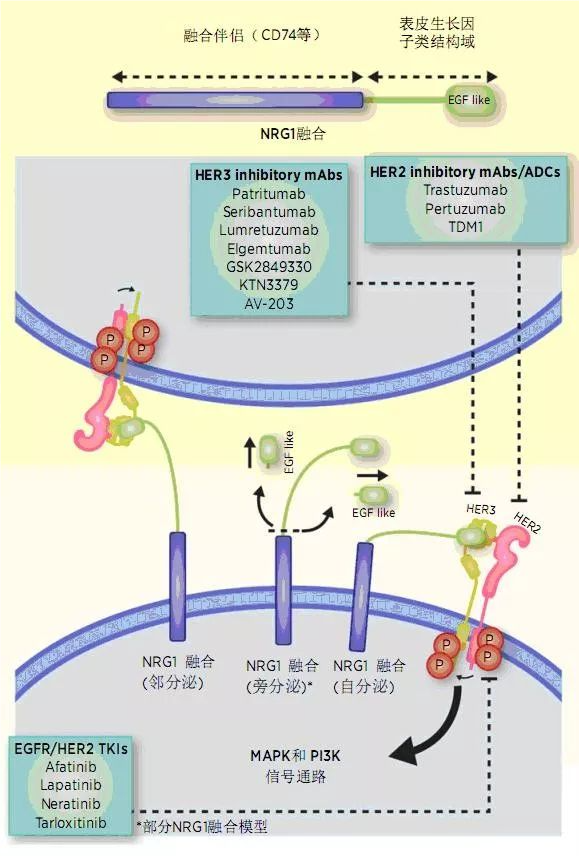
5. Treatment Strategies for NRG1 Fusion NSCLC
At present, the treatment of NRG1 fusion NSCLC is still in the exploratory stage, and existing treatment options are mainly based on HER family targeted drugs and traditional chemotherapy. In terms of targeted therapy, afatinib, as an irreversible pan-HER inhibitor, can simultaneously inhibit the tyrosine kinase activity of EGFR, HER2 and HER4, and is currently the most widely used NRG1 fusion inhibitor in clinical practice. Clinical data show that afatinib can achieve a certain degree of tumor control in the treatment of advanced NRG1 fusion NSCLC, and some patients achieve objective remission, but the overall response rate still needs to be improved, with a median progression-free survival of about 5-6 months. In addition to afatinib, HER3 monoclonal antibodies (such as patritumab) have shown certain therapeutic potential in early clinical trials by blocking the binding of NRG1 to HER3, especially partial remission cases observed in patients with CD74-NRG1 fusion.
Immune checkpoint inhibitors have poor therapeutic effects in NRG1 fusion NSCLC. Clinical studies have shown that both PD-1/PD-L1 monotherapy and chemotherapy combined with immunotherapy have an objective remission rate of 0 in advanced NRG1 fusion patients, suggesting that this subtype of lung cancer may have an immune desert or immune exclusion phenotype, with limited benefits from immunotherapy. In this case, chemotherapy remains the main treatment option for advanced patients, among which pemetrexed combined with platinum-based regimens show relatively better efficacy and can be recommended as first-line treatment. For patients with progression after targeted therapy, second-line chemotherapy drugs such as docetaxel and paclitaxel can also be used for disease control, but the overall prognosis is still not ideal.
With the deepening of research on the mechanism of NRG1 fusion, new therapeutic strategies such as bispecific antibodies and ADC drugs (antibody-drug conjugates) are being evaluated in preclinical or early clinical studies, which are expected to bring new therapeutic hope for patients with NRG1 fusion NSCLC.












 Business license (three certificates in one)