Breast cancer, known as the "number one killer" seriously endangering women's health, has an unoptimistic incidence situation. According to data released by the National Cancer Center in 2018, which was derived from the 2014 data collected by the National Cancer Registration Center in 2017, breast cancer ranked first among female malignant tumor incidences. Globally, the incidence rate of female breast cancer ranks first in both developed and developing countries. In developing countries, the mortality rate of breast cancer ranks 15th, while in developed countries, it ranks 2nd. In China, the incidence rate of female breast cancer in central and eastern regions ranks first. Although the number of cases in western regions is less than that of lung cancer, the incidence rate still ranks first. However, the mortality rate of breast cancer in all regions is generally lower than that of common malignant tumors such as lung cancer and gastric cancer. Due to the rapid urbanization process in eastern regions, affected by factors such as westernization of lifestyle, increased obesity rate, and decreased fertility rate, the burden of breast cancer is relatively heavier.
Whether in top academic journals such as Nature and Science, the annual high-profile ASCO Oncology Congress, or the drug research and development pipelines of major multinational pharmaceutical companies worldwide, research on breast cancer and the clinical progress of therapeutic drugs have always been the focus. Breast cancer is a malignant tumor involving multiple genes and developing in multiple steps. The differences in gene expression profiles make it highly heterogeneous. Patients with the same pathological type and stage have different treatment responses and prognoses. Based on this characteristic of breast cancer in molecular pathways, many potential intervenable targets have been explored, and molecular targeted therapy has thus been more widely promoted in clinical practice. Among numerous targets, poly (ADP-ribose) polymerase (PARP) has attracted much attention in recent years, bringing new hope for breast cancer treatment.
The PARP family consists of 18 subtypes, among which PARP-1 accounts for the largest proportion in the family and undertakes more than 90% of the functions, including mediating DNA repair, regulating cellular energy metabolism, and promoting the transcription of inflammatory genes.
PARP-1 is a nuclear enzyme composed of 1014 amino acid residues with a relative molecular mass of 116 ku, playing a leading role in DNA single-strand repair. It acts like a "sensor" for DNA nicks. When DNA damage occurs, it is quickly activated, recognizes and binds to the DNA break site, preventing recombination and avoiding the action of exonucleases on damaged DNA. After binding to the DNA nick, its catalytic activity increases by 10-500 times. It catalyzes the decomposition of NAD+ into nicotinamide and ADP-ribose through self-glycosylation and the formation of homodimers. Then, using ADP-ribose as a substrate, it causes poly ADP-ribosylation of nuclear receptor proteins (mainly PARP itself) to form linear or straight-chain PARP-1-ADP-ribose polymers. These polymers have many charges and large steric hindrance. On the one hand, they prevent nearby DNA molecules from recombining with damaged DNA; on the other hand, they reduce the affinity of PARP-1 for DNA, prompting PARP-1 to dissociate from the DNA break site, guiding DNA repair enzymes to bind to the DNA nick for damage repair. The PARP-1-ADP-ribose polymers dissociated from DNA are cleaved by poly (ADP-ribose) glycohydrolase (PARG). The ADP-ribose is reused for the synthesis of NAD+ from nicotinamide, and the dissociated PARP-1 regains activity, rebinds to DNA, and participates in the DNA damage repair process cyclically.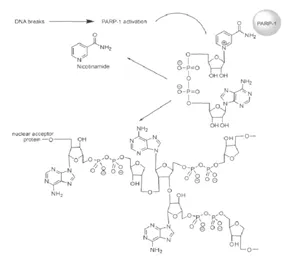
The key mechanism of PARP inhibitors is "synthetic lethality". In normal cells, DNA damage can be repaired through various repair pathways to maintain genomic stability. However, in breast cancer cells carrying BRCA1 or BRCA2 gene mutations, the homologous recombination repair (HRR) function is defective. At this time, cells are more dependent on PARP-mediated DNA single-strand repair. PARP inhibitors bind to the catalytic site of PARP1 or PARP2, preventing PARP proteins from detaching from the DNA damage site, leading to the stalling of DNA replication forks and the blockage of DNA replication. Due to the lack of HRR function, cells cannot effectively repair this damage and eventually die, while normal cells are less affected because of their normal HRR function.
In addition to the synthetic lethality effect, recent studies have found that PARP inhibitors may have other mechanisms of action. For example, studies have shown that PARP inhibitors can block the aggregation of abnormal spindles by inhibiting the synthesis of centrosomal PARP, triggering tumor cell senescence. Research on BRCA1 mutant cell models constructed by CRISPR gene editing technology has shown that PARP inhibitors can inhibit PARP2 activity, reduce the synthesis of centrosomal PARP, disrupt its electrostatic binding with positively charged proteins (such as SFI1 and ZNF721), leading to cell division failure and activating the P53-dependent senescence pathway. It has shown certain efficacy in breast cancer, ovarian cancer, and prostate cancer, providing a new perspective on the mechanism of action of PARP inhibitors.
Olaparib is a new type of poly ADP-ribose polymerase inhibitor, which can preferentially kill cancer cells through defects in the tumor DNA repair pathway. It is a single-agent therapy drug for advanced ovarian cancer related to BRCA gene mutations after chemotherapy and has also shown good prospects in breast cancer treatment. Olaparib developed by AstraZeneca was approved by the European EMA in December 2014, the US FDA in the same month, and the Japanese PMDA in January 2018, with the trade name Lynparza®. Clinical trials in 2024 showed that for high-risk early breast cancer patients with germline BRCA mutation (gBRCAm) and HER2-negative, Lynparza significantly improved the overall survival rate, reducing the risk of death by 28%. The six-year IDFS rate was 79.6% in the Lynparza group and 70.3% in the placebo group, and the DDFS rates were 83.5% and 75.7% respectively, showing good clinical efficacy.
In addition to marketed drugs, many PARP inhibitors are in the research and development stage. For example, Saruparib, a new multi-ADP-ribose polymerase-1 (PARP1) selective inhibitor, showed early efficacy and good safety in the phase I/II PETRA trial in breast cancer patients with homologous recombination repair (HRR) defects, with an objective response rate of 48.8% and a median progression-free survival of 9.1 months. At the same time, researchers are also actively exploring combination therapy regimens of PARP inhibitors. For example, a phase I study of fluzoparib (a new PARP inhibitor) combined with apatinib (an anti-angiogenic drug) in the treatment of advanced ovarian cancer and triple-negative breast cancer showed that in the highest dose level, i.e., the fluzoparib 100mg combined with apatinib 500mg treatment group, the objective response rate (ORR) was 50%. Patients with gBRCA mutations had better ORR and median progression-free survival (PFS) than those with wild-type gBRCA, bringing a new chemotherapy-free treatment direction for patients who cannot tolerate cytotoxic therapy.
Although PARP inhibitors have achieved certain results in breast cancer treatment, drug resistance has gradually become prominent. The main mechanisms of tumor cells developing PARP resistance include BRCA1/2, RAD51C/D reversion mutations; recovery of HRR activity in BRCA1 mutant tumor cells due to 53BP1 and REV7 deletion; PARP1 expression deficiency; pharmacological resistance such as upregulated expression of P-glycoprotein pumps, etc. Solving the problem of drug resistance is the key to further improving the efficacy of PARP inhibitors.
Some PARP inhibitors can cause certain toxicity to healthy cells during treatment, such as affecting rapidly growing healthy cells like hematopoietic stem cells. Studies have found that the tight binding (trapping) of PARP to DNA in PARP therapy leads to the death of both normal and cancer cells, while inhibiting enzymatic activity may be sufficient to kill cancer cells with less toxicity to normal cells. In the future, it is necessary to develop safer PARP inhibitors that inhibit the enzymatic activity of PARP while avoiding trapping it on DNA, improving the safety of treatment.
With the deepening of research, it is necessary to better screen patients who can benefit from PARP inhibitor treatment in the future, and optimize the combination therapy mode of PARP inhibitors by finding appropriate biomarkers. At the same time, designing and synthesizing PARP inhibitors with high subtype selectivity based on the structural differences among PARP family members is expected to further improve the therapeutic effect, bring more survival hope to breast cancer patients, and promote the development of breast cancer treatment towards a more precise and efficient direction.












 Business license (three certificates in one)