




Proteomics: Decoding the Molecular Codebook of TNF - α


Tumor necrosis factor alpha (TNF - α), as a multifunctional cytokine, plays a central role in inflammation, immune regulation, and disease development. The complexity of its functions and the precision of its regulatory network make it a focus of medical research.
- Recent Advances
- Product Information
I. Deciphering TNF-α’s Molecular "Blueprint"
1. Structure and Modifications: The Molecular Basis of Activity
2. Receptor Networks: Gateways to Signal Transduction
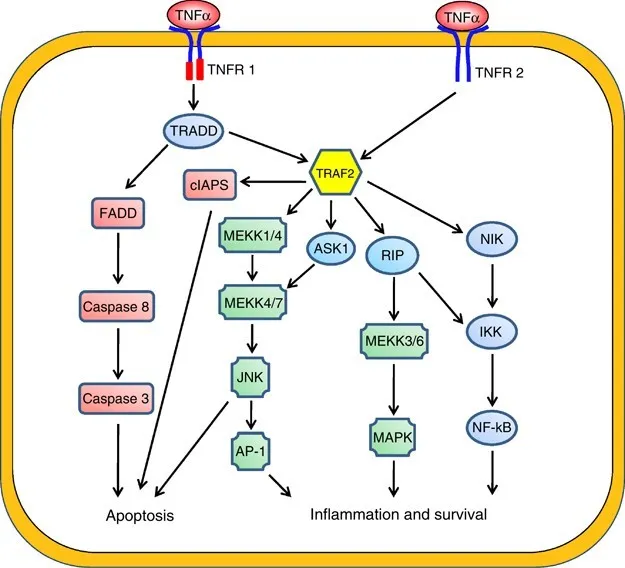
TNFR1, widely expressed, recruits adaptors such as TRADD and FADD upon TNF-α binding, initiating apoptosis or NF-κB-mediated survival signals.
TNFR2, primarily on immune cells, tends to activate NF-κB via TRAF2 to promote cell survival.
II. Tracing TNF-α’s Signaling "Cascade"
1. The NF-κB Pathway: A Master Switch for Inflammation and Survival
2. Apoptosis vs. Survival: The Crossroads of Cell Fate
3. Endocytosis: A Signal Modulator
III. Uncovering Clues for Disease and Therapy
1. Disease Biomarkers: Compasses for Clinical Diagnosis
In RA synovial fluid, TNF-α-upregulated inflammatory factors (e.g., IL-6, MMP-3) and activated complement proteins (e.g., C3) serve as activity markers, with proteins like S100A8/A9 correlating with treatment response.
2. Drug Development: From Mechanism to Clinic
Validating pathway inhibition (e.g., adalimumab downregulates IL-1β and upregulates IL-10 in RA).
Uncovering resistance mechanisms, such as elevated TNFR2 or persistent NF-κB activation.
Identifying novel targets, e.g., TNF-α-induced S100A12 in psoriasis, whose antibodies show anti-inflammatory effects in animal models.
Conclusion
This article is reviewed and published by the technical expert team of UA
Disclaimer: This article partially utilizes artificial intelligence assistance in its creation. If any content involves copyright or intellectual property issues, please let us know and we promise to verify and remove it as soon as possible.
Purchase recombinant protein, choose Nanjing UA-Bio
UA protein focuses on providing various protein reagents, raw materials, and services required for drug research and development, cell therapy, gene therapy, and basic scientific research, including drug target proteins, immune checkpoint proteins, cytokines, tool enzymes, customized protein expression, and full-length transmembrane protein development. Youai is committed to providing customers with high-quality products and professional services, and building a High-tech Biological Enterprise with International Competitiveness.







 Business license (three certificates in one)