Research on vascular endothelial growth factor (VEGF) originated from the "angiogenesis-stimulating factor" hypothesis proposed in 1939. After more than half a century of exploration, its status as a core regulatory factor in angiogenesis has been established. The VEGF family includes VEGFA, VEGFB, VEGFC, VEGFD, VEGFE, and placental growth factor (PGF). Among them, VEGFA has been the most extensively studied. Through alternative gene splicing, it produces subtypes such as VEGF121, VEGF145, and VEGF165, with VEGF165 being the most abundant, possessing both soluble and matrix-binding properties.
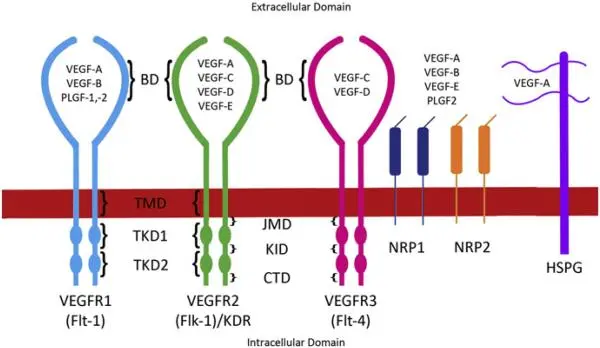
The biological functions of VEGF are exerted through binding to three types of tyrosine kinase receptors: VEGFR-1, VEGFR-2, and VEGFR-3. VEGFR-2 primarily regulates vascular endothelial cell proliferation and vascular permeability, while VEGFR-3 is mainly involved in lymphangiogenesis. Under physiological conditions, VEGF participates in processes such as embryonic development and wound healing, and also has non-angiogenic functions including immune regulation and neuroprotection, making it a key target across multiple disease fields.
Image: VEGF family and its ligands
Most malignant tumors exhibit high VEGF expression. VEGF secreted by tumor cells and stromal cells can stimulate the proliferation of vascular endothelial cells and promote the formation of abnormal new blood vessels. These blood vessels have a disorganized structure and high permeability, not only providing nutrients for tumors but also serving as channels for metastasis. They are directly associated with tumor invasiveness, metastatic capacity, and poor prognosis, thus making VEGF a core target for anti-angiogenic tumor therapy.
Ocular diseases such as age-related macular degeneration and diabetic retinopathy are associated with VEGF overexpression. Abnormally elevated VEGF in the eye induces the formation of retinal neovascularization, which is prone to leakage and bleeding, leading to complications such as macular edema and tractional retinal detachment, resulting in vision loss. Inhibiting VEGF activity can effectively block the growth of new blood vessels, making it an important therapeutic approach for such diseases.
(3) Regulation of the Cardiovascular System
VEGF plays a dual role in cardiovascular diseases: in ischemic heart disease and peripheral arterial disease, increased VEGF expression can promote collateral circulation formation and improve blood perfusion; however, excessive activation may be involved in pathological processes such as atherosclerosis. Precise regulation of VEGF activity has therefore become a potential strategy for the treatment of cardiovascular diseases.
(4) Association with the Nervous System
Recent studies have found that VEGF has neuroprotective effects. In neurodegenerative diseases such as amyotrophic lateral sclerosis (ALS), abnormal VEGF expression may be involved in disease progression, and related clinical trials have explored its potential as a neuroprotective drug.
VEGF-targeted drugs cover various types: Monoclonal antibodies such as bevacizumab block receptor binding by targeting VEGFA and are widely used in the treatment of colorectal cancer, lung cancer, etc.; Small-molecule tyrosine kinase inhibitors (TKIs) such as sunitinib inhibit VEGFR activity and are used in the treatment of renal cell carcinoma, liver cancer, etc.; In the ophthalmology field, ranibizumab and aflibercept have significantly improved vision in patients with neovascular eye diseases; Gene therapy drugs such as Russia’s Neovasculgen, which carries VEGF165 via a plasmid vector, are used to treat peripheral arterial disease.
Bispecific antibodies, by simultaneously targeting VEGF and other targets such as PD-1/PD-L1 and ANG-2, have shown synergistic effects in tumor immunotherapy; Adeno-associated virus (AAV) vector-mediated gene therapy can achieve long-term regulation of VEGF, reducing the frequency of administration and associated risks; mRNA technology enables transient regulation of VEGF expression with both high efficiency and safety; siRNA technology, by silencing VEGF or its receptor genes, has shown therapeutic potential in disease models.
Current VEGF-targeted therapy faces issues such as the short half-life of monoclonal antibodies requiring frequent administration, potential drug resistance and adverse reactions (e.g., hypertension, proteinuria) with long-term use, and poor response in some patients. Researchers are addressing these challenges by developing long-acting formulations, exploring combination therapy regimens, and designing personalized treatment approaches. New drug delivery methods such as ophthalmic gels and microneedle patches have also made progress in improving delivery efficiency and reducing risks.
As a star target, research on VEGF has achieved a complete transformation from basic theory to clinical application, and related drugs have benefited patients in fields such as oncology, ophthalmology, and cardiovascular diseases. With the development of biotechnology, new strategies such as gene therapy, bispecific/trispecific antibodies, and combination therapy continue to emerge. Future efforts will focus on improving treatment specificity, reducing adverse reactions, and achieving precise therapy.
VEGF research not only provides effective means for disease treatment but also establishes a model for biomedical transformation. Its continuous development will offer new ideas for interdisciplinary integration and demonstrate greater value in the era of precision medicine












 Business license (three certificates in one)