




Targeting GPR75: A New Strategy Against Obesity and Diabetes


GPR75 (G protein-coupled receptor 75) is a class A G protein-coupled receptor (GPCR) that has recently garnered significant attention due to its potential role in metabolic and cardiovascular diseases.
- Recent Advances
- Reference
1. GPR75 Signaling Mechanism
GPR75 belongs to the rhodopsin-like GPCR family, with its gene located on human chromosome 2p16.3. The ligand for GPR75 remained unknown until a 2017 study by Garcia et al. identified 20-hydroxyeicosatetraenoic acid (20-HETE) as an activator of GPR75. This activation occurs through the Gαq/11-phospholipase C/protein kinase C (PKC) and c-Src/epidermal growth factor receptor (EGFR) signaling pathways, leading to vascular effects. This discovery marked a significant milestone in the study of cytochrome P450 (CYP) eicosanoids, as it was the first evidence that such eicosanoids function through GPCRs. GPR75 had previously been "deorphanized," with its endogenous ligand identified as the chemokine RANTES (CCL5). Research has shown that activating GPR75 can protect the hippocampus from β-amyloid toxicity and stimulate insulin secretion from pancreatic islet cells.
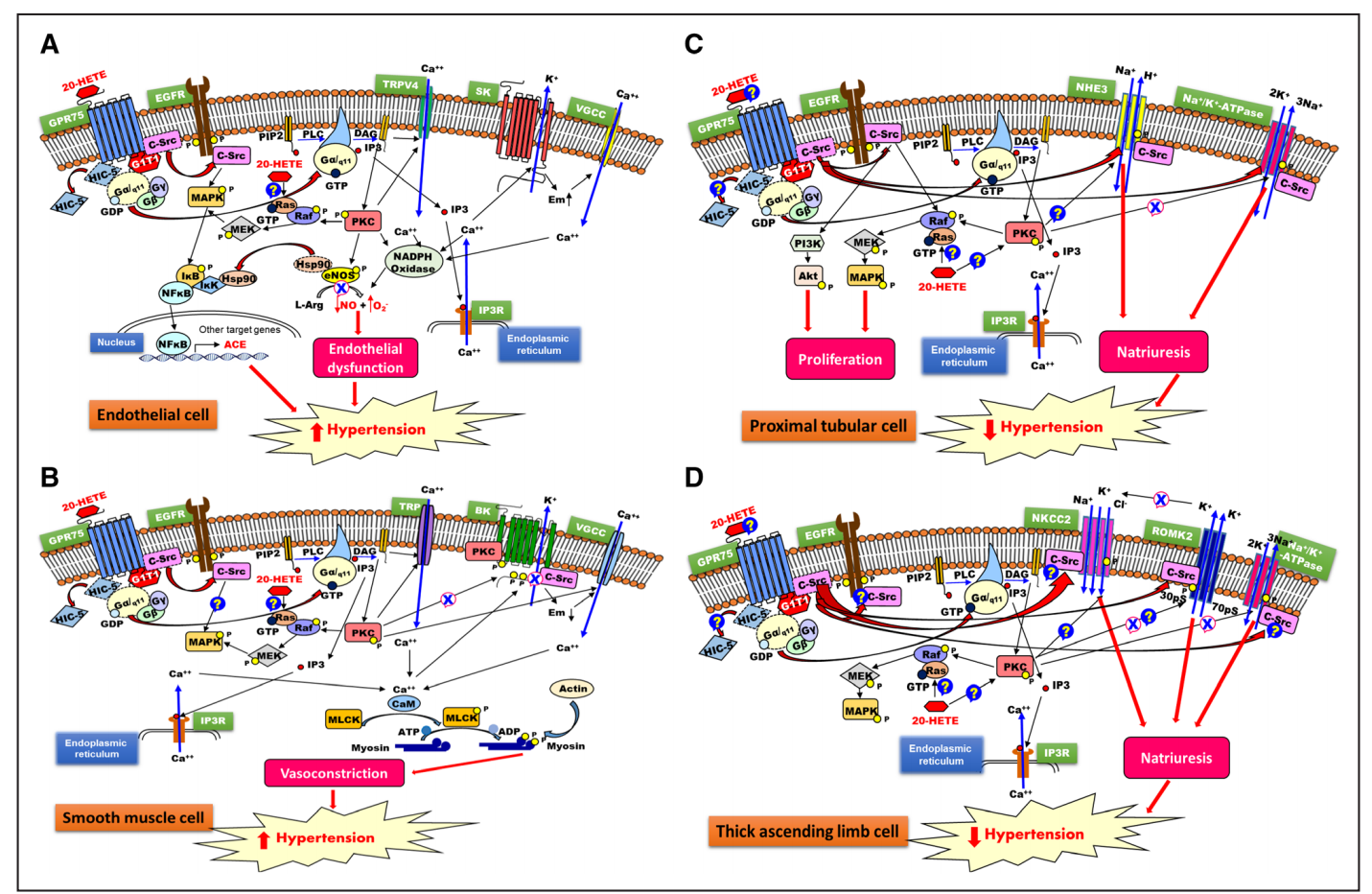
Hypothetical Integration of GPR75 Signaling Pathway in 20-HETE Vascular and Renal Tubular Effects
A. Role of 20-HETE in Endothelial Cells: 20-HETE, through the GPR75 signaling pathway, causes endothelial nitric oxide synthase (eNOS) uncoupling, promoting endothelial dysfunction and increasing angiotensin-converting enzyme (ACE) expression.
Specific mechanisms: eNOS uncoupling: 20-HETE activates GPR75, leading to the generation of diacylglycerol (DAG) and inositol trisphosphate (IP3) via the Gαq/11-phospholipase C (PLC) pathway, which activates PKC. PKC activation results in eNOS uncoupling, reducing nitric oxide (NO) production and causing endothelial dysfunction. Increased ACE expression: 20-HETE activates the nuclear factor κB (NF-κB) signaling pathway through the c-Src/EGFR pathway, increasing ACE expression and further promoting vasoconstriction and elevated blood pressure.
B. Vasoconstrictive Role of 20-HETE in Vascular Smooth Muscle Cells (VSMCs): 20-HETE activates the Gαq/11-PLC pathway through GPR75, increasing intracellular calcium levels and causing vasoconstriction.
Specific mechanisms: PLC activation: Gαq/11 activates PLC, hydrolyzing phosphatidylinositol 4,5-bisphosphate (PIP2) to generate IP3 and DAG. IP3 promotes calcium release from the endoplasmic reticulum, while DAG activates PKC. Increased calcium: Elevated intracellular calcium activates myosin light-chain kinase (MLCK), leading to vascular smooth muscle contraction. Potassium channel inhibition: 20-HETE also inhibits calcium-activated potassium channels (BK channels), further promoting membrane depolarization and increasing calcium influx through voltage-gated calcium channels (VGCCs), enhancing vasoconstriction.
C. Natriuretic Role of 20-HETE in the Proximal Tubule: 20-HETE activates PKC, inhibiting sodium-hydrogen exchanger 3 (NHE3) and Na+/K+-ATPase in the proximal tubule, reducing sodium reabsorption and promoting natriuresis.
Specific mechanisms: NHE3 inhibition: 20-HETE phosphorylates NHE3 via PKC, inhibiting its activity and reducing sodium reabsorption. Na+/K+-ATPase inhibition: 20-HETE phosphorylates Na+/K+-ATPase via PKC, inhibiting its activity and further reducing sodium reabsorption.
D. Natriuretic Role of 20-HETE in the Thick Ascending Limb: 20-HETE inhibits the renal outer medullary potassium channel (ROMK) and Na-K-Cl cotransporter (NKCC), reducing potassium recycling and sodium reabsorption, promoting natriuresis.
Specific mechanisms: ROMK inhibition: 20-HETE phosphorylates ROMK via c-Src, inhibiting its activity and reducing potassium recycling. NKCC inhibition: 20-HETE inhibits NKCC activity via PKC, reducing sodium reabsorption.
2. Role of GPR75 in Diseases
GPR75 is expressed in various tissues, including adipose tissue, liver, skeletal muscle, heart, and blood vessels. Research indicates that GPR75 is involved in regulating energy metabolism, insulin sensitivity, vascular tone, and inflammatory responses.
Role of GPR75 in Metabolic Diseases
Studies suggest that GPR75 plays a significant role in metabolic diseases such as obesity and type 2 diabetes. Animal studies have shown that GPR75 knockout mice exhibit reduced weight gain, decreased adipose tissue inflammation, and improved insulin sensitivity under high-fat diet conditions. Additionally, GPR75 antagonists can ameliorate metabolic abnormalities in obese mice.
Role of GPR75 in Cardiovascular Diseases
GPR75 also plays a crucial role in cardiovascular diseases. The 20-HETE/GPR75 signaling pathway is involved in regulating vascular tone, blood pressure, and vascular remodeling. Research indicates that excessive activation of GPR75 leads to vasoconstriction, elevated blood pressure, and vascular inflammation, promoting the development of cardiovascular diseases such as atherosclerosis and hypertension.
Potential of GPR75 as a Therapeutic Target
Given the significant role of GPR75 in metabolic and cardiovascular diseases, drug development targeting GPR75 holds great promise. Currently, several GPR75 antagonists are in preclinical studies and have shown promising therapeutic effects. For example, GPR75 antagonists can improve metabolic abnormalities in obese mice and reduce the formation of atherosclerotic plaques.
3. Summary and Future Perspectives
GPR75, as an emerging therapeutic target for metabolic and cardiovascular diseases, has garnered increasing attention in recent years. Research indicates that GPR75 plays a crucial role in physiological processes such as energy metabolism, insulin sensitivity, vascular tone, and inflammatory responses. Drug development targeting GPR75 holds promise for providing new treatment strategies for obesity, type 2 diabetes, atherosclerosis, and hypertension. However, further research into the biological functions and signaling pathways of GPR75 is needed to develop safer and more effective GPR75-targeted drugs.
Future Research Directions:
- In-depth study of GPR75 signaling mechanisms and downstream effectors.
- Development of more selective and efficient GPR75 agonists and antagonists.
- Evaluation of the safety and efficacy of GPR75-targeted drugs in clinical settings.
- Exploration of the potential role of GPR75 in other diseases.
With continued research into GPR75, it is believed that GPR75 will become an important target in the treatment of metabolic and cardiovascular diseases, bringing benefits to human health.
This article is reviewed and published by the technical expert team of UA
Disclaimer: This article partially utilizes artificial intelligence assistance in its creation. If any content involves copyright or intellectual property issues, please let us know and we promise to verify and remove it as soon as possible.
Purchase recombinant protein, choose Nanjing UA-Bio
UA protein focuses on providing various protein reagents, raw materials, and services required for drug research and development, cell therapy, gene therapy, and basic scientific research, including drug target proteins, immune checkpoint proteins, cytokines, tool enzymes, customized protein expression, and full-length transmembrane protein development. Youai is committed to providing customers with high-quality products and professional services, and building a High-tech Biological Enterprise with International Competitiveness.

[1] Garcia, V., et al. (2017). 20-HETE signals through GPR75 to promote endothelial dysfunction and hypertension. The Journal of Clinical Investigation, 127(12), 4507-4522.
[2] Zhang, Y., et al. (2019). GPR75 mediates the effects of 20-HETE on adipocyte differentiation and function. Diabetes, 68(5), 1025-1037.
[3] Wang, Y., et al. (2020). Targeting GPR75 for the treatment of obesity and type 2 diabetes. Nature Medicine, 26(12), 1858-1868.
[4] Fan Fan; Richard J. Roman. (2017). GPR75 Identified as the First 20-HETE Receptor. Circulation Research.






 Business license (three certificates in one)