




The role of RSPO3 in angiogenesis


RSPO3 (R-spondin 3) is a key member of the R-spondin protein family. As a multifunctional secreted glycoprotein, its most classic and widely recognized function is as a potent agonist of the classic Wnt/β - catenin signaling pathway. It effectively stabilizes and enhances Wnt signaling by binding to its receptor LRP6 and other receptors.
- Recent Advances
- Product Information
Q: As an important secretory protein, what is the most classic function of RSPO3? How does it affect angiogenesis?
A: RSPO3 (R-spondin 3) is a key member of the R-spondin protein family. As a pluripotent secretory glycoprotein, its most classic and widely recognized function is acting as a potent agonist of the canonical Wnt/β-catenin signaling pathway. It effectively stabilizes and enhances Wnt signal transduction by binding to its receptors, such as LRP6. The direct biological consequence of this process is the promotion of the transcription and expression of vascular endothelial growth factor (VEGF). VEGF is a core regulatory factor of angiogenesis; therefore, RSPO3 significantly promotes the occurrence of neovascularization through this pathway. Simultaneously, studies have also shown that it inhibits hematopoietic cell differentiation during this process. Based on these key functions, RSPO3 has been universally recognized by the scientific community as a core signaling protein regulating embryonic vascular development and pathological angiogenesis.
Q: Beyond the canonical Wnt pathway, does RSPO3 function through other mechanisms? What is the current research bottleneck?
A: Yes, increasing evidence in recent years indicates that the function of RSPO3 is not confined to the Wnt/β-catenin pathway. Multiple studies suggest it can also activate the Akt signaling pathway, and Akt is a core molecule regulating cell survival, proliferation, and metabolism. However, a crucial scientific question follows: what role does Akt signaling play in RSPO3-induced angiogenesis? What are the upstream activation mechanisms and downstream effectors? This question of "how" and "why," i.e., the related molecular mechanisms, remained unclear for a long time, becoming a critical missing piece in understanding the full picture of RSPO3's function.
Q: Gαi proteins are traditionally thought to bind to GPCRs. How are they associated with RSPO3 signaling?
A: This involves a scientific discovery that traditional understanding. Gαi proteins were originally defined as exclusive partners of G protein-coupled receptors (GPCRs). However, prior breakthrough research revealed that the Gαi1/3 subtypes can associate with receptor tyrosine kinases (RTKs) and mediate downstream signal activation. Specifically, under VEGF stimulation, Gαi1/3 promotes the endocytosis of VEGFR2, thereby activating the Akt-mTOR signaling axis and ultimately driving retinal angiogenesis. This not only confirmed that Gαi1/3 is an important signaling node regulating endothelial cell function but also provided us with a novel idea: could RSPO3 also utilize this non-canonical mechanism? In other words, is Gαi1/3 also a bridge for RSPO3 signal transduction?
Q: Do metabolic factors participate in the angiogenesis process mediated by RSPO3 and Gαi proteins?
A: Interestingly, metabolism and angiogenic signaling converge here. Phosphoenolpyruvate carboxykinase 1 (PCK1) is a key rate-limiting enzyme in the gluconeogenesis pathway. Research has found that PCK1 can upregulate the expression level of Gαi3, thereby promoting the activation of Akt-mTOR signaling and demonstrating a crucial role in angiogenesis in both in vitro and in vivo models. This discovery provides a novel regulatory perspective from the angle of "vascular endothelial cell metabolic homeostasis," cleverly linking cellular energy metabolism with the angiogenic signaling network, and also offering potential new for metabolic intervention in treating neovascular eye diseases.
Q: Regarding RSPO3, Gαi proteins, and angiogenesis, is there research directly confirming the mechanistic link between the three?
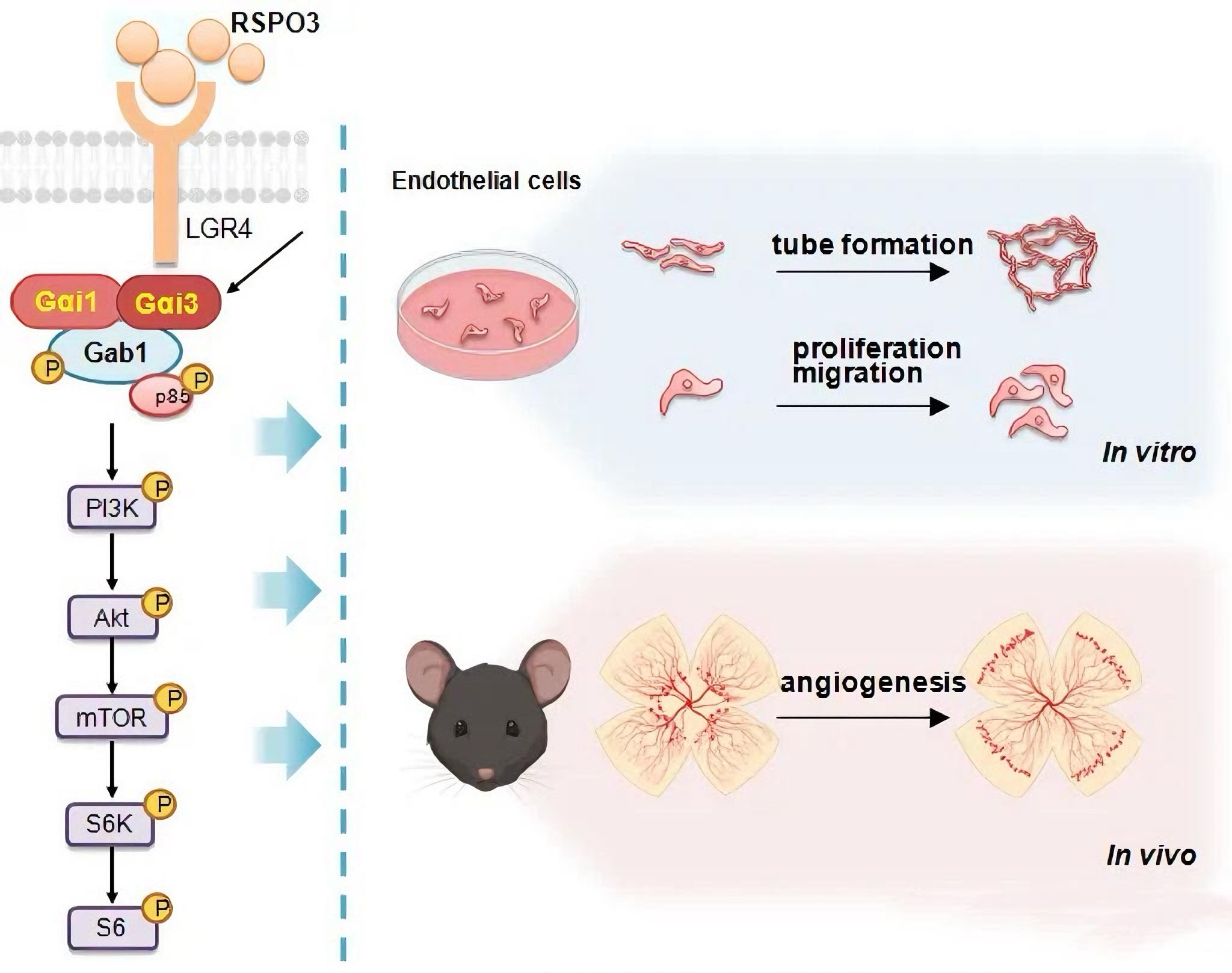
A: Yes, an important study published in Protein & Cell in 2022 clearly answered this question for the first time. This research was completed by a joint team from the Affiliated Eye Hospital of Nanjing Medical University and the Institute of Neuroscience of Soochow University. They discovered a novel signaling mechanism in endothelial cells: RSPO3 can induce its receptor LGR4 to assemble with Gαi1/3 and the scaffolding protein Gab1 into a functional signal complex. The successful assembly of this complex is the critical first step in initiating the downstream Akt-mTOR signaling cascade.
Q: Does this newly discovered signaling mechanism depend on the canonical Wnt pathway of RSPO3?
A: The research provides a very clear answer: no, it does not. This is one of the most novel aspects of this discovery. Experimental evidence showed that silencing Gαi1/3 using shRNA did not affect the accumulation of active β-catenin induced by RSPO3. Conversely, when β-catenin was inhibited, the expression of Gαi1/3 and the activation of Akt-mTOR by RSPO3 remained unaffected. This fully demonstrates that the two pathways are parallel and independent: one is the classic Wnt/β-catenin pathway, and the other is the newly identified LGR4–Gαi1/3–Gab1–Akt-mTOR pathway.
Q: Is Gαi1/3 functionally necessary for the pro-angiogenic effects of RSPO3?
A: Both gain-of-function and loss-of-function experiments provided affirmative evidence. In in vitro experiments, knocking down Gαi1/3 in human umbilical vein endothelial cells (HUVECs) and human cerebral microvascular endothelial cells (HCMEC/D3) significantly inhibited RSPO3-stimulated cell migration, invasion, proliferation, and in vitro vessel formation capabilities. Conversely, ectopic overexpression of Gαi1/3 significantly enhanced these pro-angiogenic effects of RSPO3. In vivo experiments confirmed this conclusion: specifically knocking down Gαi1/3 in mouse endothelial cells effectively impeded RSPO3 overexpression-induced retinal angiogenesis, while overexpressing Gαi1/3 promoted this process.
Q: What is the scientific significance and potential application value of this study's findings?
A: This study is the first to systematically reveal a novel signaling axis independent of Wnt/β-catenin through which RSPO3 promotes angiogenesis, greatly enriching and expanding our understanding of the biological functions of the R-spondin family proteins. More importantly, it re-emphasizes the core role of Gαi1/3 as a key signal integrator in pathological angiogenesis (such as retinopathy and tumor vascularization). This provides new potential targets for future development of innovative therapies for neovascular diseases: meaning one can not only target the VEGF-VEGFR2 axis but also consider intervening in the new RSPO3-Gαi1/3-Akt-mTOR pathway, thereby offering patients more treatment options.
This article is reviewed and published by the technical expert team of UA
Disclaimer: This article partially utilizes artificial intelligence assistance in its creation. If any content involves copyright or intellectual property issues, please let us know and we promise to verify and remove it as soon as possible.
Purchase recombinant protein, choose Nanjing UA-Bio
UA protein focuses on providing various protein reagents, raw materials, and services required for drug research and development, cell therapy, gene therapy, and basic scientific research, including drug target proteins, immune checkpoint proteins, cytokines, tool enzymes, customized protein expression, and full-length transmembrane protein development. Youai is committed to providing customers with high-quality products and professional services, and building a High-tech Biological Enterprise with International Competitiveness.







 Business license (three certificates in one)