




The role of GM-CSF in immune, inflammatory, and therapeutic applications


Granulocyte macrophage colony-stimulating factor (GM-CSF) is a glycoprotein initially identified as a hematopoietic growth factor that promotes the differentiation of bone marrow progenitor cells into granulocytes and macrophages. With the deepening of research, it has been found that its biological function goes far beyond hematopoietic function.
- Recent Advances
- Product Information
Q: What is GM-CSF, and why has it gained renewed attention in biomedical research?
A: Granulocyte-macrophage colony-stimulating factor (GM-CSF) is a glycoprotein initially identified as a hematopoietic growth factor that promotes the differentiation of bone marrow progenitor cells into granulocytes and macrophages. Over time, research has revealed that its biological roles extend far beyond hematopoiesis. The COVID-19 pandemic has reignited interest in GM-CSF among clinical researchers, immunologists, and pharmaceutical developers due to its significant role in inflammatory responses and severe respiratory syndromes.
Q: How does GM-CSF contribute to the maintenance of lung macrophage homeostasis?
A: In healthy individuals, GM-CSF is nearly undetectable in the bloodstream. However, it serves as a crucial homeostatic factor in the alveolar environment. At low physiological levels, GM-CSF supports the development and long-term maintenance of alveolar macrophages, which are essential for lung immunity and surfactant clearance. A deficiency in GM-CSF can lead to pulmonary alveolar proteinosis (PAP), a condition characterized by impaired macrophage function and an increased susceptibility to pulmonary infections. This highlights its non-redundant role in respiratory health.
Q: In what ways does GM-CSF participate in inflammatory processes?
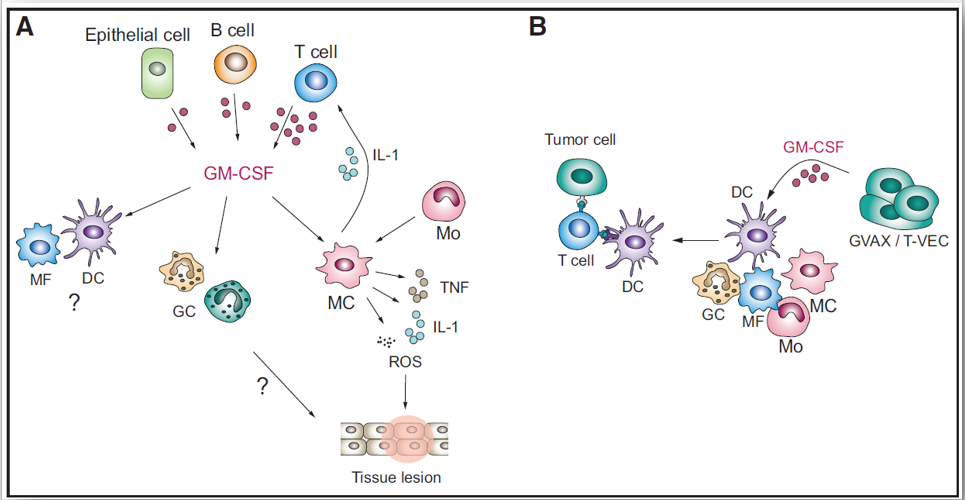
A: GM-CSF is secreted by various cell types, including epithelial cells and specific T-helper (Th) cell subsets. Its receptor is predominantly expressed on myeloid cells. GM-CSF exerts dual functions during immune responses: first, it polarizes mature myeloid cells toward a pro-inflammatory phenotype through autocrine and paracrine signaling; second, it mediates "emergency hematopoiesis" by promoting the differentiation of progenitor cells into myeloid lineages and facilitating their expansion and migration to sites of inflammation. Activated myeloid cells under GM-CSF influence produce reactive oxygen species, express high levels of pro-inflammatory cytokines such as IL-1, IL-6, and TNF, and release chemokines like CCL2 and IL-8, which attract monocytes and neutrophils. GM-CSF-producing CD4+ T cells enhance immune responses by recruiting and activating inflammatory myeloid cells. Some researchers describe GM-CSF as a central communication channel between lymphoid and myeloid cells in inflammation.
Q: How does dysregulated GM-CSF expression contribute to disease?
A: Overexpression or sustained release of GM-CSF can lead to excessive inflammation, pain, tissue damage, and the production of other pathogenic cytokines. The "GM-CSF network" forms a positive feedback loop involving monocytes, macrophages, Th cells, and neighboring stromal or immune cells that mutually secrete GM-CSF and pro-inflammatory mediators. Key cytokines in this network, including IL-1, IL-6, and TNF, have been successfully targeted in treating various inflammatory diseases. Aberrant GM-CSF signaling is implicated in a range of conditions, such as acute respiratory distress syndrome (ARDS) in COVID-19, cytokine release syndrome (CRS), hemophagocytic lymphohistiocytosis (HLH), graft-versus-host disease (GVHD), and certain cardiovascular disorders. Additionally, GM-CSF-producing Th cells have been identified as key players in multiple autoimmune diseases.
Q: What is the role of GM-CSF in severe COVID-19 manifestations?
A: Approximately 20% of COVID-19 patients develop severe complications like ARDS, often associated with a cytokine storm. Elevated GM-CSF levels contribute significantly to this hyperinflammatory state by promoting massive infiltration of inflammatory myeloid cells—particularly monocytes, macrophages, and neutrophils—into the lungs. This pathological process resembles macrophage activation syndrome and leads to widespread tissue damage and respiratory failure. Targeting GM-CSF has thus emerged as a potential therapeutic strategy in mitigating severe COVID-19 outcomes.

Q: What antibody-based therapies target GM-CSF, and what are their applications?
A: Several monoclonal antibodies against GM-CSF or its receptor have been developed to modulate inflammatory pathways. These biologics aim to interrupt the GM-CSF-mediated amplification of inflammation in autoimmune and hyperinflammatory diseases. For instance, anti-GM-CSF antibodies are being evaluated in clinical trials for conditions such rheumatoid arthritis, inflammatory lung diseases, and cytokine-driven syndromes like CRS and HLH. By selectively inhibiting GM-CSF, these therapeutics offer a promising approach to control excessive immune activation while preserving homeostatic functions.
This article is reviewed and published by the technical expert team of UA
Disclaimer: This article partially utilizes artificial intelligence assistance in its creation. If any content involves copyright or intellectual property issues, please let us know and we promise to verify and remove it as soon as possible.
Purchase recombinant protein, choose Nanjing UA-Bio
UA protein focuses on providing various protein reagents, raw materials, and services required for drug research and development, cell therapy, gene therapy, and basic scientific research, including drug target proteins, immune checkpoint proteins, cytokines, tool enzymes, customized protein expression, and full-length transmembrane protein development. Youai is committed to providing customers with high-quality products and professional services, and building a High-tech Biological Enterprise with International Competitiveness.







 Business license (three certificates in one)