




IL-17RA: Key Role from Molecular Mechanisms to Targeted Therapy


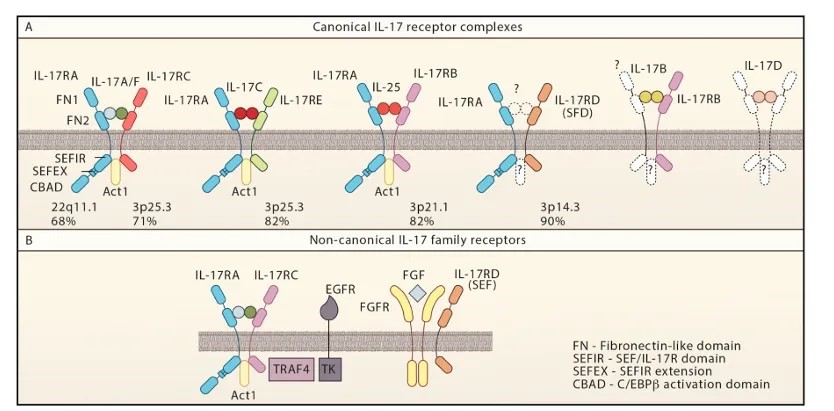
IL-17RA is one of the most important and widely functional members of the IL-17 receptor family. It is defined as a "shared receptor" because it not only participates in IL-17A signaling, but also combines with other receptor subunits such as IL-17RC and IL-17RB to mediate the biological effects of different cytokines such as IL-17F and IL-17E (IL-25).
- Recent Advances
- Product Information
Q: What is the role of IL-17RA in the IL-17 signaling system?
A: IL-17RA is one of the most important and functionally versatile members of the IL-17 receptor family. It is defined as a "shared receptor" because it not only participates in IL-17A signaling but can also combine with other receptor subunits such as IL-17RC and IL-17RB to mediate the biological effects of different cytokines including IL-17F and IL-17E (IL-25). IL-17RA is widely expressed in all hematopoietic cells and epithelial cells. Its intracellular segment contains a conserved SEFIR domain, which shares homology with the TIR domain in Toll-like receptor signaling and serves as a key foundation for the assembly of downstream signaling complexes. Studies have shown that IL-17RA has a much higher affinity for IL-17A than for IL-17F, which partly explains the significant difference in their inflammatory intensities.
Q: How does IL-17RA initiate downstream signaling pathways?
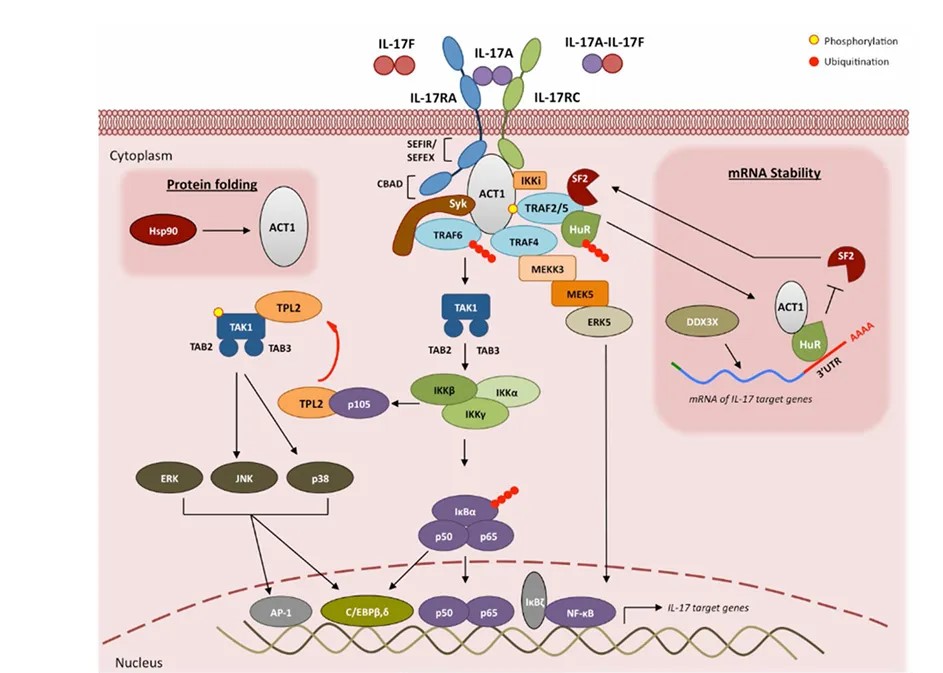
A: When IL-17A binds to IL-17RA and its partner receptors (such as IL-17RC), the receptors undergo conformational changes and dimerize. This recruits the adaptor protein Act1 (also known as CIKS) via the intracellular SEFIR domain. Act1 acts as a critical signaling hub, functioning as an E3 ubiquitin ligase that mediates K63-linked ubiquitination of TRAF6, thereby activating the TAK1 and IKK kinase complexes. The activated IKK then phosphorylates IκBα, leading to the release and nuclear translocation of NF-κB, which initiates the transcription of various pro-inflammatory genes including IL-6, IL-8, CXCL1, and CCL20. Additionally, IL-17RA signaling can amplify inflammatory responses through the MAPK pathways (such as p38, JNK, and ERK) and members of the C/EBP transcription factor family.
Q: Are there precise negative regulatory mechanisms for IL-17RA-mediated signaling?
A: Yes, to prevent excessive inflammation and tissue damage, the body has evolved multi-layered negative feedback mechanisms to finely regulate IL-17RA signaling. For example, deubiquitinating enzymes such as A20 (TNFAIP3) and USP25 can remove ubiquitin chains from TRAF6, thereby inhibiting NF-κB activation. At the receptor level, TRAF3 and TRAF4 can competitively bind to Act1 or specific domains of IL-17RA, interfering with the formation of signaling complexes. Furthermore, the RNA degradation enzyme MCPIP1 (encoded by Zc3h12a) can limit inflammatory amplification by degrading mRNA of IL-17 target genes. Under sustained stimulation, the E3 ubiquitin ligase β-TrCP can mediate K48-linked ubiquitination and proteasomal degradation of Act1, thereby terminating signal transduction.
Q: How does IL-17RA function in different tissue microenvironments?
A: The function of IL-17RA is highly context-dependent and varies across tissues. In joint synovial tissues, IL-17RA synergizes with TNF receptor signaling to significantly enhance osteoclast differentiation and the expression of matrix metalloproteinases, leading to joint erosion. Thus, it plays a destructive role in rheumatoid arthritis (RA) and psoriatic arthritis (PsA). Conversely, at entheseal sites in ankylosing spondylitis (AS), activation of IL-17RA promotes heterotopic ossification. In barrier tissues such as the skin and intestine, IL-17RA signaling is essential for maintaining epithelial barrier integrity, inducing antimicrobial peptide expression, and recruiting neutrophils to control microbial infections. However, dysregulation of this function can lead to pathological conditions such as psoriasis or inflammatory bowel disease.
Q: What are the therapeutic strategies targeting IL-17RA, and how effective are they clinically?
A: Currently, monoclonal antibodies directly targeting IL-17RA are used in clinical practice. Brodalumab is a human anti-IL-17RA monoclonal antibody that broadly inhibits IL-17 signaling by blocking the binding of IL-17A, IL-17F, and IL-17E to their receptors. It has been approved for the treatment of moderate-to-severe plaque psoriasis, psoriatic arthritis, and ankylosing spondylitis. Clinical studies have shown that even patients who respond poorly to anti-IL-17A antibodies (such as secukinumab) can experience significant improvement in skin and joint symptoms with brodalumab, highlighting the broad inhibitory effect of receptor-level blockade. Additionally, indirect targeting strategies, such as anti-IL-23 drugs that reduce IL-17 cytokine production by inhibiting Th17 cell differentiation, also attenuate IL-17RA activation at the source.
Q: What clinical challenges are associated with targeting IL-17RA?
A: Although targeting IL-17RA has shown significant efficacy, several challenges remain. The primary issue is response heterogeneity, particularly in rheumatoid arthritis patients, where response rates are relatively low, possibly due to genetic background and disease heterogeneity. Secondly, because IL-17RA plays a key role in mucosal host defense, pharmacological inhibition may increase the risk of Candida infections, with an incidence rate of approximately 2%–4%. Most notably, the use of IL-17RA inhibitors in Crohn's disease patients may exacerbate the condition, reflecting the indispensable role of this pathway in intestinal barrier protection. Therefore, careful patient selection and the development of tissue-specific targeting strategies are essential in clinical practice.
Q: What are important future research directions for IL-17RA?
A: Researchers are expanding the scientific and clinical frontiers related to IL-17RA from multiple perspectives. On one hand, tissue-specific delivery technologies are being explored to achieve local immune modulation and reduce systemic side effects. On the other hand, developing small-molecule inhibitors targeting downstream signaling components (such as Act1, TRAF6, or MCPIP1) may offer new therapeutic options. Additionally, elucidating the crosstalk between IL-17RA and other signaling pathways (such as TNF and IL-23), as well as the synergistic or antagonistic mechanisms among different receptor members, will contribute to the design of more effective combination therapies. The ultimate goal is to achieve personalized treatment based on patient genetic background, microbiome characteristics, and disease molecular phenotypes.
This article is reviewed and published by the technical expert team of UA
Disclaimer: This article partially utilizes artificial intelligence assistance in its creation. If any content involves copyright or intellectual property issues, please let us know and we promise to verify and remove it as soon as possible.
Purchase recombinant protein, choose Nanjing UA-Bio
UA protein focuses on providing various protein reagents, raw materials, and services required for drug research and development, cell therapy, gene therapy, and basic scientific research, including drug target proteins, immune checkpoint proteins, cytokines, tool enzymes, customized protein expression, and full-length transmembrane protein development. Youai is committed to providing customers with high-quality products and professional services, and building a High-tech Biological Enterprise with International Competitiveness.







 Business license (three certificates in one)