




TNFR-1/CD10a: Key receptors from inflammatory signaling to targeted therapy


TNFR-1, Also known as CD120a or TNFRSF1A, it is a member of the tumor necrosis factor receptor superfamily, primarily responsible for mediating the biological functions of TNF - α. As a type I transmembrane protein widely expressed on various cell surfaces, TNFR-1 plays a central role in key immune processes such as inflammation, cell survival, and programmed cell death.
- Recent Advances
- Product Information
Ask: What is TNFR-1 (CD120a), and what role does it play in the immune system?
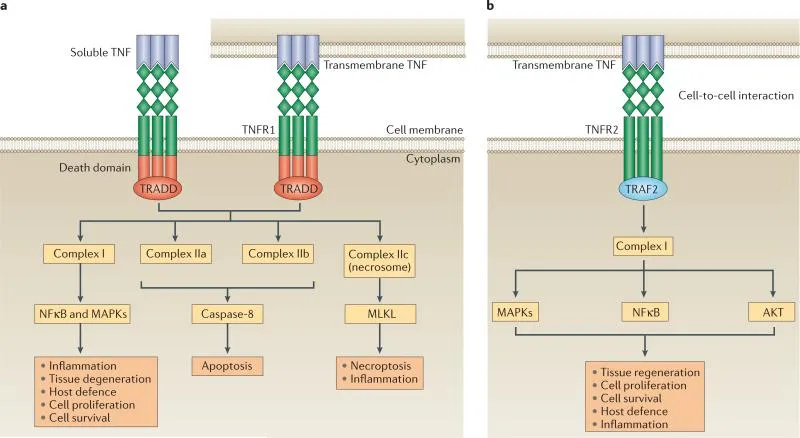
TNFR-1, also known as CD120a or TNFRSF1A, is a member of the tumor necrosis factor receptor superfamily and is primarily responsible for mediating the biological functions of TNF-α. As a type I transmembrane protein widely expressed on the surface of various cells, TNFR-1 plays a central role in key immune processes such as inflammatory responses, cell survival, and programmed cell death. Unlike its homologous receptor TNFR-2 (CD120b), TNFR-1 contains an intracellular "death domain," which enables it not only to initiate pro-inflammatory signals but also to directly induce apoptosis and necroptosis.
Ask: How is TNFR-1 activated, and how does it transmit downstream signals?
When soluble or transmembrane forms of TNF-α bind to TNFR-1, the receptor undergoes trimerization and recruits various adapter proteins, such as TRADD (TNFR1-associated death domain protein), TRAF2, and RIPK1, collectively assembling into a membrane-associated signaling complex (Complex I). This complex can activate the NF-κB and MAPK pathways, promoting the expression of inflammatory factors (e.g., IL-6, IL-8) and cell survival. Under specific conditions, such as when NF-κB signaling is inhibited or RIPK1 becomes deubiquitinated, TNFR-1 can also form intracellular Complex IIa, IIb, or IIc, initiating caspase-8-mediated apoptosis or RIPK3/MLKL-dependent necroptosis.
Ask: What important role does TNFR-1 signaling play in disease development?
Dysregulation of the TNFR-1 signaling pathway is closely associated with various autoimmune diseases and chronic inflammatory conditions. For example, in rheumatoid arthritis (RA), persistent TNFR-1 activation leads to inflammatory cell infiltration in synovial tissues, osteoclast activation, and joint destruction. In inflammatory bowel disease (IBD), this pathway exacerbates intestinal mucosal barrier damage and tissue fibrosis. Additionally, TNFR-1 is involved in neuroinflammation and pain sensitization processes, and its role in neurodegenerative diseases such as Alzheimer's disease and multiple sclerosis has also attracted significant attention.
Ask: What therapeutic strategies currently target TNFR-1 or TNF-α?
Current clinical approaches primarily use TNF-α-neutralizing biologics to indirectly inhibit TNFR-1 signaling, such as adalimumab (Humira) and infliximab (Remicade). These drugs effectively reduce inflammation and improve conditions by blocking the binding of TNF-α to TNFR-1, and they are widely used in the treatment of rheumatoid arthritis, psoriasis, and Crohn's disease. It is worth noting that since TNFR-2 typically exerts anti-inflammatory and tissue repair functions, completely inhibiting TNF may affect its beneficial effects. Therefore, next-generation drug development is focusing on creating antagonists that specifically target TNFR-1 rather than TNFR-2, aiming to achieve more precise immune regulation.
Ask: What challenges does targeting TNFR-1 therapy face?
Although anti-TNF therapies have shown significant efficacy, some patients still experience poor responses or develop drug resistance. Additionally, systemic blockade of TNF signaling may increase the risk of infections (e.g., tuberculosis recurrence), trigger autoimmune reactions, or exacerbate heart failure. Due to the complex functions of TNFR-1 in different tissues and pathological states, the cell death programs it mediates can be protective in certain contexts (e.g., anti-tumor immunity). Therefore, comprehensive inhibition of this pathway may lead to unexpected adverse effects. Researchers are exploring tissue-specific delivery technologies, combination drug strategies, and novel small-molecule inhibitors targeting downstream signaling molecules (e.g., RIPK1, caspase-8) to improve treatment safety and efficacy.
Ask: What emerging research directions are there for TNFR-1 in future therapies?
Current research is not limited to traditional antibody drugs, and more innovative strategies are emerging. For example, bispecific antibodies are being developed to simultaneously block TNF-α and other inflammatory factors (e.g., IL-17 or IL-23). Receptor domain-selective antibodies are also being designed to precisely regulate the balance between NF-κB and cell death signaling. Additionally, gene editing technologies are being explored to modulate TNFR-1 expression. Furthermore, since TNFR-1 may mediate immune suppression in the tumor microenvironment, combination therapies involving TNFR-1 antagonists and immune checkpoint inhibitors (e.g., anti-PD-1 antibodies) are being evaluated in multiple clinical trials.
This article is reviewed and published by the technical expert team of UA
Disclaimer: This article partially utilizes artificial intelligence assistance in its creation. If any content involves copyright or intellectual property issues, please let us know and we promise to verify and remove it as soon as possible.
Purchase recombinant protein, choose Nanjing UA-Bio
UA protein focuses on providing various protein reagents, raw materials, and services required for drug research and development, cell therapy, gene therapy, and basic scientific research, including drug target proteins, immune checkpoint proteins, cytokines, tool enzymes, customized protein expression, and full-length transmembrane protein development. Youai is committed to providing customers with high-quality products and professional services, and building a High-tech Biological Enterprise with International Competitiveness.







 Business license (three certificates in one)