




Utilizing NK cell activation: targeting the NKG2D/CD314 pathway


NKG2D is a key receptor that activates the anti-tumor response of NK cells. Although tumors have evolved mechanisms to evade this pathway, new therapeutic strategies are emerging to restore and utilize NKG2D signaling.
- Recent Advances
- Product Information
How have immune checkpoint inhibitors (ICIs) changed cancer treatment, and what challenges remain to be resolved?
ICIs have revolutionized the field of immuno-oncology, enabling some cancer patients to achieve durable immune control. However, due to tumor immune escape mechanisms, many patients still do not benefit from them. Overcoming these limitations requires innovative combination treatment strategies to enhance anti-tumor immunity or target immune escape pathways in the tumor microenvironment (TME). Natural killer (NK) cells, as emerging key players in this effort, are increasingly gaining attention due to their potent anti-tumor capabilities. One of the most promising directions is targeting the NKG2D receptor (also known as CD314) and its ligands—a pathway central to NK cell activation and tumor recognition.
Why are NK cells at the forefront of immuno-oncology?
NK cells are innate immune effector cells that play a critical role in recognizing and eliminating malignant cells. Unlike T cells, NK cells can recognize threats without prior sensitization. Their activity is regulated by the balance of activating and inhibitory receptor signals. In recent years, NK cells have gradually become a focus of immunotherapy research. Multiple strategies, such as monoclonal antibodies, adoptive NK cell transplantation, and chimeric antigen receptor NK (CAR-NK) cells, are being developed to maximize their anti-tumor potential.
Notably, CAR-NK cells offer several advantages over CAR-T cells, including a shorter lifespan that reduces off-target effects and a different cytokine secretion profile (e.g., producing IFN-γ and GM-CSF without triggering severe cytokine storms). However, their efficacy in solid tumors remains limited, primarily due to the immunosuppressive TME and poor infiltration of NK cells into tumors. Therefore, combining NK cell-based therapies with other agents may be key to unlocking their full potential.
What is the NKG2D receptor, and how does it function?
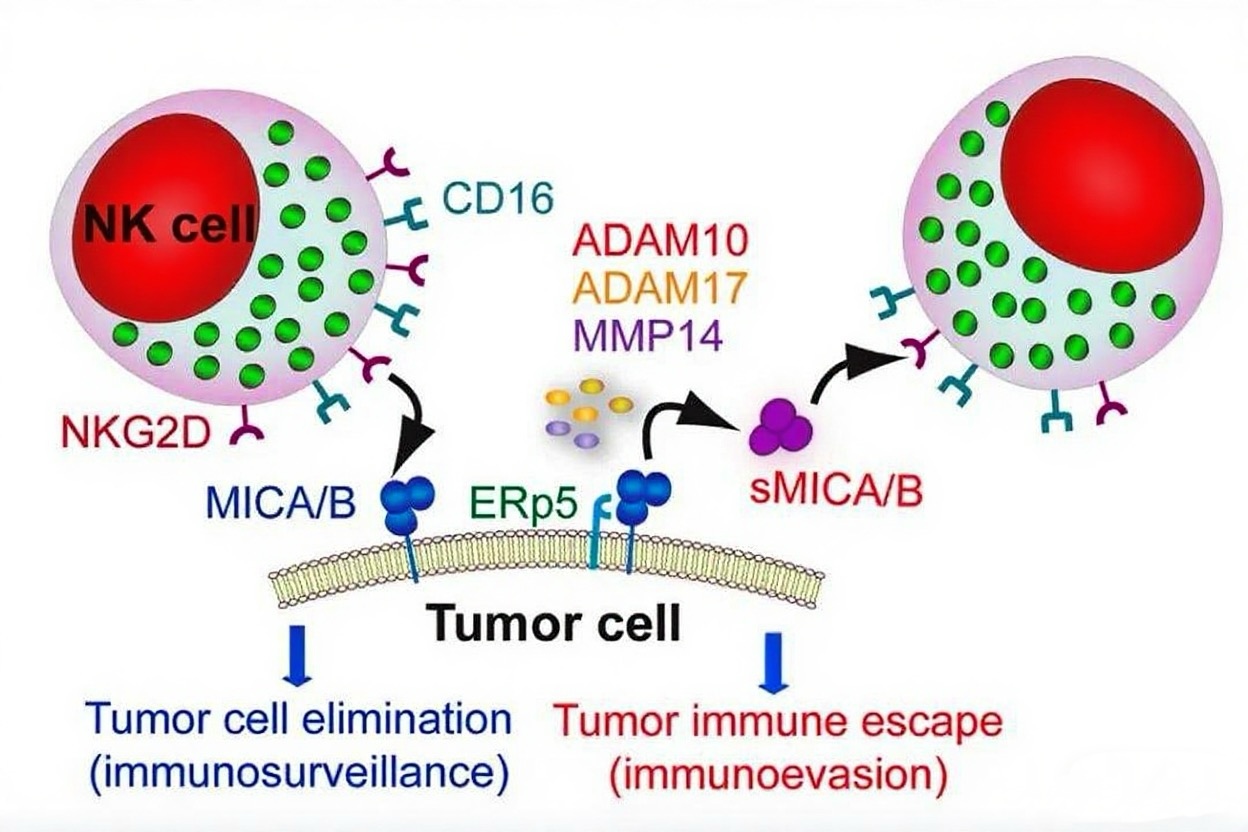
NKG2D (CD314) is one of the most important activating receptors on NK cells. It recognizes eight stress-induced ligands, collectively known as NKG2D ligands (NKG2DLs), including MHC class I chain-related proteins A and B (MICA and MICB) and UL16-binding proteins (ULBPs). In healthy tissues, NKG2DL expression is minimal, but it is significantly upregulated in damaged, infected, or transformed cells. When NKG2D binds to these ligands, it triggers NK cell cytotoxicity and cytokine production, leading to the elimination of abnormal cells.
The genes encoding MICA and MICB are highly polymorphic, and their variations can affect ligand stability, surface expression, and interaction with NKG2D. Unfortunately, tumors often exploit this pathway for immune escape. For example, metalloproteinases (MMPs) in the TME can cleave MICA/B on the tumor surface, producing soluble forms (sMICA/sMICB). These soluble ligands downregulate NKG2D on NK cells, thereby suppressing their responsiveness.
How does the tumor microenvironment suppress NK cell activity?
The TME poses multiple challenges to NK cell efficacy. For instance, TGF-β, a major immunosuppressive cytokine, negatively regulates NKG2D and other activating receptors (such as NKp30 and NKp46). It also impairs NK cell metabolism, reducing glycolysis and oxidative phosphorylation, which are critical for effector functions. Additionally, prolonged NKG2D stimulation may lead to receptor downregulation and NK cell exhaustion.
Tumor-associated macrophages (TAMs) further exacerbate immunosuppression by producing anti-inflammatory cytokines and inhibiting NK cell activity. Other inhibitory receptors expressed on NK cells—such as TIGIT, CD96, NKG2A, TIM-3, and LAG-3—also act as immune checkpoints and represent potential targets for restoring NK cell function. For example, blocking TIGIT or NKG2A has been shown to enhance NK cell activity and improve responses to ICIs.
What therapeutic strategies target the NKG2D–NKG2DL axis?
Several innovative approaches are being developed to leverage the NKG2D pathway:
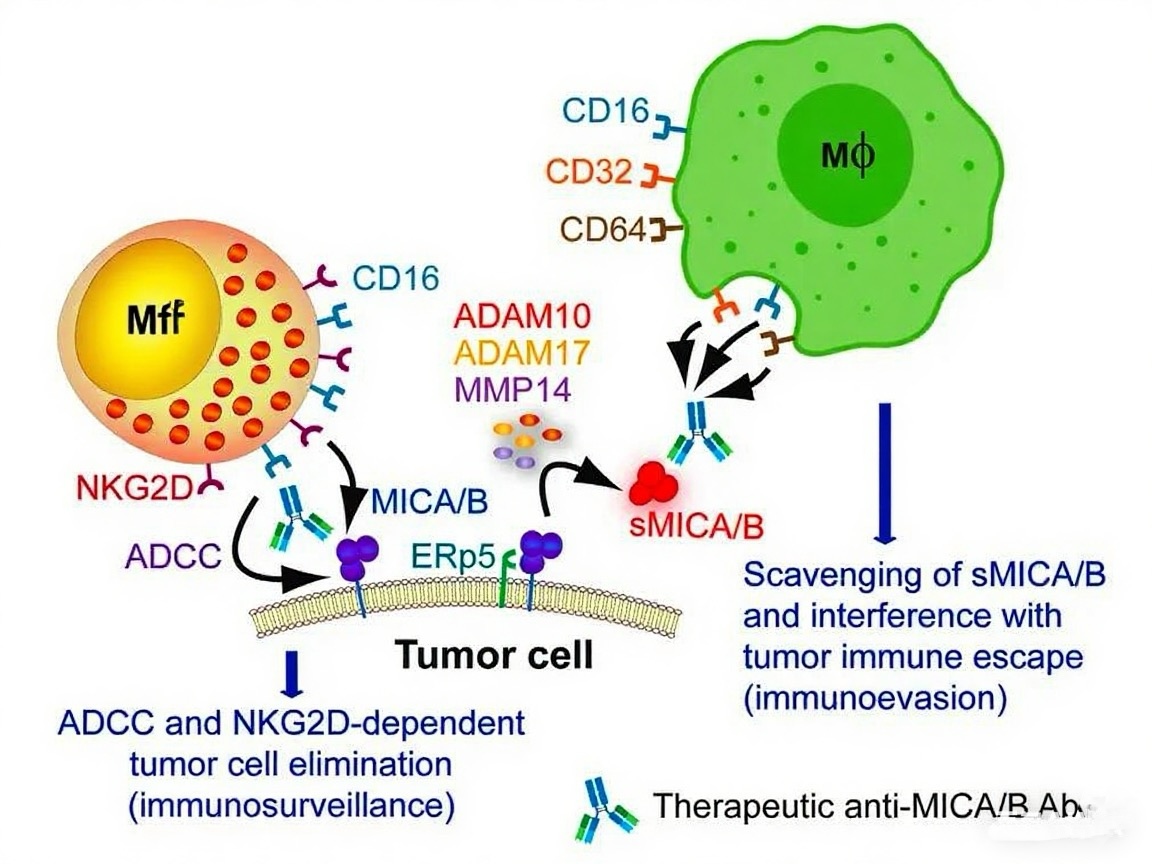
Antibodies targeting MICA/B: Monoclonal antibodies that bind to MICA/B can prevent proteolytic shedding, stabilize ligand expression on tumor cells, and promote antibody-dependent cellular cytotoxicity (ADCC). For instance, the antibody 7C6 inhibits MICA/B shedding and synergizes with histone deacetylase inhibitors (HDACis) to enhance NK cell killing.
Vaccines inducing anti-MICA/B immunity: Vaccines such as BLS-MICA fuse the extracellular domain of MICA with bacterial immunogens, inducing high-titer antibodies that clear soluble MICA and promote cross-presentation by dendritic cells.
NKG2D-engineered CAR-NK and CAR-T cells: Chimeric receptor cells incorporating NKG2D domains have shown enhanced effector functions in preclinical models. Early clinical data in colon cancer patients suggest that NKG2D-based CAR-NK cells can mediate tumor regression.
Combination therapy strategies:
Epigenetic modulators: HDAC inhibitors like vorinostat upregulate MICA/B expression on tumor cells.
PARP inhibitors: PARP inhibitors such as olaparib induce NKG2DL expression and enhance NK cell sensitivity.
STING agonists: Activation of the STING pathway promotes inflammatory signaling and upregulation of NKG2DL.
Immunogenic cell death (ICD) inducers: Chemotherapeutic agents like anthracyclines enhance tumor immunogenicity and promote NK cell recruitment.
What is the future of NKG2D-targeted therapy?
Future efforts should focus on optimizing combination strategies to counteract TME suppression and enhance NK cell infiltration and persistence. Novel agents—such as compounds targeting TAMs, MMP inhibitors, and next-generation CAR-NK designs—hold great promise. Additionally, biomarkers such as soluble MICA levels or NKG2D expression on immune cells may help identify patients most likely to benefit from these treatments.
Conclusion
NKG2D is a key receptor for activating NK cell anti-tumor responses. Although tumors have evolved mechanisms to evade this pathway, new therapeutic strategies are emerging to restore and leverage NKG2D signaling. By combining NKG2D-targeting agents with immunomodulators, epigenetic drugs, or cell therapies, it may be possible to overcome immune resistance and transform "cold" tumors into "hot" tumors susceptible to immune attack. The future of NK cell immunotherapy lies in integrated approaches that fully harness the potential of this powerful receptor-ligand system.
This article is reviewed and published by the technical expert team of UA
Disclaimer: This article partially utilizes artificial intelligence assistance in its creation. If any content involves copyright or intellectual property issues, please let us know and we promise to verify and remove it as soon as possible.
Purchase recombinant protein, choose Nanjing UA-Bio
UA protein focuses on providing various protein reagents, raw materials, and services required for drug research and development, cell therapy, gene therapy, and basic scientific research, including drug target proteins, immune checkpoint proteins, cytokines, tool enzymes, customized protein expression, and full-length transmembrane protein development. Youai is committed to providing customers with high-quality products and professional services, and building a High-tech Biological Enterprise with International Competitiveness.







 Business license (three certificates in one)