




IL-7: The Immune System’s “Survival Signal” — Guardian of Health or Trigger of Disease?


IL-7 is a soluble secreted protein encoded by the IL7 gene, with a molecular weight of approximately 25 kDa.
- Recent Advances
- Product Information
- Reference
1. What is IL-7?
IL-7 is a soluble secreted protein encoded by the IL7 gene, with a molecular weight of approximately 25 kDa. Its receptor, IL-7R, is a heterodimeric complex composed of an IL-7Rα chain and the common gamma chain (γc), the latter of which is also shared by receptors for other interleukins such as IL-2, IL-4, IL-9, IL-15, and IL-21. The IL-7/IL-7R-mediated signaling pathway plays a central role in T cell development, B cell generation (particularly in mice), naïve T cell differentiation and survival, and the generation and maintenance of memory T cells. With the discovery of more members of the innate lymphoid cell (ILC) family, IL-7 has been shown to be critical for the development and homeostasis of multiple ILC subsets, the formation of lymphoid structures, and the regulation of barrier immunity. Additionally, this pathway is widely involved in the pathogenesis of various lymphoid dysfunction-related diseases. This article systematically reviews the physiological and pathological functions of IL-7/IL-7R signaling and explores the potential and prospects of targeting this pathway for disease treatment.
2. In Which Tissues and Cells Are IL-7 and Its Receptor Expressed?
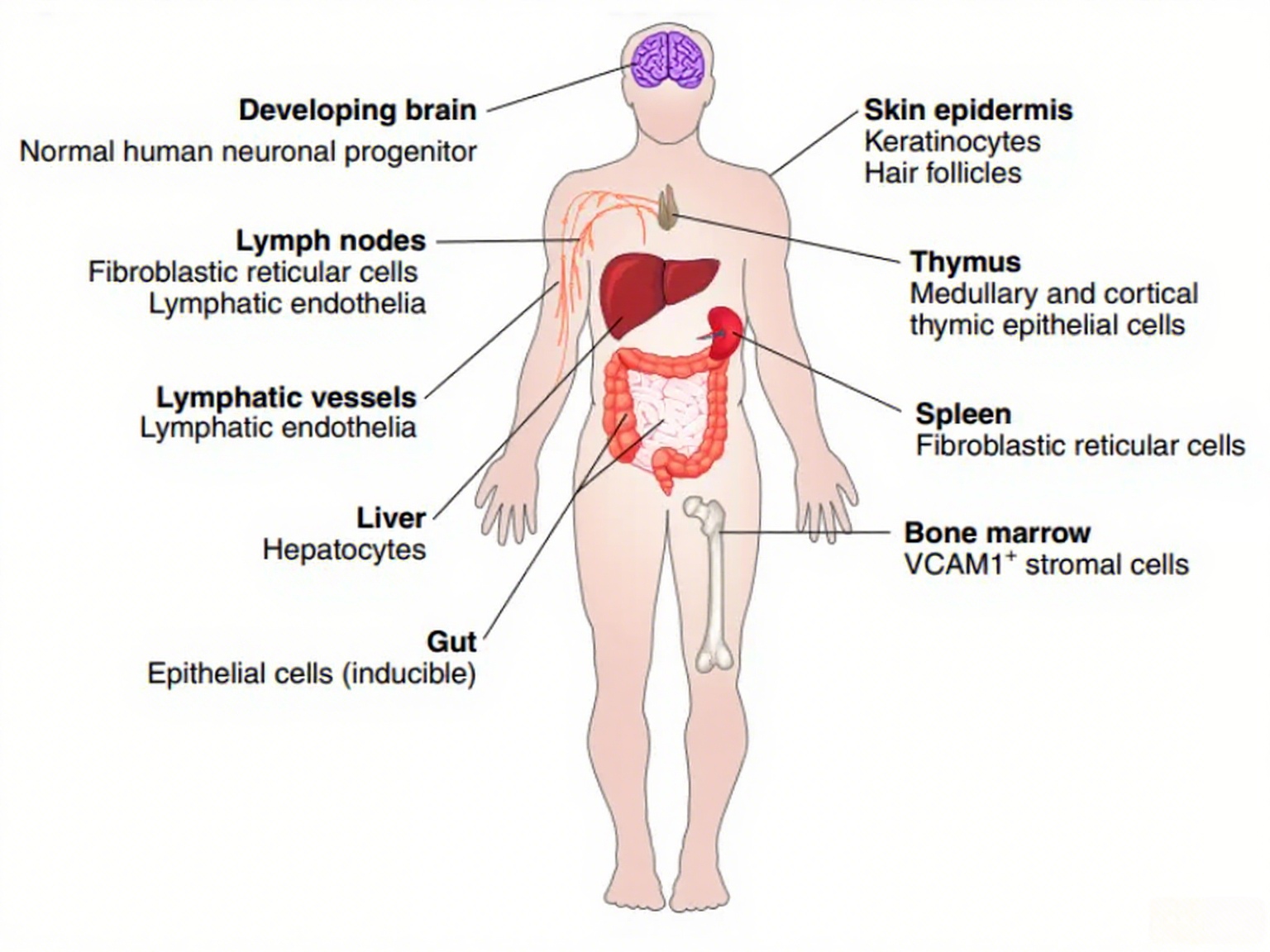
IL-7 mRNA was initially discovered in the thymus, and subsequent studies have confirmed its broad expression across various tissues. The highest expression levels are observed in lymphoid organs such as the thymus and lymph nodes, while significant expression is also detected in non-lymphoid tissues including the intestine, lung, liver, and skin.
In terms of cellular sources, IL-7 is primarily derived from non-hematopoietic cells. Thymic epithelial cells (TECs) and fibroblastic reticular cells (FRCs) are major producers of IL-7 in lymph nodes. Keratinocytes in the skin constitutively express IL-7, and its expression in intestinal epithelial cells can be induced by IFN-γ signaling. Additionally, neuronal precursor cells in the brain have been reported to produce IL-7.
IL-7Rα expression is widely distributed in the lymphoid system, including B cell progenitors, various ILCs, and throughout T cell development. Recent studies have also identified its expression during the development of fetal-derived macrophages. Among non-hematopoietic cells, lymphatic endothelial cells express IL-7Rα and participate in lymphatic vessel expansion during the formation of tertiary lymphoid structures.
3. How Does IL-7 Regulate Lymphoid System Development?
Studies on IL-7-deficient mice clearly demonstrate that IL-7 signaling is indispensable for the development and maintenance of T cells, B cells, and ILCs.
In B lymphocytes, IL-7 is a key factor for the development of mouse B cells from common lymphoid progenitors (CLPs) to pro-B cells and mature B cells, determining their differentiation toward the B cell lineage rather than the T cell lineage. However, human B cell development is less dependent on IL-7.
Lymphoid progenitors in the thymus rely on IL-7 signaling to support their proliferation and differentiation. Thymic natural killer (NK) cells are more dependent on IL-7 than conventional NK cells. At the pre-T cell stage, the differentiation of CD4⁻CD8⁻ double-negative (DN) cells from DN2 to γδ T cells is entirely dependent on IL-7, a process involving the upregulation of growth-related genes such as CD98. By the CD4⁺CD8⁺ double-positive (DP) stage, IL-7R expression decreases, and this population no longer depends on IL-7 signaling. Among ILCs, IL-7 is particularly critical for the development of ILC2 and ILC3, and its absence leads to the complete loss of these subsets.
4. What Role Does IL-7 Play in Immune Homeostasis?
IL-7R is constitutively expressed on naïve T cells and memory T cells, where it promotes their long-term survival by regulating the intrinsic apoptotic pathway, playing a vital role in maintaining T cell homeostasis.
Upon T cell activation, IL-7Rα expression is rapidly downregulated. Its sustained expression depends on the activity of the transcription factor Foxo1, which is negatively regulated by the Akt/PI3K pathway—a pathway activated by TCR or IL-2 signaling. This mechanism allows effector T cells to disengage from IL-7-dependent homeostatic regulation and instead rely on TCR and IL-2 signals for survival and proliferation.
During the late stages of an immune response, some effector T cells re-express IL-7Rα and differentiate into long-lived memory T cells, indicating that IL-7 signaling guides the formation of memory precursor cells. Additionally, the survival of ILCs is highly dependent on IL-7, further solidifying its central role in immune homeostasis.
5. Which Diseases Are Associated with IL-7/IL-7R Abnormalities?
While normal IL-7/IL-7R signaling is crucial for immune balance, its dysregulation is closely linked to various immune disorders and malignancies.
In autoimmune diseases, hyperactivation of IL-7 signaling can promote the expansion of autoreactive T cells and is associated with type 1 diabetes, multiple sclerosis (MS), rheumatoid arthritis, ankylosing spondylitis, and inflammatory bowel disease. Elevated levels of IL-7/IL-7R have been detected in the cerebrospinal fluid of MS patients and the salivary glands of primary Sjögren’s syndrome (pSS) patients, correlating positively with disease severity. Genome-wide association studies (GWAS) have identified single nucleotide polymorphisms (SNPs) in the IL7R locus linked to autoimmune disease susceptibility. Some haplotypes lead to increased soluble IL-7R levels, though the exact pathogenic mechanisms remain incompletely understood.
In oncology, IL-7Rα overexpression or gain-of-function mutations are associated with various leukemias. Pediatric B-cell acute lymphoblastic leukemia (B-ALL) relapse is linked to IL-7Rα overexpression, and some precursor B-ALL patients harbor IL-7Rα mutations that enable ligand-independent activation. In T-cell ALL (T-ALL), IL-7 signaling promotes tumor progression, with approximately 10% of patients carrying IL-7Rα mutations, making it a potential therapeutic target. Notably, while most studies support the anti-tumor immune effects of IL-7, some reports suggest it may promote tumor progression in certain contexts (e.g., non-small cell lung cancer), warranting further investigation to clarify its role.
Conclusion
As a critical cytokine, IL-7, through binding to its receptor IL-7R, plays a central role in lymphocyte development, immune homeostasis maintenance, and barrier defense. Abnormal activation of this pathway contributes to the pathogenesis of autoimmune diseases, chronic inflammation, and leukemias. With advancing mechanistic insights and accumulating clinical data, modulating the IL-7 signaling pathway holds promise for benefiting more patients in the future.
This article is reviewed and published by the technical expert team of UA
Disclaimer: This article partially utilizes artificial intelligence assistance in its creation. If any content involves copyright or intellectual property issues, please let us know and we promise to verify and remove it as soon as possible.
Purchase recombinant protein, choose Nanjing UA-Bio
UA protein focuses on providing various protein reagents, raw materials, and services required for drug research and development, cell therapy, gene therapy, and basic scientific research, including drug target proteins, immune checkpoint proteins, cytokines, tool enzymes, customized protein expression, and full-length transmembrane protein development. Youai is committed to providing customers with high-quality products and professional services, and building a High-tech Biological Enterprise with International Competitiveness.

1.Nature Immunology(2019) 20: 1584–1593
2.Journal of Interferon & Cytokine Research (2022) 42(6): 243–250
3.Frontiers in Immunology (2020) 11: 1557






 Business license (three certificates in one)