




Summary of Antibody Internalization and Degradation Detection Technologies—Facilitating ADC Drug Development


Antibody-drug conjugates (ADCs), hailed as "biological missiles," are designed to leverage the targeting capability of antibodies to deliver highly cytotoxic small-molecule payloads precisely into tumor cells, thereby achieving potent killing effects while minimizing systemic toxicity.
- Recent Advances
- Product Information
Antibody-drug conjugates (ADCs), hailed as "biological missiles," are designed to leverage the targeting capability of antibodies to deliver highly cytotoxic small-molecule payloads precisely into tumor cells, thereby achieving potent killing effects while minimizing systemic toxicity. However, the efficacy of a successful ADC is not merely the sum of an "antibody" and a "toxin." The key lies in the stability of the linker and the ability of the antibody to be efficiently internalized and degraded intracellularly to release the payload.
I. Why Are Internalization and Degradation Detection Crucial?
In the mechanism of action of ADCs, internalization and degradation are pivotal steps:
-
Internalization: After the ADC binds to the target antigen on the cell membrane, it enters the cell via clathrin-mediated endocytosis or other pathways, forming endosomes.
-
Degradation: Endosomes gradually acidify and mature into lysosomes, where the antibody component is degraded by abundant proteases and acidic conditions. Cleavable linkers are broken, releasing the free payload, which then exerts its cytotoxic effects.
II. Summary of Core Detection Technologies
Various detection technologies are available for internalization and degradation, categorized based on their principles and applications.
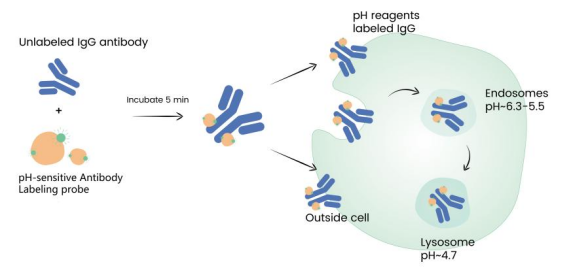
1. Internalization Efficiency Detection Based on pH-Sensitive Dyes
-
Principle: pH-sensitive dyes exhibit minimal fluorescence at neutral pH but show significantly increased fluorescence in acidic intracellular environments (pH < 6). Labeling antibodies with such dyes allows fluorescence intensity to directly correlate with internalization extent.
-
Advantages: Extremely low background signal, high sensitivity, particularly suitable for high-throughput screening (HTS).
-
Applications: Large-scale preliminary screening of antibody libraries in 96- or 384-well plates.
|
Early Endosome to Lysosome |
Late Endosome and Lysosome |
||
|
Fluorescent Reagents |
pH-Sensitive Reagent Green |
pH-Sensitive Reagent Red |
pH-Sensitive Reagent Deep Red |
|
Common Filter Sets |
FITC |
PE |
Cy5 |
|
Excitation/Emission Wavelength (nm) |
509/533 |
560/585 |
640/655 |
|
Signal-to-Noise Ratio |
|
|
|
|
Photostability |
|
|
|
|
Brightness |
|
|
|
|
pKa* |
6.5 |
6.5 |
5 |
|
Multicolor Labeling |
Yse |
||
|
Applications |
Flow Cytometry、Fluorescence Microscopy High-Content Screening(HCS) |
||
|
Colocalization Reagents |
|
EGF-Alexa Fluor 488 (UA011307) |
Lysotracker Green DND-20 (UA079025) |
|
Ready-to-Use Human, Mouse, Rabbit Universal |
UA070122 |
UA070127 |
UA079026 |
|
Amine-Reactive Dyes |
|
|
UA079027 |


Signal appears before environmental pH reaches pKa.
Validation Data:

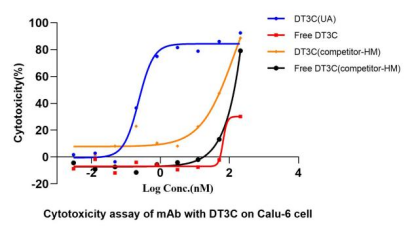
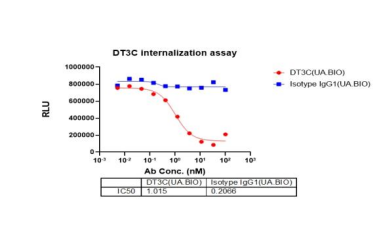
2. Internalization Efficiency Detection Based on Cell Killing—DT3C Recombinant Protein
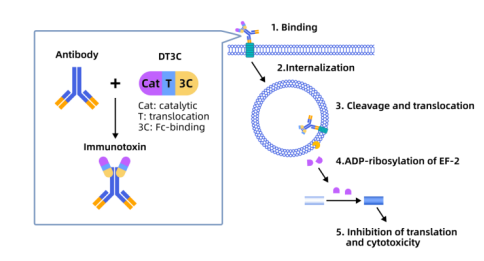
DT3C is a recombinantly expressed fusion protein with high affinity for the antibody Fc region. Upon antibody internalization, DT3C enters the cell and releases diphtheria toxin (DT), which inhibits protein synthesis, ultimately leading to cell death.
Cell viability or death is detected using methods such as MTT, WST-1, or the UA-Glo Cell Viability Assay Kit (UA070103) to evaluate antibody internalization efficiency.
Data Presentation:
|
货号 |
产品名称 |
|
UA070063 |
DT3C (Diphtheria toxin & spg 3C domain) Protein, Corynephage beta |
|
UA070103 |
UA-Glo Luminescent Cell Viability Assay/细胞活力检测试剂盒 |
3. Degradation and Payload Release Detection Technologies
1) Liquid Chromatography-Mass Spectrometry (LC-MS/MS)
-
Principle: The gold standard method. Highly sensitive mass spectrometry directly quantifies the absolute levels of free payload and its metabolites in cell lysates.
-
Advantages: Extremely high sensitivity (up to picomolar or even femtomolar levels), capable of simultaneous qualitative and quantitative analysis, providing direct evidence of payload release.
-
Applications: ADC efficacy evaluation, linker stability testing, metabolic kinetic studies.
2) Western Blot (WB) and Immunoprecipitation (IP)
-
Principle: Specific antibodies against the Fc region, idiotype, or payload are used to detect ADC degradation fragments or released payload in cell lysates.
-
Advantages: Provides molecular weight information of degradation products with high specificity.
-
Disadvantages: Semi-quantitative, labor-intensive, low throughput.
3) Reporter Gene Assay
-
Principle: Engineered cell lines are constructed where payload-induced cell killing negatively correlates with reporter gene activity (e.g., luciferase). More payload release leads to lower cell viability and weaker reporter signals.
-
Advantages: Functionally reflects the overall biological effect of payload release with high throughput.
-
Disadvantages: Indirect detection, susceptible to interference from other factors.
Related Product Recommendations:
|
货号 |
产品名称 |
|
Monoclonal Anti-DXD&Exatecan Antibody |
|
|
Monoclonal Anti-DM-1&DM-4 Antibody |
|
|
Monoclonal Anti-MMAE&MMAF Antibody |
|
|
Monoclonal Anti-Eribulin Antibody |
|
|
Monoclonal Anti-SN38 antibody |
|
|
S0B0710 |
Monoclonal Anti-Dxd/Exatecan Antibody |
III. Technology Integration and Future Perspectives
In practical ADC development projects, multiple technologies are often combined for mutual validation:
-
Preliminary Screening: High-throughput internalization screening using pHrodo or flow cytometry.
-
Mechanism Validation: Confocal microscopy to observe internalization pathways and lysosomal colocalization.
-
Ultimate Validation: LC-MS/MS as the gold standard for precise quantification of payload release and kinetics.
Antibody internalization and degradation are critical to the "precision killing" effect of ADCs. A mature, comprehensive, and innovative detection technology system equips ADC researchers with "eagle eyes," enabling them to penetrate cell membranes and observe intracellular processes in detail. Through a deep understanding and precise quantification of these key processes, researchers can more efficiently screen optimal drug candidates, optimize linker technologies, and ultimately accelerate the development of safer and more effective ADC therapies for cancer patients worldwide.
This article is reviewed and published by the technical expert team of UA
Disclaimer: This article partially utilizes artificial intelligence assistance in its creation. If any content involves copyright or intellectual property issues, please let us know and we promise to verify and remove it as soon as possible.
Purchase recombinant protein, choose Nanjing UA-Bio
UA protein focuses on providing various protein reagents, raw materials, and services required for drug research and development, cell therapy, gene therapy, and basic scientific research, including drug target proteins, immune checkpoint proteins, cytokines, tool enzymes, customized protein expression, and full-length transmembrane protein development. Youai is committed to providing customers with high-quality products and professional services, and building a High-tech Biological Enterprise with International Competitiveness.







 Business license (three certificates in one)