




IL-7Rα (CD127): How Does It Regulate Immune Homeostasis and Emerge as a Key Therapeutic Target?


IL-7Rα (CD127), as the specific alpha chain of the interleukin-7 receptor, is the key molecule mediating the biological functions of IL-7. This type I transmembrane protein is widely expressed in both lymphoid organs (such as bone marrow, thymus, and lymph nodes) and non-lymphoid tissues (including skin, lung, and liver), forming the structural basis for IL-7 signal transduction.
- Recent Advances
- Product Information
I. What Core Role Does IL-7Rα Play in Immune System Development?
IL-7Rα (CD127), as the specific alpha chain of the interleukin-7 receptor, is the key molecule mediating the biological functions of IL-7. This type I transmembrane protein is widely expressed in both lymphoid organs (such as bone marrow, thymus, and lymph nodes) and non-lymphoid tissues (including skin, lung, and liver), forming the structural basis for IL-7 signal transduction. From an immunological development perspective, the expression level of IL-7Rα is closely related to the differentiation and maturation of lymphocytes. Its functional loss leads to severe defects in the development of B cells, T cells, NK cells, monocytes, macrophages, dendritic cells, and innate lymphoid cells.
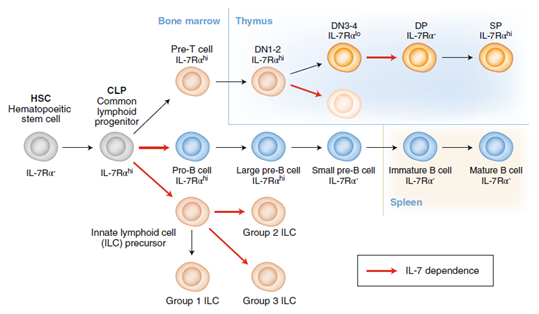
During T cell development, IL-7Rα promotes thymocyte survival and differentiation by regulating the expression of the anti-apoptotic protein Bcl-2. It is an indispensable key factor for the homeostasis maintenance of naïve T cells and memory T cells. Studies have shown that IL-7Rα-deficient mice exhibit a severe combined immunodeficiency phenotype, characterized by significantly reduced thymocyte numbers and an almost complete absence of peripheral T cells, which fully demonstrates the central role of IL-7Rα in immune system development.
II. How Does IL-7Rα Finely Regulate IL-7 Signaling Through Different Forms?
IL-7Rα exists in two functionally distinct molecular forms—membrane-bound and soluble (sIL-7Rα)—which together constitute a fine-tuned regulatory network for IL-7 signaling. The membrane-bound IL-7Rα forms a high-affinity IL-7 receptor complex with the common cytokine receptor gamma chain (IL-2Rγ, CD132), responsible for recognizing and binding IL-7 to initiate downstream signaling.
In contrast, soluble IL-7Rα (sIL-7Rα) plays a more complex regulatory role. On one hand, sIL-7Rα can compete with membrane-bound IL-7Rα for binding IL-7, acting as a buffer when IL-7 concentrations are high to prevent excessive signal activation. On the other hand, under IL-7-limited conditions, the sIL-7Rα-IL-7 complex may deliver IL-7 to cells expressing IL-2Rγ via a trans-presentation mechanism, indirectly enhancing IL-7 bioavailability. More complexly, sIL-7Rα can also directly bind to IL-2Rγ on the cell membrane, forming a non-functional receptor complex, thereby inhibiting IL-7 signal transduction. This multi-layered regulatory mechanism ensures precise control of IL-7 signaling under physiological conditions, maintaining immune system homeostasis.
III. How Do the Downstream Signaling Pathways Mediated by IL-7Rα Function?
After IL-7 binds to the membrane-bound IL-7Rα, it induces a conformational change in the receptor, rapidly recruiting the IL-2Rγ chain to form a functional heterodimeric receptor complex. This process activates the receptor-associated Janus kinases (JAK1 and JAK3), triggering their mutual phosphorylation and establishing a signaling platform. The activated JAK kinases then phosphorylate specific tyrosine residues on the intracellular segment of IL-7Rα, providing docking sites for Signal Transducer and Activator of Transcription 5 (STAT5).
Phosphorylated STAT5 forms homo- or heterodimers that translocate into the nucleus, regulating the expression of a series of genes related to cell proliferation, differentiation, and survival, including Cyclin D1, Bcl-2, and Pim kinases. Concurrently, IL-7Rα activation also initiates the PI3K-AKT signaling pathway: the phosphorylated receptor recruits and activates Phosphatidylinositol 3-kinase (PI3K), which catalyzes the production of PIP3, subsequently recruiting and activating AKT. Activated AKT, by phosphorylating various substrates including mTOR, FOXO transcription factors, and GSK-3β, synergistically promotes cellular metabolic reprogramming, enhanced proliferation, and inhibition of apoptosis.
IV. Which Diseases Are Closely Associated with Aberrant IL-7Rα Expression?
Abnormal expression or function of IL-7Rα is closely associated with the pathogenesis and progression of various immune-related diseases. In the field of autoimmune diseases, genome-wide association studies (GWAS) have identified several IL-7Rα gene polymorphisms significantly correlated with Multiple Sclerosis (MS). These genetic variants, by affecting the expression level or function of IL-7Rα, break immune tolerance within the central nervous system, promote the activation and infiltration of autoreactive T cells, and drive the demyelination pathology.
In the context of tumor immunology, the expression pattern of IL-7Rα is closely linked to tumor progression and prognosis. Gain-of-function mutations in IL-7Rα have been discovered in Acute Lymphoblastic Leukemia (ALL), leading to constitutive JAK-STAT signaling activation and promoting abnormal proliferation and survival of leukemic cells. Conversely, in the solid tumor microenvironment, downregulated IL-7Rα expression on Tumor-Infiltrating Lymphocytes (TILs) is often associated with a T cell exhausted state, limiting the effectiveness of the anti-tumor immune response. Furthermore, IL-7Rα deficiency is directly linked to the pathogenesis of Severe Combined Immunodeficiency (SCID), where patients present with recurrent infections and comprehensive immune system failure early in life.
V. What Challenges and Opportunities Do Therapeutic Strategies Targeting IL-7Rα Face?
Given the central role of IL-7Rα in immune regulation, developing therapeutic strategies targeting this molecule has become a hotspot in the field of immunotherapy. However, this process faces multiple challenges: firstly, it requires a precise balance between immune enhancement and the risk of autoimmunity, avoiding adverse effects caused by over-activation; secondly, the differential regulation of membrane-bound and soluble IL-7Rα needs to be addressed; additionally, precise control of tissue-specific expression and signal intensity is also a technical difficulty.
Current main research directions include: IL-7Rα antagonist-based strategies for autoimmune diseases, using monoclonal antibodies or small molecule inhibitors to block aberrant signaling; IL-7Rα-directed immune enhancement therapies, utilizing engineered IL-7 variants to selectively activate specific T cell subsets; and combination strategies, integrating IL-7Rα modulation with checkpoint inhibitors or other immunomodulators. It is particularly noteworthy that the detection of sIL-7Rα has emerged as a potential biomarker for assessing the status of various diseases and treatment responses, offering new avenues for personalized therapy.
This article is reviewed and published by the technical expert team of UA
Disclaimer: This article partially utilizes artificial intelligence assistance in its creation. If any content involves copyright or intellectual property issues, please let us know and we promise to verify and remove it as soon as possible.
Purchase recombinant protein, choose Nanjing UA-Bio
UA protein focuses on providing various protein reagents, raw materials, and services required for drug research and development, cell therapy, gene therapy, and basic scientific research, including drug target proteins, immune checkpoint proteins, cytokines, tool enzymes, customized protein expression, and full-length transmembrane protein development. Youai is committed to providing customers with high-quality products and professional services, and building a High-tech Biological Enterprise with International Competitiveness.







 Business license (three certificates in one)