




Breaking the Therapeutic Bottleneck in Allergic Diseases by Targeting IL-4Rα


The core pathogenesis of allergic diseases lies in the abnormal activation of the type 2 inflammatory pathway. This pathway, primarily mediated by T helper 2 (Th2) cells, regulates the direction of the immune response through a complex cytokine network. As a crucial subset of CD4+ T cells, Th2 cells differentiate into effector cells upon allergen stimulation and initiate and sustain the type 2 immune response by secreting the key cytokines interleukin (IL)-4, IL-5, and IL-13.
- Recent Advances
- Product Information
I. Why Have Allergic Diseases Become a Global Health Challenge?
Allergic diseases are type I hypersensitivity reactions mediated by Immunoglobulin E (IgE), characterized by diverse clinical manifestations and a continuously rising prevalence. They have become a major global public health issue. According to statistics from the World Allergy Organization, these diseases cumulatively affect approximately 40% of the global population. This includes approximately 400 million patients with Allergic Rhinitis (AR), about 300 million with Bronchial Asthma, and around 250 million with Food Allergies. Other allergic diseases like Atopic Dermatitis (AD) also show significant increasing trends. From an epidemiological distribution perspective, the prevalence in developed countries is significantly higher than in developing countries. However, with accelerating urbanization in newly industrialized nations, the incidence of allergic diseases is also showing a rapid growth trend.
II. How Does the Type 2 Inflammatory Pathway Drive the Onset and Progression of Allergic Reactions?
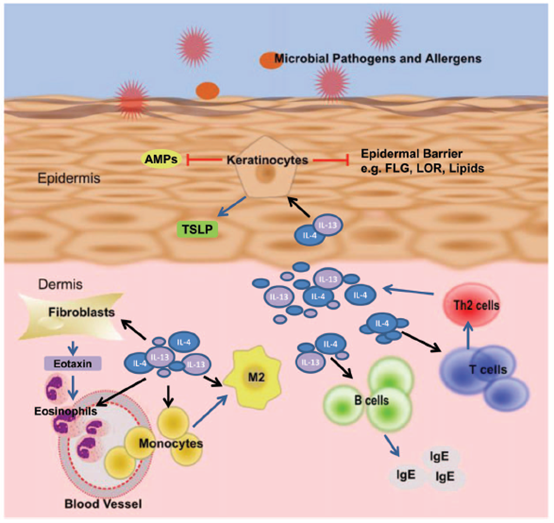
The core pathogenesis of allergic diseases lies in the abnormal activation of the type 2 inflammatory pathway. This pathway, predominantly mediated by T helper 2 (Th2) cells, regulates the direction of the immune response through a complex cytokine network. As a crucial subset of CD4+ T cells, Th2 cells differentiate into effector cells upon allergen stimulation and initiate and sustain the type 2 immune response by secreting the key cytokines Interleukin (IL)-4, IL-5, and IL-13.
Analyzing the molecular mechanisms: IL-4 is primarily responsible for promoting B cell class switching, inducing the production of IgE antibodies. IL-5 selectively acts on eosinophils, promoting their differentiation, maturation, and tissue infiltration. IL-13 mainly regulates epithelial cell function, promoting mucus secretion and airway hyperresponsiveness. These three cytokines act synergistically, forming a complete type 2 immune response axis, leading to typical pathophysiological changes such as elevated specific IgE levels, eosinophilia, and mast cell activation. This intricate immunoregulatory network explains why allergic diseases often present with multi-organ involvement and a tendency toward chronicity.
III. How Do IL-4 and IL-13 Play a Central Role in Type 2 Inflammation?
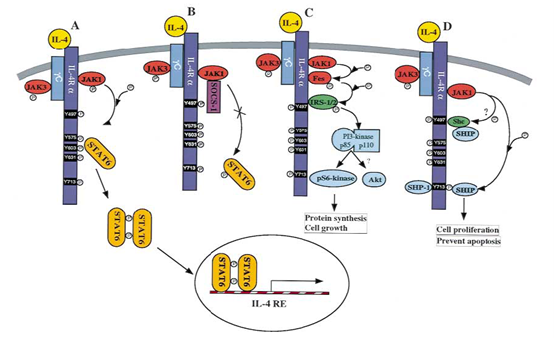
Although the amino acid sequence homology between IL-4 and IL-13 is only 25%, they exhibit significant functional overlap and share the critical receptor subunit IL-4Rα. This provides an important perspective for understanding the molecular basis of type 2 inflammation. IL-4 transmits signals through two distinct receptor complexes: the Type I receptor, composed of IL-4Rα and the common gamma chain (γc), is primarily expressed on lymphocytes. The Type II receptor consists of IL-4Rα and IL-13Rα1 and is widely expressed on non-hematopoietic cells such as epithelial cells and fibroblasts.
In contrast, IL-13 primarily acts through the Type II receptor complex, functionally complementing IL-4. When IL-4 or IL-13 binds to its respective receptor, it induces receptor dimerization and activates the downstream JAK-STAT signaling pathway. Specifically, the IL-4Rα chain primarily recruits the JAK1 tyrosine kinase, which subsequently phosphorylates the transcription factor STAT6. JAK3 associated with the γc chain and JAK2 associated with IL-13Rα1 also participate in the signal transduction process. Activated STAT6 forms dimers that translocate into the nucleus, regulating the expression of a series of key genes involved in inflammatory responses, mucus secretion, and tissue remodeling.
IV. What Special Role Does IL-13Rα2 Play in Allergy Regulation?
Beyond the classical signaling pathway, IL-13 also exerts unique regulatory functions through another receptor subunit, IL-13Rα2. Unlike IL-13Rα1, which is a signaling component, IL-13Rα2 was initially considered a decoy receptor due to its short intracellular domain and lack of obvious signaling motifs. However, recent studies indicate that this receptor can activate non-canonical signaling pathways under specific conditions.
Stimulation by inflammatory cytokines such as Tumor Necrosis Factor-alpha (TNF-α) significantly upregulates the expression of IL-13Rα2 on the cell surface. When IL-13 binds to IL-13Rα2, it can activate the transcription factor AP-1, subsequently inducing the expression of specific genes and promoting the secretion and activation of Transforming Growth Factor-beta (TGF-β). This pathway is significant in chronic allergic complications such as tissue fibrosis and airway remodeling, providing a new perspective for understanding the pathological progression of allergic diseases.
V. What Unique Advantages Do Therapeutic Strategies Targeting IL-4Rα Offer?
Given the central role of IL-4 and IL-13 in type 2 inflammation and their shared use of the IL-4Rα subunit, inhibitors targeting this receptor subunit demonstrate unique therapeutic value. Compared to single cytokine inhibitors, IL-4Rα-targeting drugs can simultaneously block the dual signaling pathways mediated by both IL-4 and IL-13, thereby regulating the type 2 immune response at a more upstream level.
From a pharmacological mechanism perspective, these drugs work by competitively binding to IL-4Rα, interfering with its interaction with either IL-4 or IL-13, thus inhibiting the activation of the JAK-STAT signaling pathway. This mechanism of action not only reduces IgE production but also suppresses eosinophilic inflammation, lowers airway hyperresponsiveness, and improves epithelial barrier function, achieving synergistic control over various allergic symptoms. Clinical studies have confirmed that IL-4Rα monoclonal antibodies show significant efficacy in treating moderate-to-severe Atopic Dermatitis, refractory asthma, and various other allergic diseases, offering new options for patients who respond poorly to traditional therapies.
This article is reviewed and published by the technical expert team of UA
Disclaimer: This article partially utilizes artificial intelligence assistance in its creation. If any content involves copyright or intellectual property issues, please let us know and we promise to verify and remove it as soon as possible.
Purchase recombinant protein, choose Nanjing UA-Bio
UA protein focuses on providing various protein reagents, raw materials, and services required for drug research and development, cell therapy, gene therapy, and basic scientific research, including drug target proteins, immune checkpoint proteins, cytokines, tool enzymes, customized protein expression, and full-length transmembrane protein development. Youai is committed to providing customers with high-quality products and professional services, and building a High-tech Biological Enterprise with International Competitiveness.







 Business license (three certificates in one)