




Can 4-1BB Agonist Antibodies Become a Key Breakthrough in Tumor Immunotherapy?


4-1BB (CD137/TNFRSF9) is a key member of the tumor necrosis factor receptor superfamily (TNFRSF). As an inducible costimulatory receptor, it plays a central role in the initiation, expansion, and maintenance of anti-tumor immune responses.
- Recent Advances
- Product Information
What is Cancer Immunotherapy and its Core Mechanism?
Cancer immunotherapy represents a revolutionary strategy for managing cancer. Its core principle lies in mobilizing the body's own immune system to recognize, attack, and eliminate tumor cells. Unlike traditional chemotherapy or radiotherapy which directly kill cells, immunotherapy aims to restore or enhance the immune system's natural defense capabilities against tumors. The key to its success is the precise targeting of molecules specifically expressed on the surface of tumor cells, known as Tumor-Associated Antigens (TAAs). By directing the killing power of the host immune system (particularly T lymphocytes) towards these TAAs, the treatment aims to establish or re-activate a robust and durable adaptive immune response against cancer cells. Over the past few decades, monoclonal antibodies (mAbs) have achieved remarkable success as crucial weapons in immunotherapy, with numerous mAbs targeting different immune checkpoints approved for clinical use or in advanced trial stages.

Why is 4-1BB Considered a Promising Immunotherapy Target?
The discovery of 4-1BB (also known as CD137 or TNFRSF9) dates back to 1989, when it was initially identified as a gene induced on T cells after antigen stimulation, but not expressed on resting T cells. Further research revealed that the expression profile of 4-1BB is not limited to activated CD4+ and CD8+ T lymphocytes but is also found on the surface of various other immune cells, including dendritic cells (DCs), natural killer cells (NKs), natural killer T cells (NKTs), eosinophils, and mast cells. Notably, myeloid-derived suppressor cells (MDSCs), which have immunosuppressive functions, typically do not express 4-1BB. Functional studies have shown that targeted activation of 4-1BB signaling using agonistic antibodies can significantly enhance the activity and function of cytotoxic T cells and promote the production of key cytokines like interferon-gamma (IFN-γ), thereby demonstrating potent anti-tumor potential in preclinical studies and establishing it as a closely watched target in the field of cancer immunotherapy.
What are the Molecular Characteristics and Signaling Mechanism of 4-1BB?
To understand the function of 4-1BB, one must start with its molecular classification. 4-1BB is one of the 29 members of the Tumor Necrosis Factor Receptor Superfamily (TNFRSF), which plays a central role in immune regulation. TNFRSF members can be broadly divided into two categories: death receptors and (like 4-1BB) activating receptors. Their common features include an intracellular domain that mediates intracellular signal transduction and an extracellular domain that can bind corresponding ligands. These ligands belong to the Tumor Necrosis Factor Superfamily (TNFSF). Research indicates that TNFSF-TNFRSF ligand-receptor pairs, such as CD40-CD40L, CD27-CD70, OX40-OX40L, and 4-1BB-4-1BBL, can regulate key physiological processes like cell development, survival, death, and the production of cytokines and chemokines. Substantial evidence shows that members of this family are involved in inflammatory and pathological processes of various diseases, including cancer, making intervention strategies targeting their interactions highly promising therapeutically.
Full T cell activation requires a dual signal. The first signal is antigen-specific, generated when the T cell receptor (TCR) recognizes antigen peptides presented by MHC molecules on the surface of antigen-presenting cells (APCs). The second signal is a non-antigen-specific co-stimulatory signal, provided by the interaction of co-stimulatory molecules on the surfaces of T cells and APCs. 4-1BB is precisely such an important co-stimulatory molecule, belonging to the TNFRSF family. Its ligand, 4-1BBL (belonging to the TNFSF), was cloned in 1994 and is primarily expressed on activated antigen-presenting cells such as dendritic cells, B cells, and macrophages.
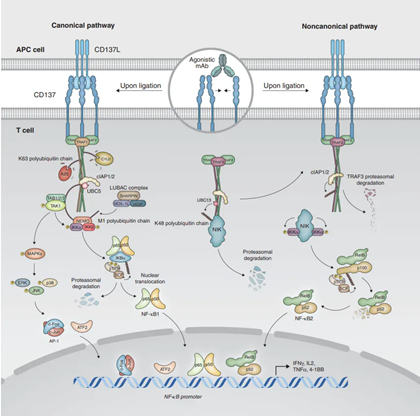
At the molecular mechanism level, after 4-1BB binds to its ligand 4-1BBL, it recruits TNFR-Associated Factors (such as TRAF1 and TRAF2), subsequently activating downstream NF-κB, JNK/SAPK, and p38 MAPK signaling pathways. This series of signaling events provides a powerful co-stimulatory signal for T cells, particularly favoring the proliferation and survival of CD8+ cytotoxic T cells. It can also prolong T cell effector function by providing survival signals that inhibit Activation-Induced Cell Death (AICD). For CD4+ T helper cells, the activation of p38 MAPK is crucial for their differentiation into Th1 or Th2 subsets and the functional regulation of Th1 effector cells. Furthermore, the impact of the 4-1BB/4-1BBL pathway extends far beyond T cells: it can amplify monocyte-mediated invariant Natural Killer T cell (iNKT) proliferation, thereby indirectly regulating immune responses; its agonists can stimulate adipocytes and macrophages to produce inflammatory factors like IL-6, TNF-α, and MCP-1; on B cells, cross-linking of 4-1BB can also provide co-stimulatory signals, activating and inducing B cell proliferation.
How Do 4-1BB Agonist Antibodies Exert Anti-Tumor Effects in Preclinical Models?
Numerous animal experiments have confirmed that agonistic anti-4-1BB monoclonal antibodies can induce and enhance effective anti-tumor immunity in various tumor models. Their mechanism of action is complex and pleiotropic, centrally involving the coordinated regulation of various immune cells within the tumor microenvironment:
-
Activation of Effector Immune Cells: Anti-4-1BB antibodies potently stimulate and activate key effector cells. They significantly enhance the cytotoxic activity and IFN-γ production of CD8+ T lymphocytes, activate NKT cells and antigen-presenting cells (like macrophages), thereby synergistically killing cancer cells. Simultaneously, they expand the pool of tumor antigen-specific memory T cells and enhance their function, laying the groundwork for long-term immune surveillance and prevention of recurrence. Studies also show that the co-stimulatory signal from 4-1BB can promote T cell cycle progression and proliferation by regulating cyclins and their dependent kinases, and by activating the Akt pathway. The role regarding NK cells shows species differences: in mouse models, the antibody clearly activates NK cells; whereas in human systems, its effect on NK cells (activation or suppression) may be more context-dependent.
-
Inhibition of Immunosuppressive Cells: While activating effector pathways, anti-4-1BB antibodies can also effectively inhibit the activity and proliferation of immunosuppressive cells. They can suppress the infiltration and function of myeloid-derived suppressor cells (MDSCs) and regulatory T cells (Tregs) at the tumor site, thereby alleviating the immunosuppressive state of the tumor microenvironment. Some studies report that their inhibitory effect on Tregs might be partly related to blocking IL-9 production.
These effects of anti-4-1BB antibodies are highly dependent on the expression of the 4-1BB receptor on both target cells and host cells. Gene knockout studies indicate that the absence of 4-1BB on either tumor cells or host cells (including hematopoietic and non-hematopoietic sources) significantly impairs or even abolishes the anti-tumor effects of the antibody. It is particularly noteworthy that 4-1BB expressed on tumor-associated endothelial cells helps promote the migration and infiltration of activated T cells into tumor tissue. Furthermore, anti-4-1BB antibody-mediated tumor rejection (e.g., in lymphoma) requires the synergistic action of both perforin/granzyme and FAS-L cytolytic mechanisms.
This article is reviewed and published by the technical expert team of UA
Disclaimer: This article partially utilizes artificial intelligence assistance in its creation. If any content involves copyright or intellectual property issues, please let us know and we promise to verify and remove it as soon as possible.
Purchase recombinant protein, choose Nanjing UA-Bio
UA protein focuses on providing various protein reagents, raw materials, and services required for drug research and development, cell therapy, gene therapy, and basic scientific research, including drug target proteins, immune checkpoint proteins, cytokines, tool enzymes, customized protein expression, and full-length transmembrane protein development. Youai is committed to providing customers with high-quality products and professional services, and building a High-tech Biological Enterprise with International Competitiveness.







 Business license (three certificates in one)