




Unraveling the Biology and Therapeutic Promise of LIF, a Multifunctional Cytokine


Leukemia Inhibitory Factor (LIF) is a pleiotropic cytokine belonging to the interleukin-6 (IL-6) family. Since its discovery, the LIF protein has garnered significant attention due to its diverse biological functions, which include regulating cell proliferation and differentiation, immune modulation, embryonic development, neuroprotection, and metabolic regulation.
- Recent Advances
- Product Information
- Reference
I. Introduction
Leukemia Inhibitory Factor (LIF) is a pleiotropic cytokine belonging to the interleukin-6 (IL-6) family. Since its discovery, the LIF protein has attracted significant attention due to its diverse biological functions, including regulating cell proliferation and differentiation, immune modulation, embryonic development, neuroprotection, and metabolic regulation.
II. Structure and Function of the LIF Protein
(A) Structural Characteristics
The LIF protein is a pleiotropic cytokine composed of 180 amino acids, belonging to the long four-α-helix bundle cytokine superfamily. Mature murine LIF is expressed as a highly variably glycosylated 32-62 kDa monomer. LIF exerts its effects by binding to a heterodimeric receptor complex consisting of a ligand-binding subunit, LIFRα/CD118, and a signal-transducing subunit, gp130.

[Figure 1. LIF splice variants and functional domains]
(B) Biological Functions
-
Regulation of Cell Proliferation and Differentiation
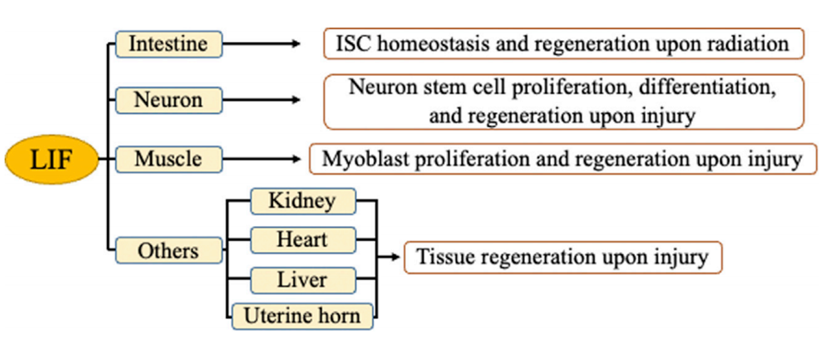
Stem Cells: LIF is the "gold standard" factor for maintaining embryonic stem cell pluripotency. It promotes the proliferation and differentiation of stem cells by activating signaling pathways such as JAK/STAT. In neural stem cells (NSCs), LIF can promote their proliferation and differentiation into neurons or glial cells.
Other Cells: LIF induces terminal differentiation of leukemia cells, promotes the differentiation of hematopoietic cells and neuronal cells, and stimulates acute-phase protein synthesis in hepatocytes.
-
Immunoregulation
Induction of Immune Tolerance: LIF can promote the expansion of regulatory T cells (Tregs) and achieve immune tolerance through various mechanisms.
Inflammation Regulation Paradox: In acute inflammation, LIF exhibits pro-inflammatory properties, whereas in chronic inflammation models, it exerts anti-inflammatory effects. This duality is related to its concentration dependency.
- Embryonic Development
LIF plays a critical role in embryonic development. It is involved in the maintenance and differentiation of embryonic stem cells and is crucial for preparing the endometrium during embryo implantation. In mice, endometrial LIF expression peaks during the implantation window, promoting embryo adhesion to the uterine wall by upregulating integrin αvβ3 and osteopontin.
- Neuroprotection and Repair
LIF has neuroprotective and reparative functions in the nervous system. It can promote neuronal survival and regeneration, which is significant for repair following nervous system injury. For example, LIF expression is upregulated upon neuronal injury and promotes motor neuron survival and oligodendrocyte myelination.
-
Metabolic Regulation
LIF is involved in regulating metabolic processes, influencing adipocyte differentiation and energy metabolism. For instance, LIF inhibits adipogenesis by suppressing lipoprotein lipase in adipocytes.
III. Signaling Mechanisms of the LIF Protein
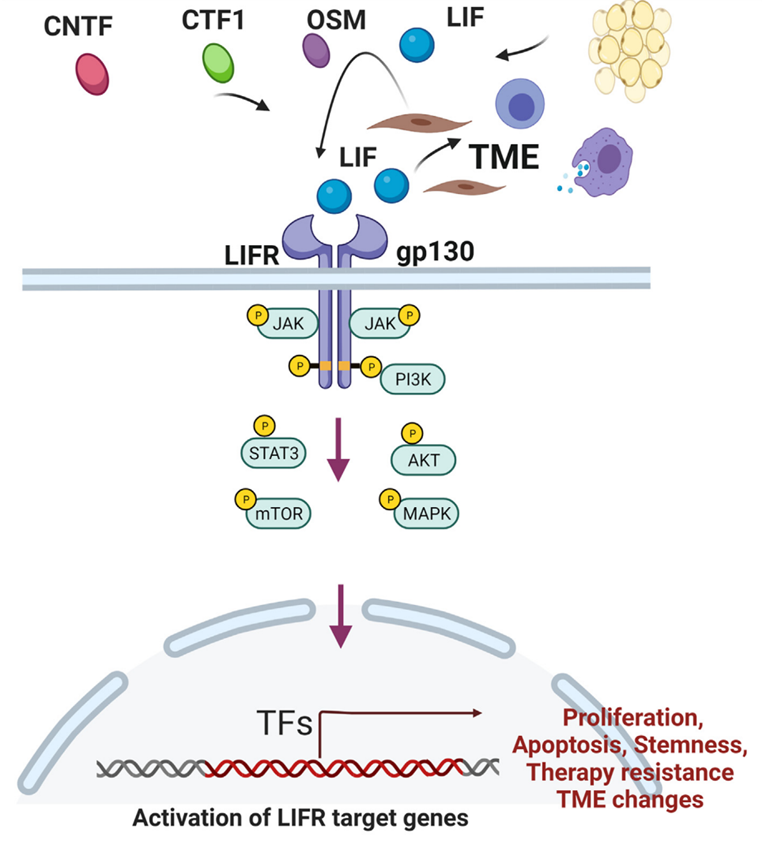
LIF's biological functions are mediated primarily through three key signaling pathways: JAK/STAT, PI3K/AKT, and MAPK/ERK.
- JAK/STAT Pathway Activation
Upon LIF binding to its receptor, JAK kinases associated with the intracellular domain of gp130 undergo autophosphorylation, subsequently catalyzing the phosphorylation of STAT3 at tyrosine residue 705. Phosphorylated STAT3 forms homodimers that translocate to the nucleus, regulating the expression of pluripotency genes, including Nanog, Oct4, and Sox2.
- PI3K/AKT Pathway Regulation
LIF recruits PI3K via the IRS-1 protein, catalyzing the conversion of PIP2 to PIP3 and activating downstream AKT kinase. This pathway not only promotes glucose uptake and metabolic reprogramming but also enhances stem cell self-renewal by inhibiting GSK3β-mediated β-catenin degradation through phosphorylation.
- MAPK/ERK Dynamic Balance
ERK1/2 activation exhibits a biphasic pattern: rapid initial activation (0-30 minutes) promotes cell proliferation, while sustained activation (>2 hours) induces differentiation signals. This time-dependent effect explains the functional differences of LIF observed at different concentrations.
IV. Application Prospects of the LIF Protein
(A) Disease Treatment
Cancer Therapy
Monoclonal antibodies targeting the LIF/LIFR axis (e.g., EC18.3) reduced metastases by 70% in pancreatic cancer models.
-
Neurodegenerative Diseases
Intracerebroventricular injection of recombinant LIF reduced Aβ plaques by 40% in a mouse model of Alzheimer's disease.
-
Reproductive Medicine
LIF supplementation increased the implantation rate in IVF from 35% to 52%.
(B) Stem Cell Research
The LIF protein provides an essential tool for maintaining stem cell pluripotency and inducing differentiation. Its application in stem cell research helps deepen the understanding of stem cell biology and lays the foundation for the advancement of regenerative medicine.
V. Summary
In summary, LIF, as a multifunctional cytokine, plays important roles in various biological processes including cell proliferation and differentiation, immune regulation, embryonic development, neuroprotection and repair, and metabolic regulation. With deepening understanding of LIF's biological functions and advancements in genetic engineering technologies, the potential of the LIF protein in biomedical research and clinical applications will be further realized. In the future, LIF is expected to become an effective therapeutic strategy for various diseases, contributing significantly to human health.
This article is reviewed and published by the technical expert team of UA
Disclaimer: This article partially utilizes artificial intelligence assistance in its creation. If any content involves copyright or intellectual property issues, please let us know and we promise to verify and remove it as soon as possible.
Purchase recombinant protein, choose Nanjing UA-Bio
UA protein focuses on providing various protein reagents, raw materials, and services required for drug research and development, cell therapy, gene therapy, and basic scientific research, including drug target proteins, immune checkpoint proteins, cytokines, tool enzymes, customized protein expression, and full-length transmembrane protein development. Youai is committed to providing customers with high-quality products and professional services, and building a High-tech Biological Enterprise with International Competitiveness.

- Suryavathi Viswanadhapalli; Kalarickal V. Dileep; Kam Y. J. Zhang; Hareesh B. Nair; Ratna K. Vadlamudi. Targeting LIF/LIFR signaling in cancer. Genes and Diseases.2022.
- Jianming Wang; Chun‐Yuan Chang; Xue Yang; Fan Zhou; Juan Liu; et al. Leukemia inhibitory factor, a double-edged sword with therapeutic implications in human diseases. Molecular Therapy.2022.






 Business license (three certificates in one)