




Novel c-Met Degrader D19: A Breakthrough in Efficient Degradation and Overcoming Drug Resistance


Tyrosine kinase c-Met, which serves as the receptor for hepatocyte growth factor (HGF), plays a central role in regulating cell proliferation, migration, and angiogenesis. Abnormal activation of its signaling pathway — including gene amplification, mutation, or overexpression — has been confirmed to be closely associated with the progression and metastasis of various malignant tumors, such as lung cancer, gastric cancer, and liver cancer.
- Recent Advances
- Product Information
The tyrosine kinase c-Met, serving as the receptor for hepatocyte growth factor (HGF), plays a central role in regulating cell proliferation, migration, and angiogenesis. Abnormal activation of its signaling pathway (including gene amplification, mutation, or overexpression) has been confirmed to be closely associated with the progression and metastasis of various malignant tumors such as lung cancer, gastric cancer, and liver cancer. Although c-Met-specific inhibitors (e.g., tepotinib, capmatinib) have shown initial efficacy in clinical treatment, the widespread emergence of acquired resistance (e.g., mutations at sites like D1228N, Y1230H) severely limits their long-term application. In recent years, Proteolysis-Targeting Chimeras (PROTAC) technology, which induces ubiquitination and degradation of target proteins, has provided a new strategy to overcome the challenge of resistance to traditional inhibitors. However, first-generation c-Met-targeting PROTAC molecules still face key technical bottlenecks such as low oral bioavailability and poor metabolic stability.
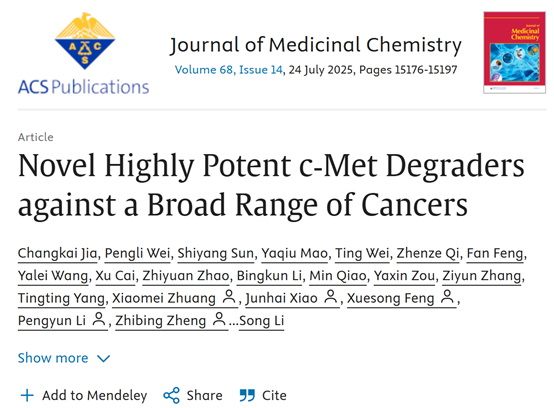
Recently, the National Engineering Research Center for Emergency Antimicrobial Drugs, the National Key Laboratory of Special Medicines for National Security, in collaboration with China Medical University, published a research paper titled "Novel Highly Potent c-Met Degraders against a Broad Range of Cancers" in the Journal of Medicinal Chemistry (DOI: 10.1021/acs.jmedchem.5c01470). Through systematic structural optimization, the study successfully developed a new generation of c-Met degraders, D19, D26, and G4, which significantly improved pharmacokinetic properties while maintaining high degradation activity. The lead compound D19 demonstrated near-complete tumor suppression in various preclinical models and effectively overcame resistant mutations, providing a breakthrough solution for the clinical treatment of c-Met-driven tumors.
I. How Did Rational Design Overcome the Druggability Bottleneck of PROTAC Molecules?
Starting from their previously developed degrader D15 (Acta Pharm. Sin. B. 2023;13(6):2715-2735), the research team implemented a multi-dimensional structural optimization strategy targeting its core deficiencies of low oral bioavailability (0.7%) and poor metabolic stability. First, replacing the amide bond in the linker with a methylene unit significantly enhanced stability against hydrolases, yielding candidate molecule D19. Second, through systematic screening of E3 ligase ligands, they found that CRBN ligands (thalidomide derivatives) were more conducive to forming a stable c-Met–PROTAC–CRBN ternary complex compared to VHL ligands, leading to the optimized degrader D26. Additionally, the team developed a low-molecular-weight derivative, G4, by simplifying the molecular backbone, which significantly improved drug-like properties while maintaining degradation activity. This series of precise modifications based on structural biology provides an important molecular design paradigm for the clinical translation of PROTAC technology.
II. Did the Novel Degraders Exhibit Ultra-Potent Antitumor Activity in In Vitro Models?
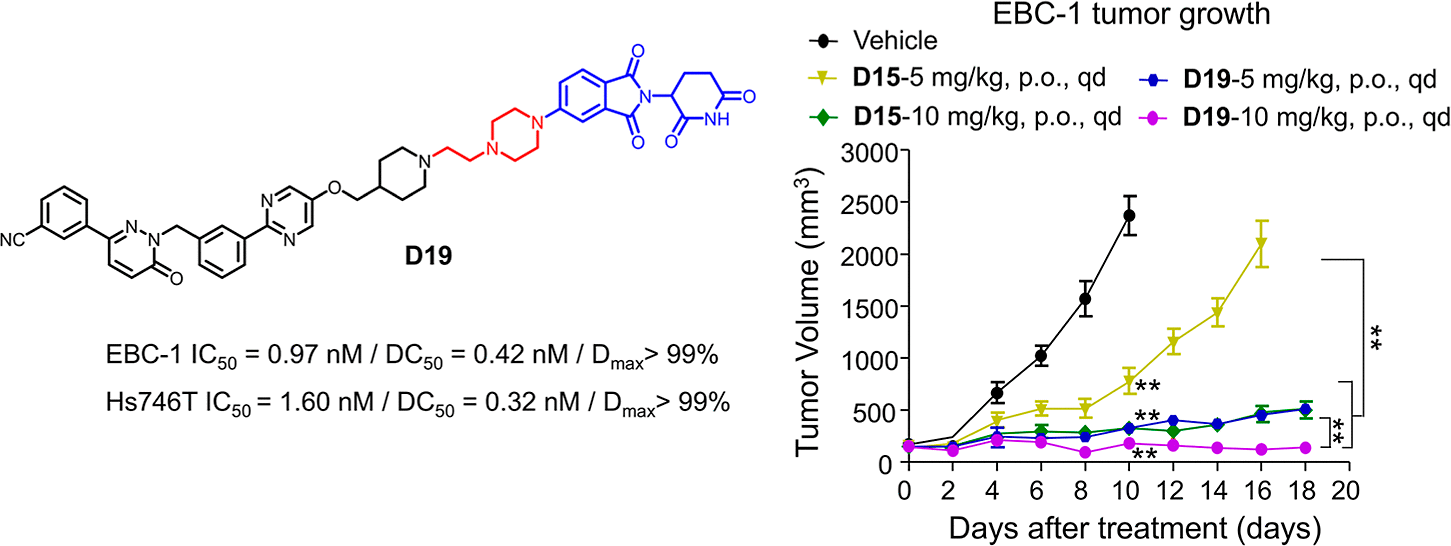
In cellular experiments, D19 and G4 exhibited nanomolar-level inhibitory activity (IC₅₀ = 0.97–12.4 nM) against various cancer cell lines with abnormal c-Met expression (including EBC-1 non-small cell lung cancer, Hs746T gastric cancer, MHCC97H liver cancer, etc.), significantly outperforming the previous generation molecule D15 and clinical inhibitors like tepotinib and capmatinib. More notably, both achieved picomolar-level c-Met protein degradation efficiency (DC₅₀ = 0.21–0.52 nM) mediated by the CRL4CRBN E3 ligase-mediated ubiquitin-proteasome pathway, with a maximum degradation rate exceeding 99%. Western blotting analysis further confirmed that a concentration of just 1 nM D19 significantly reduced the activation levels of phosphorylated c-Met (p-c-Met) and its downstream signaling molecule STAT3, while 10 nM completely blocked the c-Met signaling pathway. Importantly, the degraders showed no significant toxicity (IC₅₀ > 100 μM) towards normal cells (LO2 hepatocytes, 293T renal epithelial cells), demonstrating excellent selectivity.
III. Did the Optimized Degraders Solve the Pharmacokinetic Challenges?
Pharmacokinetic evaluation showed that the oral bioavailability of D19 and G4 in rat models reached 7.54% and 7.43%, respectively, representing an approximately 20-fold increase compared to D15 (0.3%). Simultaneously, their half-lives (t₁/₂) extended to 12.47 hours and 11.42 hours, plasma exposure (AUC₀–∞) increased significantly, and liver microsomal metabolic stability was greatly improved. These data indicate that rational linker optimization and molecular simplification strategies can effectively overcome the common absorption barriers and rapid metabolism issues of PROTAC-like molecules, laying the foundation for oral administration.
IV. Did In Vivo Experiments Validate Its Actual Antitumor Efficacy and Safety?
In the EBC-1 xenograft model, daily oral administration of D19 at a dose of 5 mg/kg inhibited tumor growth (TGI) by 91.9%, and the 10 mg/kg dose group achieved 98.4% TGI, with some experimental animals showing complete tumor regression. Notably, no signs of tumor recurrence were observed 18 days after discontinuation of treatment. Histological analysis showed significantly upregulated apoptosis markers (Cleaved Caspase-3) and significantly inhibited proliferation indicators (Ki-67) in the treatment group, while no pathological damage was observed in vital organs (heart, liver, kidney), and mouse body weight remained stable, proving that D19 possesses good safety alongside high antitumor efficacy.
V. Can the Novel Degrader Overcome Clinical Resistance Mutations?
To verify its inhibitory effect on resistance mutations, the research team constructed cell models carrying c-Met D1228N and c-Met Y1230H point mutations. The results showed that the IC₅₀ values of D19 for the D1228N and Y1230H mutant strains were 25.4 nM and 40.8 nM, respectively, whereas the IC₅₀ of the clinical inhibitor tepotinib under the same conditions exceeded 1000 nM. Further mechanistic studies revealed that D19 could completely degrade mutant c-Met protein and effectively inhibit its autophosphorylation activity at a concentration of 1000 nM, a characteristic significantly superior to traditional ATP-competitive inhibitors that only partially inhibit kinase activity.
VI. What is the Profound Significance of This Research for PROTAC Technology Development?
This study not only successfully developed a c-Met degrader with clinical translation potential but also made important breakthroughs in PROTAC molecular design strategy. Firstly, it addressed the oral absorption challenge of PROTACs through linker rigidification and metabolic site shielding. Secondly, it enhanced degradation efficiency by leveraging the synergistic effect of CRBN ligands. Furthermore, the successful development of the low-molecular-weight derivative G4 demonstrated the feasibility of optimizing drug-like properties while maintaining potency. These experiences provide a referable technical path for the development of PROTACs targeting other kinase targets.
Conclusion and Outlook
Through multi-level rational design, this study successfully elevated the activity, stability, and pharmacokinetic properties of c-Met-targeting PROTAC molecules to new heights. The broad-spectrum antitumor activity, ability to overcome drug resistance, and oral efficacy demonstrated by the lead compound D19 mark a critical step towards the clinical application of PROTAC technology. Future research could further explore its efficacy variations across different c-Met-driven tumor populations and its synergistic mechanisms with other immunotherapies or targeted drugs. With the accumulation of more preclinical and clinical data, such degraders are expected to provide superior treatment options for patients with c-Met pathway abnormalities and propel targeted cancer therapy into a new era of "protein degradation."
This article is reviewed and published by the technical expert team of UA
Disclaimer: This article partially utilizes artificial intelligence assistance in its creation. If any content involves copyright or intellectual property issues, please let us know and we promise to verify and remove it as soon as possible.
Purchase recombinant protein, choose Nanjing UA-Bio
UA protein focuses on providing various protein reagents, raw materials, and services required for drug research and development, cell therapy, gene therapy, and basic scientific research, including drug target proteins, immune checkpoint proteins, cytokines, tool enzymes, customized protein expression, and full-length transmembrane protein development. Youai is committed to providing customers with high-quality products and professional services, and building a High-tech Biological Enterprise with International Competitiveness.







 Business license (three certificates in one)