




Unraveling the Structural Secrets of Chemokine Receptor CCR5: How It Precisely Recognizes Ligands and Orchestrates Intracellular Signaling


In the immune system, directional cell migration is a prerequisite for immune responses, a process precisely regulated by the chemokine and receptor system. As key members of the G protein-coupled receptor (GPCR) superfamily, chemokine receptors play critical roles in physiological and pathological processes such as inflammatory responses, immune cell homing, tissue development, and the regulation of the tumor microenvironment.
- Recent Advances
- Product Information
- Reference
In the immune system, directional cell migration is a prerequisite for immune responses, a process precisely regulated by the chemokine and receptor system. As key members of the G protein-coupled receptor (GPCR) superfamily, chemokine receptors play critical roles in physiological and pathological processes such as inflammatory responses, immune cell homing, tissue development, and the regulation of the tumor microenvironment. Among them, CCR5 has garnered significant attention for its role as a co-receptor in HIV-1 infection and is also a potential therapeutic target for inflammatory diseases and cancer. Although its pathological importance is widely recognized, the molecular mechanisms by which CCR5 recognizes endogenous ligands and transduces signals under physiological conditions remain unclear, representing a major challenge in the field of structural immunology.
In July 2021, the research groups of Wu Beili, Zhao Qiang, and Xu Yechun at the Shanghai Institute of Materia Medica, Chinese Academy of Sciences, published a significant study titled "Structural basis for chemokine recognition and receptor activation of chemokine receptor CCR5" in Nature Communications. By integrating single-particle cryo-electron microscopy (cryo-EM), X-ray crystallography, and molecular dynamics simulations, this study successfully determined the high-resolution structures of CCR5 in complex with its endogenous ligands MIP-1α (CCL3) or RANTES (CCL5) and the G protein. It systematically revealed, for the first time, the ligand recognition mode and signal transduction mechanism of CCR5. This work not only addressed long-standing scientific questions in the field but also provided a crucial structural foundation for drug design targeting CCR5.
I. How Does CCR5 Specifically "Grasp" Its Endogenous Ligands?
Chemokine receptor recognition of their ligands is highly specific. Previous research suggested the receptor's extracellular N-terminal domain is crucial in this process. However, due to technical challenges, all previously solved structures of chemokine receptors lacked the complete N-terminal region, leaving the precise recognition mechanism obscure.
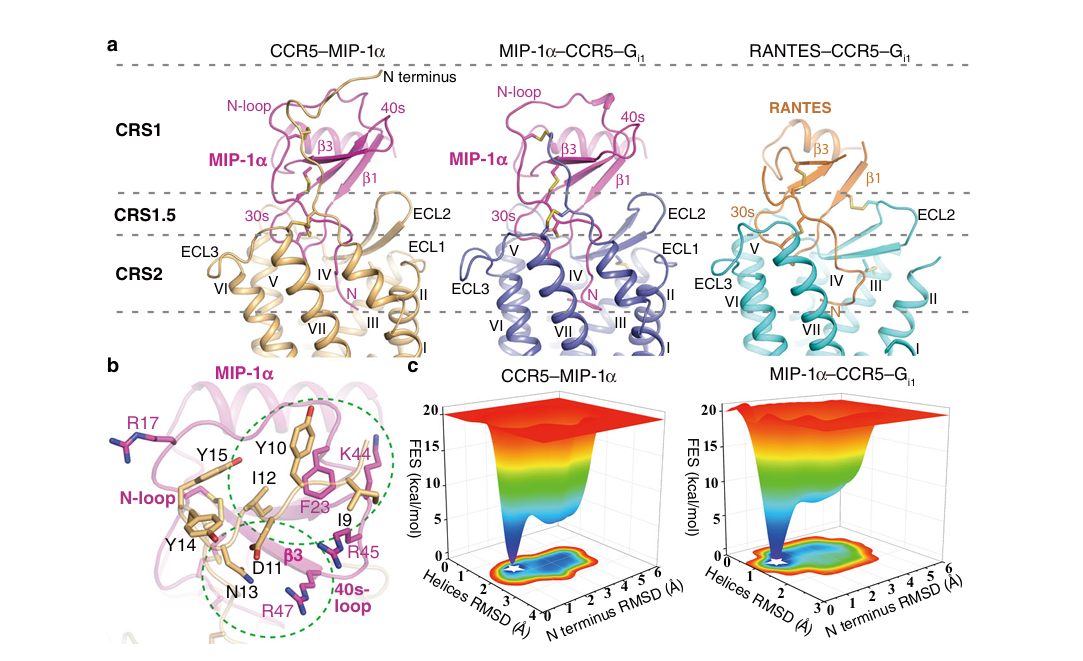
This study broke through this bottleneck by first determining the high-resolution crystal structure of CCR5 bound to its endogenous ligand MIP-1α (CCL3). This structure clearly shows how the complete N-terminus of CCR5, like a "hand," engages in detailed interactions with the core region of MIP-1α. Combining disulfide bond cross-linking experiments and molecular dynamics simulations, the researchers precisely mapped the chemical details of the N-terminus-chemokine interaction for the first time, elucidating the structural basis for ligand specificity. This not only answered a long-standing question but also provided a key paradigm for understanding the recognition mechanisms across the entire chemokine receptor family.
II. How Does the CCR5 Structure Adapt Flexibly to Different Ligands?
Under physiological conditions, a single chemokine receptor often needs to interact with multiple ligands. CCR5 is no exception; besides MIP-1α, its important endogenous ligands include RANTES (CCL5). A core question is: how does the same receptor adapt to the structural features of different ligands?
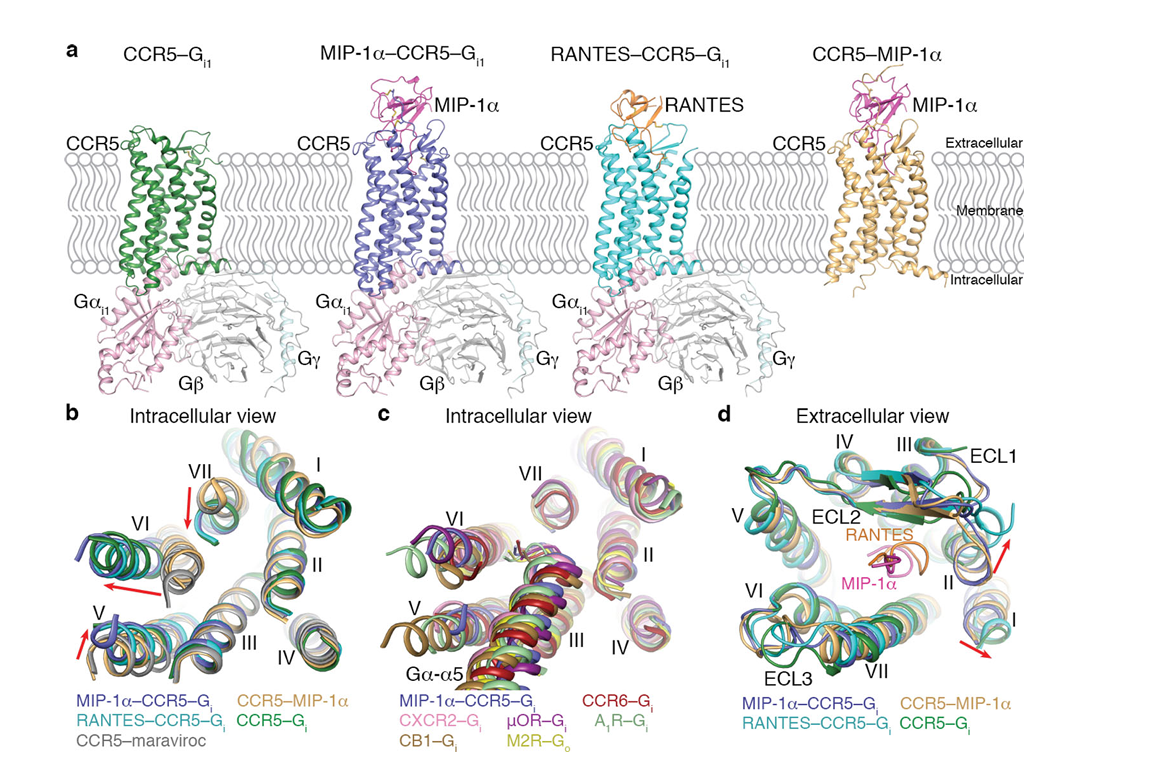
The research team further solved the cryo-EM structure of CCR5 bound to RANTES and the G protein and compared it with the CCR5–MIP-1α–G protein structure. They discovered an interesting phenomenon: compared to binding MIP-1α, when CCR5 binds to the bulkier RANTES, its first and second transmembrane helices shift outward significantly, thereby enlarging the opening of the ligand-binding pocket to accommodate RANTES's more distinctive N-terminal segment. This finding reveals the inherent structural plasticity of the CCR5 transmembrane domain. This conformational flexibility is the structural basis for its ability to efficiently bind different endogenous ligands, showcasing the sophistication and efficiency of molecular design in life.
III. How Does Ligand Binding Trigger the "Switch" for Transmembrane Signal Transduction?
A universal hallmark of GPCR activation is that ligand binding induces specific conformational changes in the transmembrane helices, which "opens" the intracellular side to recruit and activate downstream G proteins. For CCR5, how does this microscopic "switch" work precisely?
By comparing the structures of activated (ligand-bound) and inactive (antagonist-bound) CCR5, the study revealed key steps in its activation mechanism. Whether MIP-1α or RANTES, their N-termini insert deeply into the transmembrane helical pocket of CCR5 upon binding. This insertion acts like pressing a switch, critically involving the formation of a hydrogen bond with tyrosine 251 (Y251) on the transmembrane helix. This interaction prompts the side chain of another key residue, tryptophan 248 (W248), to flip its conformation and stabilize in a specific position characteristic of the active state. The stabilization of W248 ultimately drives the collective rearrangement of the transmembrane helices, forming a surface on the intracellular side capable of binding the G protein, thereby successfully initiating signal transduction.
IV. Can CCR5 Be Activated Independently of Ligand Binding?
Beyond ligand-dependent activation, some GPCRs possess a certain level of basal (or constitutive) activity even in the absence of ligand, which may have physiological and pathological significance. However, the mechanism of constitutive activation for chemokine receptors had never been elucidated.
An unexpected discovery in this study came from the analysis of the structure of the CCR5–G protein complex without any bound ligand. The researchers observed that in the ligand-free state, the side chain of tryptophan 86 (W86) on the second transmembrane helix flips by 90 degrees. This flip allows W86 to form a stable hydrophobic interaction network with multiple residues, including Y108, Y251, and W248. This network "accidentally" stabilizes W248 in a conformation similar to that seen in the ligand-activated state, thereby driving the receptor into a partially active state and enabling it to bind the G protein. This is the first time the constitutive activation mechanism of a chemokine receptor has been elucidated structurally, opening new directions for understanding the fundamental biology of this receptor class.
Conclusion and Outlook: From Structural Biology to Precision Drug Design
By determining the structures of CCR5 in multiple functional states, this study systematically delineates a comprehensive molecular map of its function, from ligand recognition to signal transduction. It answers several core scientific questions regarding ligand specificity, structural flexibility, the activation switch, and constitutive activity, greatly deepening our understanding of chemokine receptor functional mechanisms.
More importantly, this high-resolution structural information provides a solid foundation for developing next-generation drugs targeting CCR5. Based on these structures, scientists can now more rationally design highly effective, low-resistance inhibitors for AIDS. It also enables the development of "biased ligands" for treating inflammatory diseases like multiple sclerosis and rheumatoid arthritis, aiming to block pathogenic signaling while preserving beneficial physiological functions. This research is a paradigm of basic scientific research serving people's life and health and promoting translational medicine, heralding a new era for precision drug development targeting CCR5.
This article is reviewed and published by the technical expert team of UA
Disclaimer: This article partially utilizes artificial intelligence assistance in its creation. If any content involves copyright or intellectual property issues, please let us know and we promise to verify and remove it as soon as possible.
Purchase recombinant protein, choose Nanjing UA-Bio
UA protein focuses on providing various protein reagents, raw materials, and services required for drug research and development, cell therapy, gene therapy, and basic scientific research, including drug target proteins, immune checkpoint proteins, cytokines, tool enzymes, customized protein expression, and full-length transmembrane protein development. Youai is committed to providing customers with high-quality products and professional services, and building a High-tech Biological Enterprise with International Competitiveness.

Zhang, H., Chen, K., Tan, Q. et al. Structural basis for chemokine recognition and receptor activation of chemokine receptor CCR5. Nat Commun 12, 4151 (2021). https://doi.org/10.1038/s41467-021-24438-5






 Business license (three certificates in one)