




What are the essential differences in the antibody response following infection with SARS-CoV-1 versus SARS-CoV-2?


The novel coronavirus SARS-CoV-2 and SARS-CoV-1, which caused the 2003 outbreak, both belong to the genus Betacoronavirus and mediate infection by binding their spike protein to the human ACE2 receptor. Although they share similarities in genomic sequence and protein structure, there are significant differences in the clinical manifestations they cause, the durability of immune memory, and the characteristics of the antibody response. Analyzing the similarities and differences in the antibody responses following infection with these two coronaviruses is crucial for understanding the rules of immune responses to coronaviruses and for guiding the design of broad-spectrum vaccines.
- Recent Advances
- Product Information
I. Research Background and Scientific Questions
The novel coronavirus SARS-CoV-2 and SARS-CoV-1, which caused the 2003 outbreak, both belong to the genus Betacoronavirus and mediate infection by binding their spike protein to the human ACE2 receptor. Although they share similarities in genomic sequence and protein structure, there are significant differences in the clinical manifestations they cause, the durability of immune memory, and the characteristics of the antibody response. Analyzing the similarities and differences in antibody responses following infection with these two coronaviruses is crucial for understanding the rules of immune responses to coronaviruses and for guiding the design of broad-spectrum vaccines.
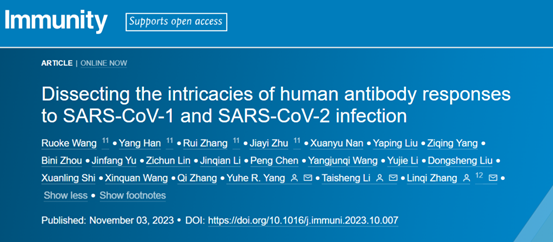
On November 3, 2023, a collaborative research team led by Professor Linqi Zhang from Tsinghua University, Professor Taisheng Li from Peking Union Medical College Hospital, and Researcher Yuhe Yang from the National Center for Nanoscience and Technology published a research paper titled "*Dissecting the intricacies of human antibody responses to SARS-CoV-1 and SARS-CoV-2 infection*" in the journal Immunity. By systematically comparing the characteristics of polyclonal and monoclonal antibodies from individuals infected with SARS-CoV-1 and SARS-CoV-2, the study revealed deep-seated differences in the immune responses to the two viral infections.
II. Differences in Polyclonal Antibody Responses
The team first conducted a systematic evaluation of serum antibodies from 25 SARS-CoV-1 convalescents (17 years post-infection) and numerous severe COVID-19 convalescents (6-12 months post-infection). The results showed:
-
Neutralizing Antibody Levels and Durability: The plasma neutralizing antibody titers in SARS-CoV-1 convalescents were significantly higher than those in severe COVID-19 convalescents and lasted longer (up to 17 years). This difference might be related to the higher proportion of RBD-specific antibodies induced by SARS-CoV-1 infection.
-
Cross-Reactive Characteristics: Sera from both convalescent groups showed some binding capacity to the heterologous virus's spike protein, but cross-neutralizing activity was weak, suggesting fundamental differences in the immunogenicity and antigenic epitope composition of their spike proteins.
III. How Monoclonal Antibody Repertoires Reveal Response Differences
To further elucidate the fine characteristics of the antibody response, the research team isolated 77 monoclonal antibodies targeting the spike protein from the memory B cells of SARS-CoV-1 convalescents. Functional analysis revealed:
-
Target Distribution and Neutralizing Potency: 60 antibodies targeted the RBD region, most exhibiting strong neutralizing activity; 15 bound to non-RBD S1 regions, and 2 targeted the S2 region, the latter showing weak or no neutralizing capacity.
-
Difference in RBD Antibody Proportion: The proportion of neutralizing RBD antibodies was significantly higher in SARS-CoV-1-infected individuals than in SARS-CoV-2-infected individuals, which might be one reason for the stronger serum neutralizing activity.
-
Somatic Hypermutation Frequency: Antibodies generated at similar time points after infection with either virus showed comparable frequencies of somatic hypermutation, indicating that antibody affinity maturation follows the body's inherent rhythm and is independent of the virus type or disease severity.
IV. Characteristics of the SARS-CoV-1 Antibody Epitope Landscape
Through structural and functional analysis of the 60 RBD antibodies, the team classified them into 7 categories (RBD-1 to RBD-7) based on epitope competition and spatial localization:
-
RBD-1~3 (RBM antibodies): Recognize different areas of the Receptor-Binding Motif (RBM), compete strongly with ACE2 and classical antibodies (e.g., 80R), exhibit strong neutralizing activity but weak cross-reactivity.
-
RBD-5~6 (non-RBM antibodies): Bind to conserved areas on the outer or inner side of the RBD. Among these, RBD-6 antibodies showed the weakest neutralizing activity but the strongest cross-reactivity. Electron microscopy revealed they can induce the spike protein to form trimer or dimer complexes.
-
RBD-7 (Unique Epitope Antibodies): Recognize a rare epitope at the lower side of the RBD top, near the junction with the adjacent NTD. These antibodies were highly prevalent in SARS-CoV-1 convalescents (13/60), often using the same V-region genes, representing a prominent feature of the SARS-CoV-1 antibody response.
V. Do Cross-Neutralizing Antibodies Have Broad-Spectrum Potential?
The study further screened 8 antibodies with cross-neutralizing activity against SARS-CoV-2 and evaluated their potency against various variants of concern (e.g., Delta, Omicron) and other ACE2-utilizing coronaviruses (e.g., SARSr-CoVs). Among them, antibodies W328-6A1 and W328-6E10 demonstrated strong broad-spectrum neutralizing capability.
By resolving the cryo-EM structures of these antibodies in complex with the spike protein, it was found that they bind to conserved epitopes on the RBD, evading common escape sites found in variants. This provides a structural basis for designing antiviral drugs and next-generation vaccines.
VI. Implications for Coronavirus Prevention and Control
-
Differences in Immune Memory Mechanisms: SARS-CoV-1 infection induces a more durable and higher proportion of RBD neutralizing antibodies, providing a reference for optimizing COVID-19 vaccine booster strategies.
-
Targets for Broad-Spectrum Antibody Design: The conserved epitopes targeted by RBD-6 and RBD-7 class antibodies are important candidate targets for developing broad-spectrum anti-coronavirus therapies.
-
Commonality in Antibody Response Patterns: Despite differences in the quality of antibodies induced by the two viruses, the patterns of somatic hypermutation are consistent, suggesting an inherent conservation in the human antibody maturation mechanism.
Conclusion
This study, through a systematic comparison of antibody response characteristics following SARS-CoV-1 and SARS-CoV-2 infections, reveals the similarities and differences in immune responses from the polyclonal serum level down to the monoclonal epitope level. It not only deepens the understanding of the immune memory formation mechanism against coronaviruses but also provides a critical theoretical basis and structural resources for designing vaccines and antibody drugs against future emerging coronaviruses. As the functions and mechanisms of more cross-reactive antibodies are deciphered, humanity moves closer to building a comprehensive defense system against coronaviruses.

This article is reviewed and published by the technical expert team of UA
Disclaimer: This article partially utilizes artificial intelligence assistance in its creation. If any content involves copyright or intellectual property issues, please let us know and we promise to verify and remove it as soon as possible.
Purchase recombinant protein, choose Nanjing UA-Bio
UA protein focuses on providing various protein reagents, raw materials, and services required for drug research and development, cell therapy, gene therapy, and basic scientific research, including drug target proteins, immune checkpoint proteins, cytokines, tool enzymes, customized protein expression, and full-length transmembrane protein development. Youai is committed to providing customers with high-quality products and professional services, and building a High-tech Biological Enterprise with International Competitiveness.







 Business license (three certificates in one)