




MERTK as a Therapeutic Target: How to Overcome the Clinical Challenges in Fibrotic Disease Treatment?


Fibrosis, as a common pathological feature of chronic metabolic diseases, has emerged as a significant global public health challenge. In chronic conditions such as metabolic dysfunction-associated steatotic liver disease (MASLD), diabetic kidney disease, hypertensive heart disease, and idiopathic pulmonary fibrosis, progressive fibrotic changes represent the key driver of organ failure and patient mortality.
- Recent Advances
I. Why Have Fibrotic Diseases Become a Major Global Health Challenge?
Fibrosis, as a common pathological feature of chronic metabolic diseases, has emerged as a significant global public health issue. In chronic conditions such as metabolic dysfunction-associated steatotic liver disease, diabetic kidney disease, hypertensive heart disease, and idiopathic pulmonary fibrosis, progressive fibrotic changes are the key factors leading to organ failure and patient mortality. Statistics indicate that nearly 50% of mortality in developed countries can be attributed to fibrosis-related diseases, with chronic kidney disease causing approximately 1.2 million deaths annually, and idiopathic pulmonary fibrosis affecting about 3 million patients worldwide.
From a pathological perspective, fibrosis is an abnormal repair response generated by the body to persistent injurious stimuli, characterized by excessive activation of myofibroblasts, massive deposition of extracellular matrix (ECM), and destruction of tissue architecture. This process is reversible in its early stages; however, as the disease progresses, progressive ECM accumulation ultimately leads to organ structural destruction and functional loss. Current clinical treatments primarily target the underlying etiology, while specific therapies directly targeting anti-fibrosis are extremely limited, highlighting the urgent need to develop novel anti-fibrotic drugs.
II. What Core Role Does the TGFβ Signaling Pathway Play in Fibrosis?
The Transforming Growth Factor-beta (TGFβ) signaling pathway is widely recognized as a core driver of the fibrotic process. During the initial stage of tissue injury, TGFβ coordinates the fibrotic response through both canonical SMAD-dependent pathways and non-canonical pathways (including MAPK, ERK, and JNK pathways). Specifically, after TGFβ binds to its receptor, it phosphorylates SMAD2/3 proteins, enabling them to form a transcriptional complex with SMAD4. This complex translocates to the nucleus to regulate the expression of fibrosis-related genes, promoting myofibroblast differentiation and ECM synthesis.
However, targeting the TGFβ pathway faces significant challenges. This pathway plays crucial roles in physiological processes such as embryonic development, immune regulation, and cell proliferation and differentiation. Systemic inhibition may lead to serious side effects, including autoimmune reactions, impaired wound healing, and an increased risk of tumorigenesis. This biological complexity urges researchers to seek specific regulatory nodes downstream of TGFβ, aiming to achieve more selective fibrosis treatment.
III. How Has MERTK Emerged as a Novel Target for Fibrosis Treatment?
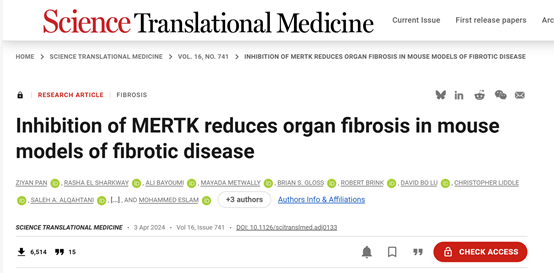
Mer Tyrosine Kinase (MERTK) is an important member of the TAM receptor tyrosine kinase family (TYRO3, AXL, MERTK), initially studied extensively in immune regulation and macrophage phagocytosis. Recent research has found that MERTK is significantly upregulated in various fibrotic disease models and positively correlates with disease severity. Key research from the Eslam team at the Westmead Institute for Medical Research, published in Science Translational Medicine, demonstrated that MERTK acts as a key downstream effector of the TGFβ signaling pathway and plays a central role in fibrosis progression across multiple organs.
From a molecular mechanism standpoint, MERTK promotes fibrotic development through a dual mechanism. On one hand, MERTK directly enhances the transcriptional activity of the TGFβ/SMAD signaling pathway, promoting the activation and proliferation of myofibroblasts. On the other hand, MERTK regulates the polarization of macrophages towards a pro-fibrotic phenotype, creating a microenvironment favorable for ECM deposition. This multi-cellular, multi-pathway regulatory characteristic makes MERTK an ideal target for intervening in the fibrotic network.
IV. What Are the Specific Molecular Mechanisms of MERTK in Fibrosis?
The molecular mechanisms by which MERTK mediates fibrosis involve intricate intracellular signaling networks. Under TGFβ stimulation, MERTK expression is significantly upregulated and activates multiple downstream pathways through autophosphorylation. Firstly, activated MERTK directly interacts with the SMAD complex, enhancing its nuclear translocation efficiency and transcriptional activity, thereby amplifying the pro-fibrotic effects of TGFβ. Secondly, MERTK regulates inflammatory responses and cell survival through the PI3K/AKT and NF-κB pathways, creating a sustained fibrotic environment.
At the cellular level, MERTK is expressed and functions in various cell types relevant to fibrosis. In myofibroblasts, MERTK promotes the expression of α-smooth muscle actin (α-SMA) and collagen. In macrophages, MERTK induces M2 polarization, increasing the secretion of TGFβ and Platelet-Derived Growth Factor (PDGF). In hepatic stellate cells and renal interstitial fibroblasts, MERTK inhibits apoptosis, prolonging their survival and enhancing ECM production capacity.
V. What Therapeutic Efficacy Does MERTK Inhibition Show in Preclinical Studies?
Research from the Eslam team provides compelling preclinical evidence that MERTK inhibition effectively slows disease progression in multiple organ fibrosis models. At the genetic level, MERTK knockout mice exhibited significantly mitigated pathological changes in models of liver, kidney, and lung fibrosis, including reduced collagen deposition, decreased inflammatory cell infiltration, and improved organ function. Notably, these protective effects did not cause significant immunosuppression or metabolic abnormalities, suggesting that MERTK inhibition may have a favorable safety profile.
In pharmacological intervention studies, the small molecule MERTK inhibitor UNC569 significantly delayed the progression of fibrosis when administered early in the disease, and could also partially reverse ECM deposition in established fibrosis models. This therapeutic effect was specific to MERTK, as similar anti-fibrotic effects were not observed in animals lacking other TAM family members. Furthermore, the study found that MERTK inhibition reduced the expression of various pro-fibrotic factors, including Connective Tissue Growth Factor (CTGF) and Tissue Inhibitors of Metalloproteinases (TIMPs), while promoting ECM degradation, thereby restoring the balance of fibrosis.
VI. What Clinical Translation Potential Do MERTK-Targeting Strategies Hold?
Based on the central role of MERTK in fibrosis, therapeutic strategies targeting this receptor show broad clinical application prospects. Firstly, MERTK inhibitors could potentially provide a unified treatment option for fibrotic diseases affecting different organs, achieving the goal of "one drug treating multiple fibroses". Secondly, because MERTK acts downstream of TGFβ, its inhibition might avoid the systemic side effects associated with directly targeting TGFβ, potentially improving treatment safety.
From a drug development perspective, various MERTK-targeting agents are under investigation. Small molecule inhibitors like MRX-2843 have already entered clinical trials for cancer, providing a good foundation for developing fibrosis indications. Antibody-based drugs may offer higher target specificity, reducing off-target effects on other TAM family members. Additionally, patient stratification strategies based on MERTK expression levels or genetic polymorphisms could help identify populations most suitable for MERTK-targeted therapy, moving towards precision medicine.
VII. What Are the Future Directions for MERTK Research?
Although the role of MERTK in fibrosis has been preliminarily confirmed, several important scientific questions remain to be explored. Mechanistically, there is a need to elucidate the specific upstream signals activating MERTK in fibrotic diseases of different organs, and the synergistic effects between MERTK and other TAM family members. In translational research, determining the optimal therapeutic time window, dosing regimens, and combination therapy strategies is crucial.
Notably, the potential synergistic effects of MERTK inhibitors with existing anti-fibrotic drugs (such as pirfenidone and nintedanib), as well as combination regimens with metabolic modulators or anti-inflammatory drugs, may produce additive or synergistic benefits. Simultaneously, developing non-invasive methods for detecting MERTK activity, such as quantitative assays for the plasma MERTK extracellular domain, will facilitate disease monitoring and treatment response assessment.
As understanding of MERTK's biological functions deepens and novel inhibitors are developed, targeting MERTK holds promise for providing breakthrough advances in the treatment of fibrotic diseases, offering new hope to millions of patients. Research achievements in this emerging field will not only advance anti-fibrotic therapy but also deepen our understanding of the mechanisms underlying tissue repair and regeneration.
This article is reviewed and published by the technical expert team of UA
Disclaimer: This article partially utilizes artificial intelligence assistance in its creation. If any content involves copyright or intellectual property issues, please let us know and we promise to verify and remove it as soon as possible.
Purchase recombinant protein, choose Nanjing UA-Bio
UA protein focuses on providing various protein reagents, raw materials, and services required for drug research and development, cell therapy, gene therapy, and basic scientific research, including drug target proteins, immune checkpoint proteins, cytokines, tool enzymes, customized protein expression, and full-length transmembrane protein development. Youai is committed to providing customers with high-quality products and professional services, and building a High-tech Biological Enterprise with International Competitiveness.







 Business license (three certificates in one)