




The Immune System's "Peacekeeping Force": How Tregs Won the 2025 Nobel Prize in Medicine


免疫系统的“维和部队”:Tregs如何赢得2025年诺贝尔医学奖
- Recent Advances
- Product Information
Three scientists, through 30 years of arduous exploration, have finally brought this once-overlooked "peacekeeping force" in the immune system into the spotlight, also opening up a new battlefield for humanity's fight against autoimmune diseases and cancer.
On October 6, 2025, Beijing time, the Nobel Prize in Physiology or Medicine was awarded to American scientists Mary E. Brenko and Fred Ramsdell, and Japanese scientist Shimon Sakaguchi, in recognition of their pioneering discoveries concerning the mechanism of peripheral immune tolerance.
Their work revealed a mystery of the immune system: our health relies not only on the immune system's powerful attack capabilities but also on an equally powerful "braking" system – regulatory T cells.
01 Guardians of Immune Balance: What are Tregs?
In the long exploration of immunology, scientists long believed that stronger immunity was better. However, this year's Nobel Prize reveals a counterintuitive truth: a healthy immune system requires not only offensive power but also precise regulatory capacity.
Regulatory T cells (Tregs) are a specialized class of cells responsible for suppressing immune responses. They act as the immune system's "security guards" or "peacekeeping force." They continuously and actively "apply the brakes" on the immune system, preventing it from mistakenly attacking the body's own tissues.
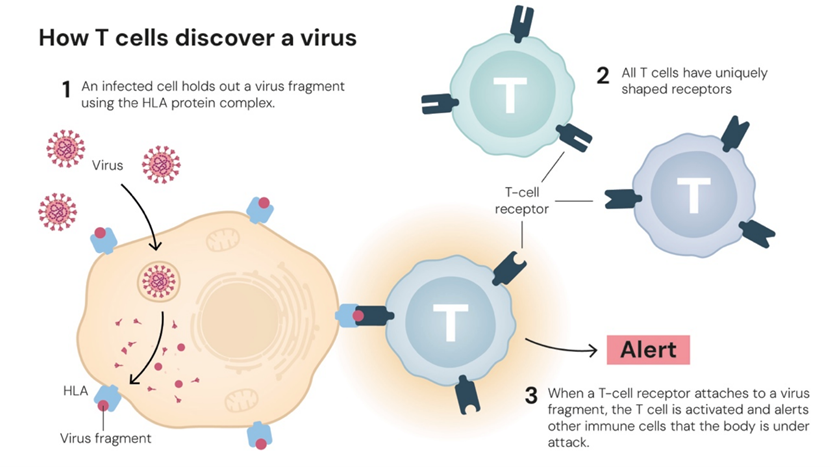
Peripheral immune tolerance refers to the state of unresponsiveness or low responsiveness exhibited by mature immune cells towards the body's own tissues or harmless foreign substances within the peripheral lymphoid organs. Its core function is to prevent mature immune cells from attacking self-tissues and causing autoimmune diseases, while also avoiding excessive reactions to harmless substances.
02 From Obscurity to the Pinnacle: The History of Treg Discovery
The birth of this Nobel-level discovery is a story of scientific exploration spanning 30 years, its clues originating from a theory nearly abandoned by the scientific community. For most of the 20th century, immunologists generally believed that immune tolerance primarily relied on "central tolerance" mechanisms. The thymus, acting as a "training school" for immune cells, was thought to eliminate T cells potentially reactive to self-tissues through a process of negative selection. However, some "rebellious" immune cells always managed to pass the thymic screening and enter the peripheral circulation.
Sakaguchi's Persistence
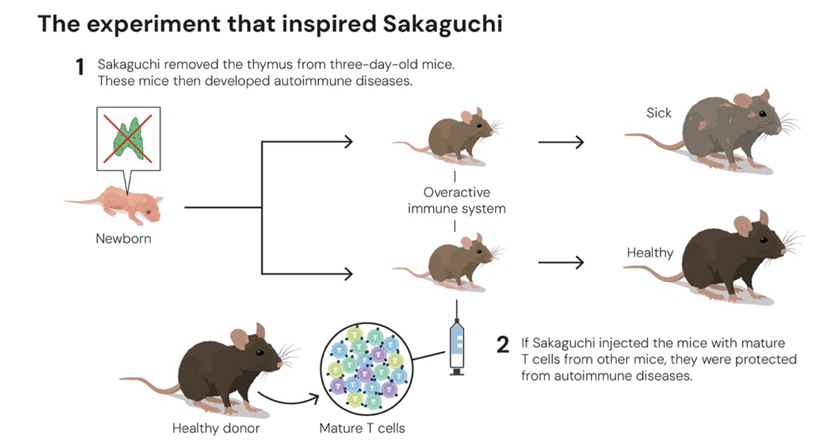
In 1995, Japanese scientist Shimon Sakaguchi first identified regulatory T cells. Initially, this discovery faced skepticism and neglect due to a lack of support from the mainstream in the field. Professor Wang Jiyang from Fudan University's School of Basic Medical Sciences recalled that in 1990, Sakaguchi reported at an immunology conference about a type of regulatory T cell, suggesting that removing this cell population via thymectomy caused autoimmune disease in mice. Nobody believed him, and there were no questions after his talk.
Genetic Evidence
The turning point came in 2001 when American scientists Brenko and Ramsdell discovered, in mouse models and human genetic disorders, that "mutations in the Foxp3 gene cause the fatal autoimmune disease IPEX syndrome," and that the key immune cells affected by this mutation were precisely Treg cells. They identified a strain of mutant mice called "scurfy" that died early due to an out-of-control immune system. After years of painstaking genetic mapping work, they pinpointed the culprit: a mutated gene named Foxp3.
The Perfect Convergence
Around the same time, Sakaguchi also verified in mice that the Foxp3 gene was the key transcription factor regulating Treg cells. Their research formed a "perfect convergence," confirming the indispensable role of Treg cells in peripheral immune tolerance. In 2003, Sakaguchi's team linked these two lines of evidence, proving that the Foxp3 gene discovered by Brenko and Ramsdell was the "master switch" for Treg development and function.
03 The Art of Immune Balance: How Do Tregs Work?
Tregs are a unique small subset of T lymphocytes, constituting only 5%-10% of peripheral T cells. They maintain immune balance through multiple mechanisms. Typically, Tregs apply the brakes on overactive immune responses by directly contacting effector T cells ("cell-to-cell contact") or by secreting inhibitory cytokines like TGF-β and IL-10, thereby inducing and maintaining immune tolerance. This prevents the body from mistakenly attacking its own tissues after clearing pathogens or tumors. Treg function fluctuates within a certain range, regulated by external physiological and pathological signals, and is crucial for maintaining immune homeostasis.
04 From Lab to Clinic: Clinical Applications of Tregs
This fundamental biological discovery is rapidly translating into clinical applications, providing new paradigms for treating a variety of diseases.
Autoimmune Disease Treatment
In autoimmune diseases like rheumatoid arthritis, inflammatory bowel disease, and type 1 diabetes, the problem is an overactive immune system attacking the body. Therefore, the therapeutic strategy is to enhance Treg function or numbers, effectively "stepping on the brakes" of the immune system. Strategies using low-dose interleukin-2 (IL-2) or direct infusion of in vitro expanded Treg cells are currently being actively explored in clinical trials.
New Directions in Cancer Therapy
In cancer, the situation is reversed. Cunning tumor cells "hijack" and recruit large numbers of Tregs to act as their "bodyguards," suppressing attacks from other immune cells. Therefore, a new anti-cancer approach involves temporarily removing or inhibiting Tregs within the tumor, effectively "releasing the brakes" on the immune system.
Companies like Pfizer and AstraZeneca have already developed CD25-ADC drugs in their pipelines. Teams led by Ying Tianlei/Wu Yanling and Wang Mingwei from Fudan University's School of Basic Medical Sciences have also published related research progress: achieving 80% tumor regression by clearing Treg cells, among other strategies.
Organ Transplantation and Other Applications
Tregs are isolated from a patient, expanded in the laboratory, and then reinfused back into the patient to increase their numbers. In some cases, researchers also engineer these T cells to carry surface antibodies, like an address label, allowing these "cellular security guards" to be precisely directed to the transplanted liver or kidney, protecting the organ from immune system attack.
05 The Connection Between the 2025 Nobel Prize in Physiology or Medicine and UA's Treg Polarization Kit, Mouse
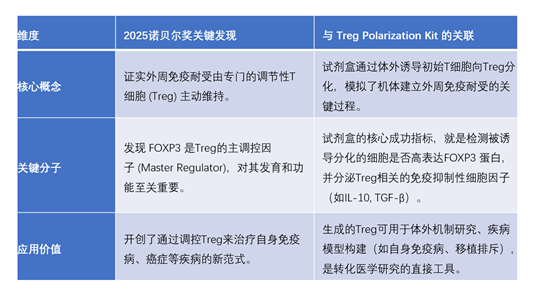
Based on the research paradigm recognized by the Nobel Prize, your Treg Polarization Kit can help you delve into cutting-edge immunological questions in the following directions:
-
Conduct Mechanistic Studies: You can use the Tregs generated with this kit todeeply investigate the specific molecular mechanisms by which they suppress the activation of other immune cells (such as effector T cells).
-
Build Disease Models: By generating Tregs in vitro and adoptively transferring them into disease model mice (such as experimental autoimmune encephalomyelitis EAE models, allergic asthma models, or transplantation models), you can directly study the therapeutic role of Tregs in disease contexts.
-
Explore Therapeutic Strategies: Your research can serve therapeutic development. For example, screening for small molecule drugs that can enhance Treg function, or optimizing protocols for the ex vivo expansion of Tregs, providing preliminary data support for cell therapies.
We hope all esteemed researchers can lead UA Protein to challenge for the Nobel Prize at an early date!
This article is reviewed and published by the technical expert team of UA
Disclaimer: This article partially utilizes artificial intelligence assistance in its creation. If any content involves copyright or intellectual property issues, please let us know and we promise to verify and remove it as soon as possible.
Purchase recombinant protein, choose Nanjing UA-Bio
UA protein focuses on providing various protein reagents, raw materials, and services required for drug research and development, cell therapy, gene therapy, and basic scientific research, including drug target proteins, immune checkpoint proteins, cytokines, tool enzymes, customized protein expression, and full-length transmembrane protein development. Youai is committed to providing customers with high-quality products and professional services, and building a High-tech Biological Enterprise with International Competitiveness.







 Business license (three certificates in one)