




Master Treg Polarization. With U&I Bio, Take Command of the Immune System.


Tregs are a critical subset of CD4+ T cells specifically responsible for immune tolerance and suppressing immune responses. They act as the "braking system" of the immune system, with their core mission being to prevent autoimmunity, suppress excessive inflammation, and maintain the stability of the internal immune environment.
- Recent Advances
- Product Information
In the intricate nation of the immune system, beyond offensive legions like Th1 and collaborative instructors like Tfh, a powerful "peacekeeping force" is essential to prevent excessive immune responses and self-inflicted damage. The core of this force is the regulatory T cell (Treg). Whether exploring cures for autoimmune diseases, improving organ transplant success rates, or managing the progression of inflammatory diseases, successfully inducing Treg differentiation and expanding their "stabilizing" power has become a cutting-edge focus of immunotherapy.
Facing the challenges of Treg's delicate polarization conditions and complex phenotyping, do you also find it difficult to master? Don't worry, this "Complete Guide to Treg Polarization" will serve as your experimental handbook, guiding you from principle to practice to precisely cultivate powerful "Immune Peacekeepers"!
Part 1: Theoretical Foundation – Understanding the In Vivo “Stabilization Experts”
1. What are Treg Cells?
Tregs are a crucial subset within CD4+ T cells dedicated to immune tolerance and suppressing immune responses. They are the "braking system" of the immune system, with the core mission of preventing autoimmunity, suppressing excessive inflammation, and maintaining the stability of the immune internal environment.
Core Markers:
-
Master Transcription Factor: Foxp3 – the "decider" of Treg identity and function.
-
Surface Markers: High expression of CD25 (IL-2 receptor α chain), CTLA-4, etc.
-
Function: Suppress the activity of effector T cells and APCs through various mechanisms, thereby "quelling the battle."
2. Why Perform In Vitro Treg Polarization?
-
Mechanistic Studies: To reveal how specific molecules affect Treg development, stability, and function.
-
Cell Therapy: To expand large numbers of functional Tregs in vitro for treating Graft-versus-Host Disease (GVHD), type 1 diabetes, and other autoimmune diseases – a highly promising "live cell drug."
-
Disease Modeling: To obtain Tregs for studying their functional status in specific disease environments.
Part 2: Core Arsenal – The Instruction Set for Building the "Peacekeeping Force"
In contrast to the pro-inflammatory environment for Th1 and Th17, Treg polarization requires a tolerogenic microenvironment.
Signaling Pathways:
-
TCR Signaling: Provided by anti-CD3/CD28 antibodies, delivering the necessary initial activation signal. Moderate TCR signal strength favors Treg differentiation.
-
Cytokine Environment:
-
TGF-β / Smad Pathway: Medium to high concentrations of TGF-β are the single most critical cytokine for inducing naive T cells to express Foxp3 and differentiate into induced Tregs (iTregs)! It initiates the Treg development program.
-
IL-2 / STAT5 Pathway: Tregs themselves do not produce IL-2, but their survival and proliferation are highly dependent on exogenous IL-2. Sufficient IL-2 signaling is crucial for the stable expansion and functional maintenance of Tregs in vitro.
-
Reinforcement and Stabilization Signals:
-
Retinoic Acid: Produced by dendritic cells, its addition in vitro can significantly enhance the inductive effect of TGF-β and promote Treg expression of gut-homing receptors, enhancing their suppressive function.
-
Rapamycin (mTOR inhibitor): Adding low-dose Rapamycin to the culture system can selectively inhibit the expansion of effector T cells, thereby "enriching" for Tregs, which are less sensitive to mTOR signaling, resulting in a purer population.
Part 3: Practical Operation – Mouse Treg Polarization Protocol
1. Cell Culture
-
Coat a 48-well cell culture plate overnight with 10 µg/ml anti-mouse CD3ε mAb and 2 µg/ml anti-mouse CD28 mAb. The next day, after washing and blocking the plate, add CD4+ T cells sorted using CD4 Nanobeads (S0K0003).
-
Use RPMI-1640 medium supplemented with 10 µg/mL anti-IFN-γ, 10 µg/mL anti-IL-4, 1 ng/mL IL-2, 30 ng/mL TGF-β1, 55 µM β-mercaptoethanol, and 10% FBS for culture.
-
Starting at 48 hours, monitor cell concentration every 12 hours. If the cell density is high, split the cells into new wells and add the above culture medium for stimulation (do not re-add CD3/CD28 antibodies for stimulation).
-
After culturing for 5 days, collect the cells and adjust the density to 10⁶/ml. Treat the cells with 10 ng/ml PMA, 1 µg/ml Ionomycin, and 10 µg/ml Brefeldin A for 5 hours.
Negative Control Group (Th0 cells):
-
Coat a 48-well cell culture plate overnight with 10 µg/ml anti-mouse CD3ε mAb and 2 µg/ml anti-mouse CD28 mAb. The next day, after washing and blocking the plate, add the sorted CD4+ T cells.
-
Use maintenance medium: RPMI-1640 supplemented with 10% FBS, 55 µM β-mercaptoethanol, 10 µg/mL anti-mouse IFN-γ, and 10 µg/mL anti-mouse IL-4 for culture.
-
Starting at 48 hours, monitor cell concentration every 12 hours. If the cell density is high, split the cells into new wells and add the above culture medium (do not add anti-mouse CD3ε and anti-mouse CD28 mAb). Culture for 5 days.
2. Flow Cytometry Detection
-
After harvesting the cells, perform staining with flow cytometry antibodies and run on the flow cytometer.
-
Antibodies:
Biolegend 118904 PE anti-mouse FOXP3 Recombinant Antibody
Biolegend 102024 Alexa Fluor® 700 anti-mouse CD25 Antibody
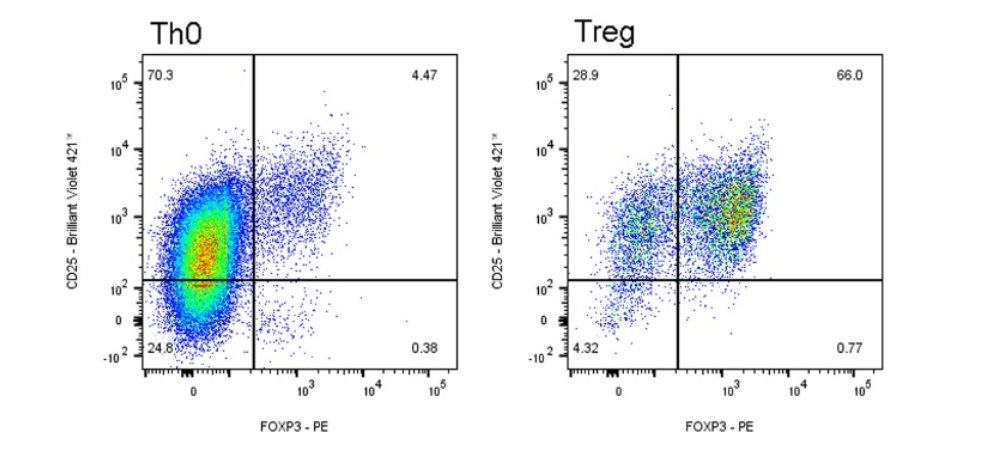
Treg Polarization Kit, Mouse / Mouse Treg Polarization Kit_UA090022_ UA BIOSCIENCE Official Website
This article is reviewed and published by the technical expert team of UA
Disclaimer: This article partially utilizes artificial intelligence assistance in its creation. If any content involves copyright or intellectual property issues, please let us know and we promise to verify and remove it as soon as possible.
Purchase recombinant protein, choose Nanjing UA-Bio
UA protein focuses on providing various protein reagents, raw materials, and services required for drug research and development, cell therapy, gene therapy, and basic scientific research, including drug target proteins, immune checkpoint proteins, cytokines, tool enzymes, customized protein expression, and full-length transmembrane protein development. Youai is committed to providing customers with high-quality products and professional services, and building a High-tech Biological Enterprise with International Competitiveness.







 Business license (three certificates in one)