




100-Billion-Yuan Blue Ocean Market: Panoramic Perspective of Hot Targets in PROTAC Technology


Most traditional small-molecule drugs and antibody drugs act through an "occupancy-driven" mechanism, in which they bind to the active sites of target proteins to inhibit their functions. These drugs face numerous challenges, such as difficulty in targeting proteins without well-defined active sites and high susceptibility to drug resistance.
- Recent Advances
- Product Information
I. PROTAC Technology Overview: A Paradigm Shift from Inhibition to Degradation
Traditional small molecule drugs and antibody drugs primarily function through an "occupancy-driven" model, meaning they inhibit the function of a target protein by binding to its active site. This model faces numerous challenges, such as difficulty in targeting proteins without well-defined active sites and susceptibility to drug resistance.
PROTAC technology pioneers a completely new "event-driven" model. Its mechanism of action is a catalytic cycle process:
-
Formation of Ternary Complex: The PROTAC molecule simultaneously binds to the target protein (POI) and an E3 ligase, forming a transient POI-PROTAC-E3 Ligase ternary complex.
-
Ubiquitination: The E3 ligase transfers ubiquitin chains onto the target protein, marking it for "destruction."
-
Degradation: The ubiquitin-tagged target protein is recognized and degraded by the cell's proteasome.
-
PROTAC Recycling: The PROTAC molecule itself is not degraded and can dissociate from the complex to catalyze the next round of the degradation cycle.
-
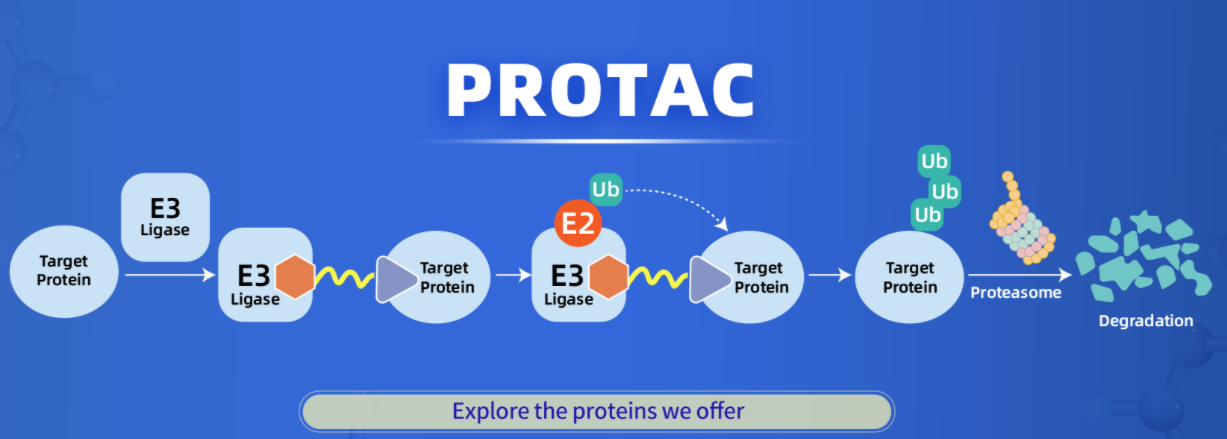
This mechanism endows PROTAC technology with unique advantages such as high selectivity, high efficiency, and the ability to overcome drug resistance, making it particularly suitable for targets traditionally considered "undruggable."
II. The E3 Ligase Toolbox: The "Guidance System" of PROTACs
E3 ligases are central to PROTAC design, determining degradation tissue specificity, efficiency, and safety. The human genome encodes over 600 E3 ligases, but current PROTAC development primarily relies on only a handful.
RING-type E3 Ligases: The most numerous type, they act as scaffolds simultaneously binding the target protein and the E2 ubiquitin-conjugating enzyme, directly catalyzing ubiquitin transfer.
| E3 Ligase/Complex | Characteristics & Functions | Application in PROTACs |
|---|---|---|
| VHL Protein | Von Hippel-Lindau protein, a component of an oxygen-sensing protein complex. | One of the two "star" E3s for PROTACs. As famous as CRBN, widely used in PROTAC design. Several VHL-recruiting PROTAC molecules have entered clinical trials. |
| MDM Family | The most important negative regulator of the p53 tumor suppressor protein. | Mainly used in developing anti-cancer drugs targeting MDM2 itself. Also used as E3 ligands in PROTACs degrading other proteins. |
| SCF Complex | Composed of Skp1, Cullin1, and an F-box protein. The F-box protein (e.g., β-TrCP, Skp2) is responsible for substrate recognition, allowing the complex to degrade various substrates. | Commonly recruited in early PROTAC designs, but less used now due to its complexity. |
| APC/C Complex | "Anaphase-Promoting Complex/Cyclosome," controls cell cycle progression, e.g., degrades Cyclins. | Functions primarily in the cell cycle; currently less used in PROTAC design. |
| Cbl Family | Primarily negatively regulates receptor tyrosine kinases, such as EGFR, PDGFR. | Their ligands can be used to design PROTACs degrading specific kinases, a promising direction. |
| TRIM Family | Involved in various processes like innate immunity and cell differentiation. | A research hotspot; exploring their ligands for PROTACs to develop immune or antiviral therapies. |
| β-TrCP | Recognizes substrates containing specific phosphorylated degron motifs, e.g., β-Catenin, IκB. | As an F-box protein of the SCF complex, its recognition mechanism is used to design phosphorylation-dependent PROTACs. |
| Skp2 | Recognizes and degrades cell cycle inhibitor proteins like p27, promoting cell proliferation. | A potential target for cancer therapy; also a source of E3 ligands. |
| IAPs | Inhibitor of Apoptosis Proteins, prevent cell apoptosis by inhibiting Caspases. | Their ligands (e.g., Bestatin analogs) are used to build degraders termed "SNIPERs" or "IAP-based PROTACs". |
| STUB1/CHIP | Cooperates with heat shock proteins to clear misfolded proteins. | Has potential in PROTACs targeting misfolded proteins (e.g., those associated with neurodegenerative diseases). |
| BRCA1-BARD1 | BRCA1 must form a heterodimer with BARD1 to possess E3 activity; plays a key role in DNA damage repair. | Current research focuses more on its role in cancer; less applied in PROTACs. |
| TRAF Family | TNF Receptor-Associated Factors, play a central role in immune and inflammatory signaling pathways. | A potential E3 source for PROTAC development in immune-related diseases. |
HECT-type E3 Ligases: These ligases possess a HECT domain. Their mechanism involves first "hijacking" ubiquitin from the E2 to form an E3-ubiquitin intermediate, before transferring ubiquitin to the substrate protein.
| E3 Ligase/Family | Characteristics & Functions | Application in PROTACs |
|---|---|---|
| WWP Family | Includes WWP1, WWP2, etc., involved in regulating cell growth, development. | Their ligands are being explored for PROTAC design to expand available E3 types. |
| E6-AP | Encoded by the UBE3A gene, its mutations are associated with Angelman syndrome. In HPV infection, recruited by viral protein E6 to degrade p53. | An important target in neurobiology and oncology; its ligands could be used for PROTACs. |
| Smurf Family | Smurf1 and Smurf2, primarily regulate TGF-β signaling and cell polarity. | Potential in regulating development and cell signaling, but PROTAC applications are still exploratory. |
| Itch | Regulates immune and inflammatory signaling, e.g., by ubiquitinating transcription factors. | A promising E3 for designing PROTACs for immune-related diseases. |
| HACE1 | A tumor suppressor that inhibits tumor growth by degrading proteins like Rac1. | Less studied, but noted due to its cancer-related substrates. |
| HUWE1 | A large HECT-type E3, degrades multiple substrates like Myc, p53, Mcl-1, plays a central role in cell fate decisions. | A very attractive E3 for PROTAC development due to its ability to degrade key oncoproteins. |
RBR-type E3 Ligases: Their mechanism is a hybrid of RING and HECT features. They have RING domains to bind E2, but their catalytic mechanism resembles HECT-type, forming a covalent E3-ubiquitin intermediate.
| E3 Ligase/Complex | Characteristics & Functions | Application in PROTACs |
|---|---|---|
| CRBN-DDB1 | CRBN forms a complex with DDB1 and other proteins; it is the direct target of thalidomide and its derivatives (lenalidomide, pomalidomide). | One of the two "star" E3s for PROTACs. The vast majority of PROTACs entering the clinic recruit CRBN. Its ligands are derived from immunomodulatory drugs, offering excellent drug-like properties and broad applicability. |
| Parkin | Closely associated with Parkinson's disease, involved in mitophagy (clearance of damaged mitochondria). | Its ligands are used to design PROTACs targeting mitochondrial-associated proteins; a research hotspot for neurodegenerative diseases. |
| HOIP/HOIL-1/LUBAC | The only known complex generating linear ubiquitin chains, crucial for the NF-κB signaling pathway. | Its unique linear ubiquitination function is being studied for developing novel PROTACs or regulatory tools. |
| HHARI | Structurally similar to Parkin, involved in transcription regulation and cellular stress response. | Research is still in early stages; a potential target for expanding the E3 toolbox. |
Currently, PROTAC R&D heavily relies on CRBN and VHL, which may lead to drug resistance and tissue specificity limitations. A key direction for future development is creating ligands for novel E3 ligases to expand the PROTAC "toolbox."
| Cat. No. | Product Name |
|---|---|
| UA080262 | Biotinylated CRBN/DDB1 Protein |
| UA080011 | DDB1/CRBN Complex, His Tag Protein |
| UA080473 | CRBN/DDB1 Protein, Dog |
| UA080012 | VHL/Elongin-C/Elongin-B Complex, His Tag Protein |
| UA080162 | MDM2 Protein |
| UA085001 | SKP1 His Tag Protein, Human |
| UA085002 | SKP2 GST Tag Protein, Human |
| UA010573 | XIAP(Bir3) His Tag Protein, Human |
| UA070026 | UBE3A His&Flag Tag Protein, Human |
| Displaying partial products, contact us for more~ |
III. In-depth Analysis of Hot Targets: The "Battleground" for PROTACs
STAT6
STAT6 is a key member of the Signal Transducer and Activator of Transcription family, primarily activated by IL-4 or IL-13. It functions as a transcription factor, playing critical roles in regulating immune responses, cell differentiation, and proliferation. STAT6 is implicated in various diseases, such as atopic dermatitis, asthma, and certain cancers. However, STAT6 loss-of-function can also lead to immunodeficiency.
In STAT6 target research, PROTAC technology shows great potential. Degrading STAT6 can address related diseases at their root. For example, KT-621, a STAT6-specific PROTAC molecule for atopic dermatitis, has demonstrated the ability to rapidly degrade STAT6 in blood cells in clinical trials.
| Cat. No. | Product Name |
|---|---|
| UA085003 | Human STAT6/CRBN PROTAC Binding Kit |
| UA080478 | STAT6 His Tag Protein, Human |
| UA080455 | STAT6 (K595R) His Tag Protein, Human |
| UA080456 | STAT6 His-Strep Tag Protein, Human |
| UA080457 | STAT6 GST Tag Protein, Human |
IRAK4
IRAK4 is a key mediator of innate immunity, and its overactivation is associated with various autoimmune diseases. IRAK4 possesses not only kinase activity but also functions as a scaffold protein in signal transduction. Traditional small molecule inhibitors only block its kinase activity, unable to interfere with its scaffolding function, limiting therapeutic efficacy.
PROTAC degraders targeting IRAK4 can simultaneously block both its kinase activity and scaffolding function, more effectively inhibiting inflammatory signaling pathways. Currently, several IRAK4 protein degrader pipelines have entered clinical research globally, with the most advanced being KT-474 (developed by Kymera in collaboration with Sanofi) and LT-002 (independently developed by the domestic Chinese company Lingtai Bio). These degraders show potential in treating diseases like atopic dermatitis and hidradenitis suppurativa.
| Cat. No. | Product Name |
|---|---|
| UA080454 | IRAK4 Protein, Human |
| UA080294 | IRAK4 His Tag Protein, Human |
GSPT1
GSPT1 is an important translation termination factor. It recognizes the stop codon on mRNA, facilitating the release of the finished protein from the ribosome. In tumor cells, GSPT1 expression is often dysregulated, and its downregulation can lead to abnormal expression of key proteins, thereby inhibiting tumor cell proliferation or inducing apoptosis. Consequently, GSPT1 is a potential target for cancer therapy.
Degradation of GSPT1 can activate the Integrated Stress Response, leading to cell death. For example, the GSPT1 degrader CC-90009 showed promising efficacy in clinical trials for Acute Myeloid Leukemia (AML). Furthermore, GSPT1 degradation has been found to disrupt the leukemic transcriptional network, reducing the expression of key fusion proteins and associated transcription factors.
| Cat. No. | Product Name |
|---|---|
| UA080159 | GSPT1 GST tag Protein, Human |
VAV1
VAV1 is a crucial signal transduction protein primarily expressed in hematopoietic cells (e.g., T cells, B cells). Through its GEF (Guanine nucleotide Exchange Factor) activity, VAV1 activates Rac/Rho family GTPases, participating in processes like cytoskeleton reorganization, cell migration and adhesion, receptor clustering, and signal transduction. Abnormal expression or dysfunction of VAV1 is associated with various diseases. In autoimmune and chronic inflammatory diseases (e.g., rheumatoid arthritis, inflammatory bowel disease), aberrant VAV1 activation can lead to excessive cytokine secretion. In cancer, VAV1 overexpression is closely related to tumor malignancy, metastasis, and prognosis.
Recently, significant progress has been made in researching VAV1 as a PROTAC target. Degradation of VAV1 can lead to a significant reduction in cytokines associated with immune-mediated disorders, thus holding potential therapeutic value in autoimmune and chronic inflammatory diseases. For instance, MRT-6160, a VAV1-targeting molecular glue degrader, has demonstrated significant efficacy in preclinical and early clinical studies.
| Cat. No. | Product Name |
|---|---|
| UA011223 | VAV1 GST Tag Protein, Human |
| UA080427 | VAV1 GST Tag Protein, Human |
IKZF1 / IKZF3
IKZF1 (Ikaros) and IKZF3 (Aiolos) are transcription factors of the Ikaros family, possessing highly conserved zinc finger domains that regulate lymphocyte differentiation and proliferation. They play key roles in various immune cells, such as regulating Interleukin-2 (IL-2) expression in T cells. In cancer cells, aberrant expression of IKZF1/IKZF3 is associated with various hematologic malignancies.
Several IKZF1/IKZF3-targeting PROTACs and molecular glue degraders have entered clinical research. For example, CELMoDs compounds like CC-92480, CC-220 (Iberdomide), and CC-99282 have shown promising activity in treating Relapsed/Refractory Multiple Myeloma (RRMM) and Relapsed/Refractory Non-Hodgkin Lymphoma (R/R NHL). Additionally, Innocare's ICP-490, a novel targeted protein degrader, is undergoing clinical trials in China for treating multiple myeloma.
| Cat. No. | Product Name |
|---|---|
| UA080160 | IKZF1 GST Tag Protein, Human |
| UA080161 | IKZF3 GST Tag Protein, Human |
IV. Summary
PROTAC technology, by harnessing the body's natural protein degradation system, opens up unprecedented avenues for disease treatment. With deepening understanding of E3 ligase biology and advances in medicinal chemistry, PROTAC drugs targeting hot and difficult targets like STAT6 and IRAK4 are expected to boom in the next decade, truly realizing the leap from "undruggable" to "degradable."
This article is reviewed and published by the technical expert team of UA
Disclaimer: This article partially utilizes artificial intelligence assistance in its creation. If any content involves copyright or intellectual property issues, please let us know and we promise to verify and remove it as soon as possible.
Purchase recombinant protein, choose Nanjing UA-Bio
UA protein focuses on providing various protein reagents, raw materials, and services required for drug research and development, cell therapy, gene therapy, and basic scientific research, including drug target proteins, immune checkpoint proteins, cytokines, tool enzymes, customized protein expression, and full-length transmembrane protein development. Youai is committed to providing customers with high-quality products and professional services, and building a High-tech Biological Enterprise with International Competitiveness.







 Business license (three certificates in one)