




Nature Double Feature: How FSP1 Seals Cancer Cells' "Ironclad" Fate?


Ferroptosis, an iron-dependent form of programmed cell death, has rapidly emerged as a research hotspot in the field of cancer treatment since its initial discovery in 2012.
- Recent Advances
- Product Information
- Reference
Ferroptosis, an iron-dependent form of programmed cell death, has rapidly emerged as a research hotspot in cancer therapy since its discovery in 2012. Its core mechanism involves lipid peroxidation of polyunsaturated fatty acid chains in cell membranes catalyzed by divalent iron or lipoxygenases when intracellular antioxidant systems are compromised, ultimately leading to cell death. Among the multiple defense systems constructed by cancer cells to evade death, ferroptosis suppressor protein 1 (FSP1) has become one of the most promising therapeutic targets in recent anticancer research due to its unique glutathione-independent mechanism.
The Dual Role of FSP1: From Apoptosis Induction to Ferroptosis Suppression
FSP1 was initially named AIFM2 (Apoptosis-Inducing Factor Mitochondria-Associated 2) due to its structural similarity to the pro-apoptotic protein AIF, suggesting a potential role in apoptosis. However, a 2019 study in Nature first revealed its core function as a ferroptosis suppressor protein: in GPX4-deficient cells, FSP1 reduces coenzyme Q10 (CoQ10) to generate its reduced form, ubiquinol (CoQH2), which acts as a radical-trapping antioxidant to directly neutralize lipid peroxyl radicals, thereby blocking the ferroptosis pathway. This discovery overturned the traditional view that ferroptosis relies solely on the GPX4-glutathione system, establishing FSP1/CoQ10/NAD(P)H as an independent parallel defense system.
Further studies showed that FSP1's anti-ferroptosis function is closely related to its cellular localization. Its N-terminal myristoylation modification targets it to the cell membrane and perinuclear lysosomes, where it forms homodimers to exert catalytic activity. A 2023 Nature study first resolved the pocket structure of FSP1 binding with FAD and CoQ, revealing that its intermediate metabolite, 6-OH-FAD, not only acts as an active cofactor to enhance enzyme activity but also directly serves as an antioxidant to trap lipid peroxyl radicals. This dual mechanism makes FSP1 a "double insurance" for cancer cells against ferroptosis.
Targeting FSP1: From Basic Research to Clinical Breakthroughs
Lung Cancer Therapy: Breaking the Metastatic Drug Resistance Dilemma
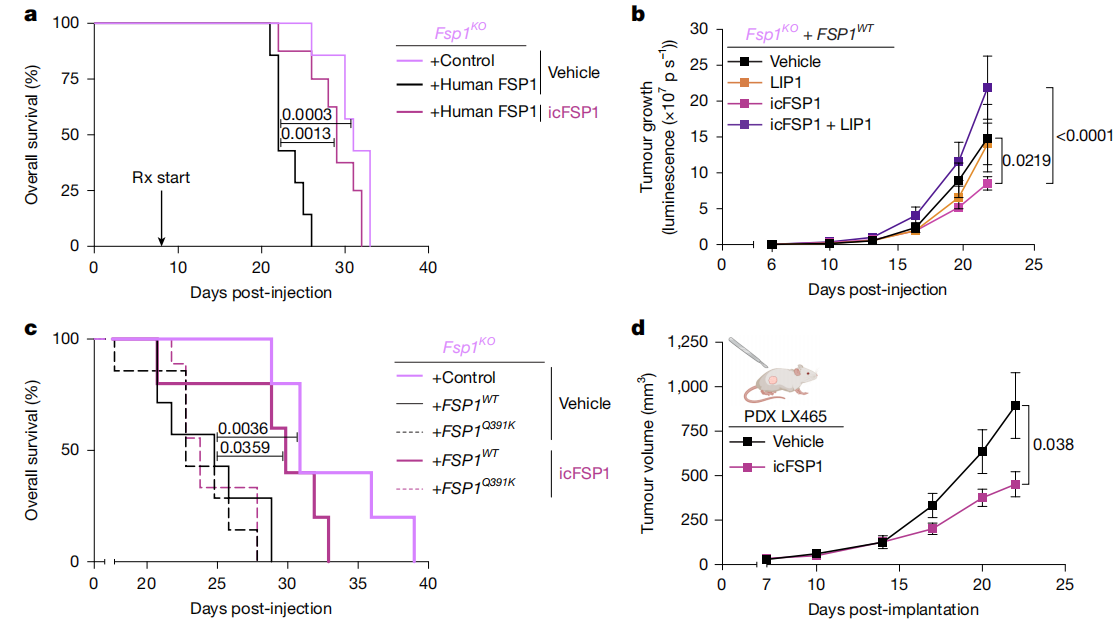
In November 2025, a study by New York University published in Nature provided direct evidence for FSP1's clinical value. By constructing a genetically engineered mouse model of lung adenocarcinoma, researchers found that knocking out the FSP1 gene reduced tumor growth by 80%, with significantly elevated lipid peroxidation levels. More crucially, the novel FSP1 inhibitor icFSP1 demonstrated efficacy comparable to gene knockout in animal experiments, with lower toxicity to normal cells. Lipidomics analysis revealed that FSP1 deficiency led to the accumulation of peroxidized phospholipids (pLPO) in tumors, while dietary supplementation with vitamin E or pharmacological inhibition of ferroptosis partially restored tumor growth, confirming FSP1's core mechanism of promoting tumor progression by suppressing ferroptosis.
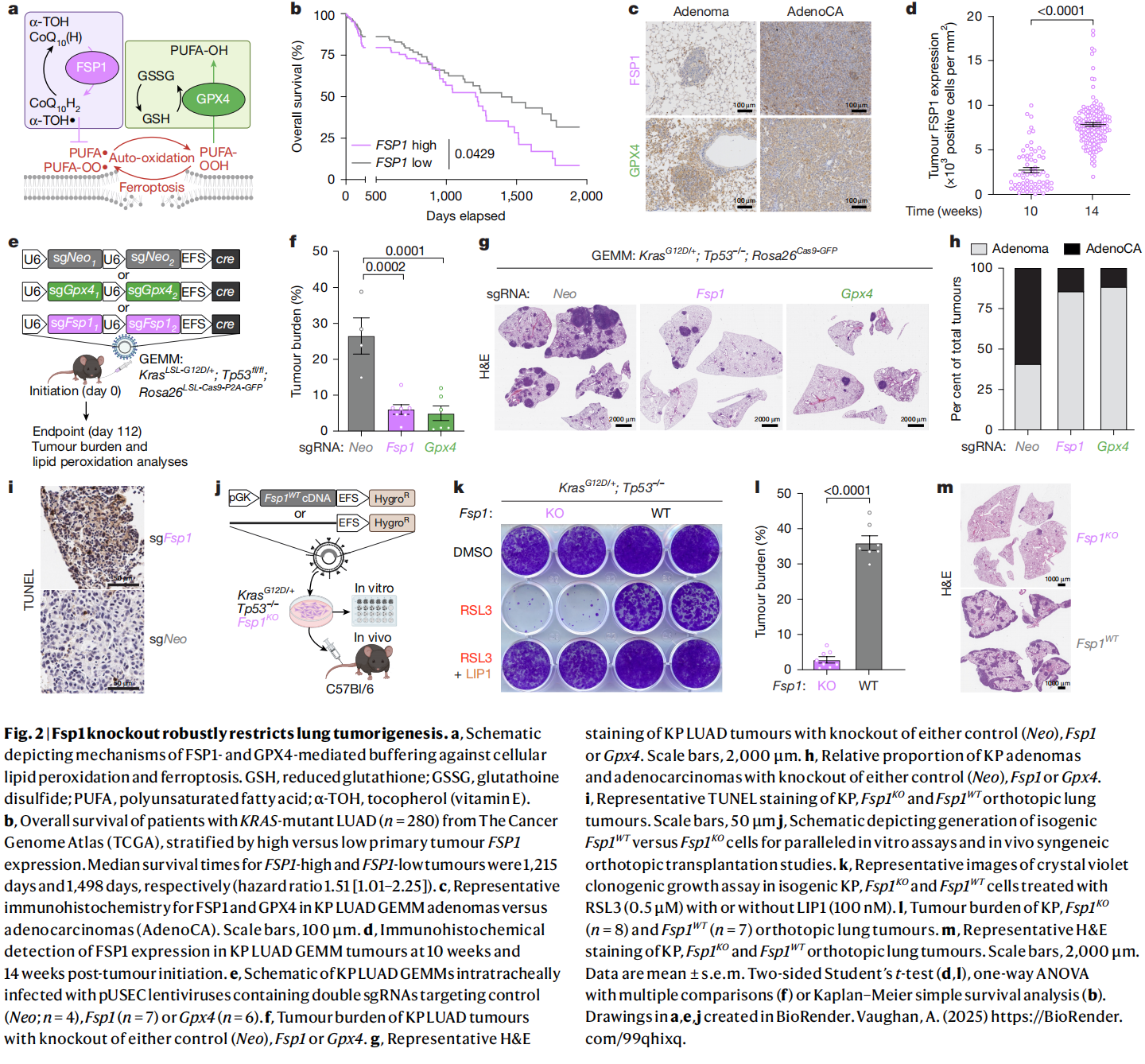
Clinical correlation analysis further revealed that high FSP1 expression is significantly associated with poor prognosis in lung adenocarcinoma patients, particularly in KRAS-mutant lung cancer, where FSP1 becomes a key target to overcome resistance to GPX4 inhibitors. icFSP1 induces FSP1 to detach from the membrane and form condensates via phase separation, blocking its interaction with lipid membranes and specifically inhibiting human FSP1 activity. This mechanism not only explains its high efficacy and low toxicity but also provides a structural basis for developing new-generation ferroptosis inducers.
FSP1 is a viable therapeutic target for KRAS-mutant lung adenocarcinoma:
Melanoma Metastasis: A New Perspective on Microenvironment Regulation
In the same November 2025 issue, a Harvard University study published in Nature revealed FSP1's specific role in metastatic melanoma. By constructing a lymph node metastasis screening model, researchers found that cancer cells shift from GPX4 dependence to FSP1 dependence to defend against ferroptosis during metastasis. This transition stems from GPX4 ubiquitination degradation and reduced glutathione (GSH) levels caused by the hypoxic lymph node microenvironment. Selective FSP1 inhibitors viFSP1 and FSEN1 significantly suppressed lymph node melanoma growth in intratumoral monotherapy but were ineffective against subcutaneous tumors, highlighting the microenvironment-specific nature of FSP1 targeting.
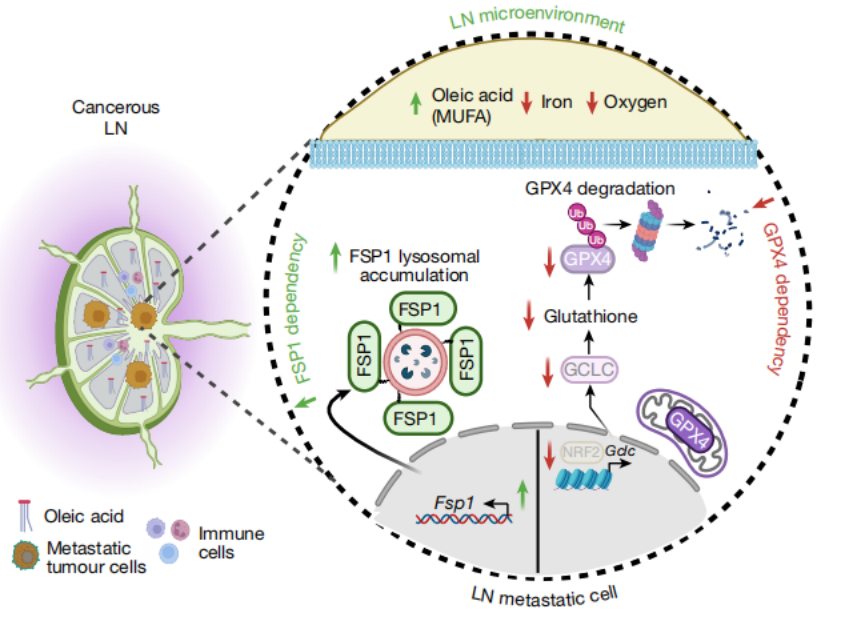
Mechanistic studies showed that metastatic cancer cells compensate for GPX4 loss by enhancing FSP1 expression in perinuclear lysosomes, and inhibiting FSP1 synergizes with ferroptosis inducers (e.g., RSL3, Erastin) to enhance efficacy. This discovery provides a novel strategy to halt melanoma progression, particularly for GPX4-low or resistant tumors, where FSP1-targeted therapy demonstrates unique advantages.
Challenges and Prospects: From Single Targets to Combination Therapy
Despite breakthroughs in FSP1-targeted therapy, its clinical translation still faces challenges. First, FSP1 is also expressed in normal cells (e.g., cardiomyocytes, neurons), necessitating further optimization of inhibitor structures for tumor-specific targeting. Second, cancer cells may develop resistance by upregulating other antioxidant pathways (e.g., DHODH, GPX4). A 2024 study by MD Anderson Cancer Center revealed a third ferroptosis defense mechanism—mitochondrial dihydroorotate dehydrogenase (DHODH) suppresses mitochondrial lipid peroxidation by reducing CoQ10, providing a new direction for combination therapy.
Future research should focus on: 1) developing highly selective inhibitors based on FSP1 phase separation mechanisms; 2) exploring synergistic treatment strategies combining FSP1 with GPX4 and DHODH inhibitors; and 3) using single-cell sequencing to analyze FSP1 expression heterogeneity in the tumor microenvironment. As understanding of the ferroptosis regulatory network deepens, targeting FSP1 is poised to become another milestone in cancer therapy following immune checkpoint inhibitors.
Product Recommendations
| Catalog No. | Product Name |
| UA079020 | FSP1 Inhibitor Assay Kit |
| UA080462 | Biotin-Kras[G12C] Protein, Human |
| UA080401 | Biotin-Kras[G12D] Protein, Human |
| UA080271 | Biotin Kras[G12A] Protein, Human |
| UA080001 | KRAS Avi&His Tag Protein |
| UA080002 | KRAS [G12C] His Tag Protein |
| UA080461 | KRAS[G12C](GDP load) His&Avi Tag Protein, Human |
| UA080003 | KRAS [G12V] Avi&His Tag Protein |
| UA080004 | KRAS [G12D] His Tag Protein |
| UA080005 | KRAS [G12R] Avi&His Tag Protein |
| UA080006 | KRAS [G13C] Avi&His Tag Protein |
| UA080007 | KRAS [G13D] Avi&His Tag Protein |
| UA080008 | KRAS [Q61H] Avi&His Tag Protein |
This article is reviewed and published by the technical expert team of UA
Disclaimer: This article partially utilizes artificial intelligence assistance in its creation. If any content involves copyright or intellectual property issues, please let us know and we promise to verify and remove it as soon as possible.
Purchase recombinant protein, choose Nanjing UA-Bio
UA protein focuses on providing various protein reagents, raw materials, and services required for drug research and development, cell therapy, gene therapy, and basic scientific research, including drug target proteins, immune checkpoint proteins, cytokines, tool enzymes, customized protein expression, and full-length transmembrane protein development. Youai is committed to providing customers with high-quality products and professional services, and building a High-tech Biological Enterprise with International Competitiveness.

- Mario Palma; Milena Chaufan; Cort B. Breuer; Sebastian Muller; Marie Sabatier; et al. Lymph node environment drives FSP1 targetability in metastasizing melanoma.Nature.2025.
- Katherine Wu; Alec Vaughan; Jozef P. Bossowski; Yuan Hao; Aikaterini Ziogou; et al. Targeting FSP1 triggers ferroptosis in lung cancer. Nature.2025.






 Business license (three certificates in one)