




New Additions to the DUBs (Deubiquitinating Enzymes) Family: Exploring the Total Number of DUB Members


UA BIOSCIENCE has made significant progress by successfully launching additional high-demand products, including USP2, USP3, USP4, USP5, and more.
- Recent Advances
- Product Information
UA BIOSCIENCE Launches More High-Demand Products: USP2, USP3, USP4, USP5!
Let’s take a closer look at each of these products:
USP2
USP2 is a key negative regulatory protein in the ubiquitin-proteasome system, located on the long arm of chromosome 11 (11q23.3). USP2 has four isoforms (1, 2, 3, and 4), containing 605, 353, 363, and 397 amino acid residues, respectively. The first isoform in humans and mice is commonly referred to as USP2-69 or USP2A.
Current research indicates that USP2 is associated with various malignancies, including prostate cancer, liver cancer, bladder cancer, and gliomas. Additionally, USP2 is highly expressed in triple-negative breast cancer and is linked to tumor migration and invasion.
Fatty acid synthase (FASN), which synthesizes palmitic acid from acetyl-CoA and malonyl-CoA, is often overexpressed in tumors and inhibits apoptosis. USP2-1 enhances FASN stability by inhibiting proteasome-dependent degradation.
p53 is another target of USP2. Under stress or DNA damage, p53 accumulates and triggers various anti-tumor events, such as DNA repair, apoptosis induction, or cell cycle arrest. MDM2, an E3 ubiquitin ligase for p53, is stabilized by USP2-1 through polyubiquitination, thereby reducing p53 levels in prostate cancer and cutaneous T-cell lymphoma. MDMX, another repressor of p53, attenuates the expression of p53 downstream genes by binding to its active transcriptional site. Studies have shown that USP2-1 stabilizes MDMX and enhances cell survival.
USP3
USP3 (Ubiquitin-Specific Protease 3) is located on human chromosome 15q22.3 and consists of 520 amino acids, including a highly conserved cysteine residue and two highly conserved histidine residues. USP3 participates in cellular processes by mediating the deubiquitination of target proteins.
USP3 regulates the levels of monoubiquitinated H2A and H2B. Knockdown of USP3 in U2OS cells leads to delayed S-phase progression and accumulation of DNA damage induced by ionizing radiation.
In HeLa cells with UV-induced DNA damage, USP3 targets RNF168 to deubiquitinate H2A and γ-H2AX, thereby reducing the accumulation of BRCA1 and 53BP1 at DNA break sites.
Additionally, USP3 inhibits the type I interferon pathway in antiviral immune responses by deubiquitinating the RIG-I receptor.
USP4
USP4 is located on chromosome 3q21.3, a region closely associated with the regulation of human malignancies.
The mammalian USP4 molecule consists of a catalytic domain and a non-catalytic domain. The catalytic domain contains characteristic Cys and His boxes, while the non-catalytic domain is largely composed of ubiquitin-like (UBL) and ubiquitin-specific protease (DUSP) domains.
USP4, USP11, and USP15 share similar structures, all containing UBL and DUSP domains. USP4 exhibits 70% sequence similarity with USP15 and 40% with USP11.
USP4 negatively regulates the Wnt pathway and inhibits TNF-α- and IL-1β-induced NF-κB activation by deubiquitinating TRAF2 and TRAF6.
USP4 interacts with ARF-BP1, deubiquitinates ARF-BP1, and promotes p53 degradation.
USP5
USP5, also known as isopeptidase T (ISOT), consists of 835 amino acids. It comprises five independent domains: two ZnF-UBP domains (amino acids 1-156 and 173-283), two UBA domains (amino acids 634-684 and 698-749), and a UBP active site.
USP5 has been shown to cleave at least five types of polyubiquitin chains, including K6, K29, K48, K63, and linear polyubiquitin chains.
In inflammation, USP5 acts as a key scaffold protein that recruits the E3 ubiquitin ligase MARCHF7 to NLRP3, promoting K48-linked polyubiquitination and subsequent degradation of NLRP3 via the autophagolysosomal pathway.
In rheumatoid arthritis, USP5 interacts with tumor necrosis factor receptor-associated factor 6 (TRAF6), stabilizing it by removing K48-linked polyubiquitin chains.
In malignancies, USP5 is highly expressed in breast cancer, liver cancer, colon cancer, lung cancer, and other tumors.
Applications of USP Family Proteins
1. Cell Experiments
2. Enzyme Activity Assays
3. Surface Plasmon Resonance (SPR)
4. ELISA
5. Bio-Layer Interferometry (BLI)
Other Functional Assays

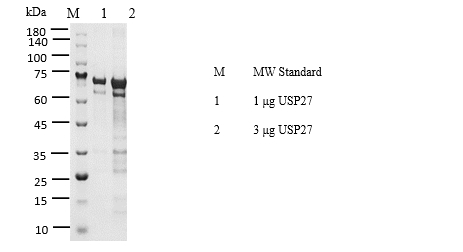
The USP27 activity was detected by cleaving the fluorogenic peptide substrate in FI assay. The reaction was performed by incubating the USP27 protein and substrate at 25℃ for 60 min, then reading RFU with BMG.
For more small molecule drug development targets, click here to explore further >>>
Click on the product catalog numbers below to access detailed information on our official website.
This article is reviewed and published by the technical expert team of UA
Disclaimer: This article partially utilizes artificial intelligence assistance in its creation. If any content involves copyright or intellectual property issues, please let us know and we promise to verify and remove it as soon as possible.
Purchase recombinant protein, choose Nanjing UA-Bio
UA protein focuses on providing various protein reagents, raw materials, and services required for drug research and development, cell therapy, gene therapy, and basic scientific research, including drug target proteins, immune checkpoint proteins, cytokines, tool enzymes, customized protein expression, and full-length transmembrane protein development. Youai is committed to providing customers with high-quality products and professional services, and building a High-tech Biological Enterprise with International Competitiveness.







 Business license (three certificates in one)