

VHL-dependent PROTAC degraders targeting BCL-XL: Innovative strategies to overcome platelet toxicity and development of reagent kits


BCL-XL is highly expressed in various tumor cells, promoting their survival and drug resistance.
- Recent Advances
- Product Information
I. Target Challenges and PROTAC Solutions
1.1 Challenges of BCL-XL as a Therapeutic Target
BCL-XL is highly expressed in various tumor cells, promoting their survival and drug resistance. However, as it is also a critical dependency protein for platelet survival, traditional small-molecule inhibitors (e.g., ABT263) induce irreversible platelet apoptosis while inhibiting tumors, leading to severe dose-limiting toxicity, primarily manifested as thrombocytopenia and potential bleeding risks.
1.2 Advantages and Design Strategies of PROTAC Technology
PROTAC technology uses bifunctional molecules to simultaneously recruit target proteins and E3 ubiquitin ligases, inducing ubiquitination and subsequent proteasomal degradation of the target protein. This strategy not only effectively eliminates target protein function but may also overcome resistance to traditional inhibitors, with catalytic and event-driven properties theoretically enabling lower doses.
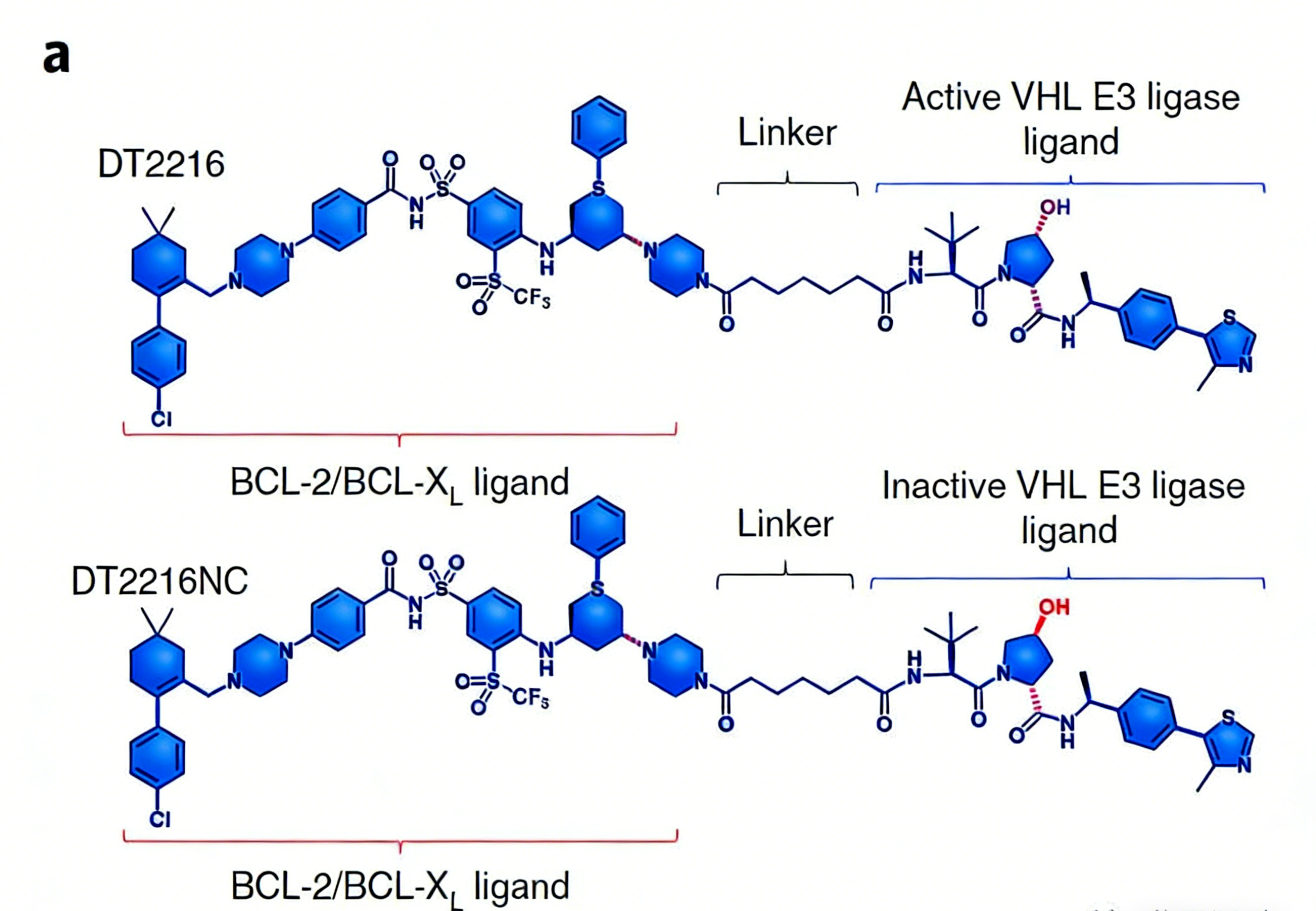
For BCL-XL, the University of Florida team designed the PROTAC molecule DT2216. Its core design rationale includes:
- Target Protein Ligand: Retains the binding moiety of the validated BCL-XL inhibitor ABT263.
- E3 Ligand: Utilizes a VHL (Von Hippel-Lindau) ligand for linkage.
- Selection Basis: VHL ligase is highly expressed in various solid and hematologic tumors but minimally expressed in platelets. This tissue distribution difference provides a theoretical foundation for selectively degrading BCL-XL in tumor cells while sparing platelets.
II. In Vitro Activity, Selectivity, and Mechanism of DT2216
2.1 High-Efficiency and Selective Tumor Cell Killing
DT2216 demonstrates excellent degradation efficiency in MOLT-4 T-cell acute lymphoblastic leukemia cells, with a half-maximal degradation concentration (DC50) of 63 nM and a maximal degradation rate (Dmax) of 90.8%. Correspondingly, its half-maximal effective concentration (EC50) for killing tumor cells is 52 nM, showing nearly fourfold higher activity compared to the parent compound ABT263. Crucially, in platelets, DT2216's degradation of BCL-XL is significantly weaker (DC50 > 3 µM, Dmax ~26%), confirming its reduced selective toxicity based on VHL expression differences.
2.2 Highly Specific Target Protein Degradation
Despite DT2216's high binding affinity for BCL-2 (Ki = 1.82 nM) and its ability to form ternary complexes with BCL-2 in vitro biochemical assays (e.g., AlphaLISA), in live-cell binding experiments (nanoBRET) and proteomic analyses, DT2216 specifically induces BCL-XL degradation without significantly affecting BCL-2, MCL-1, or other intracellular protein levels. This discrepancy in selectivity between in vitro and in vivo contexts may relate to the complex intracellular protein microenvironment, chaperone interference, or BCL-2 protein conformational differences, providing important clues for深入研究PROTAC selectivity mechanisms.
III. In Vivo Efficacy and Safety Evaluation of DT2216
3.1 Superior Anti-Tumor Activity and Pharmacokinetic Properties
In xenograft mouse models, intraperitoneal injection of DT2216 maintains effective concentrations above the EC50 in tumor tissue for over 10 days and sustains BCL-XL protein suppression. Compared to ABT263, DT2216 exhibits stronger tumor growth inhibition.
3.2 Significantly Improved Platelet Safety
ABT263 treatment causes a sharp decline in mouse platelets post-administration, followed by compensatory rebound increases, with associated bleeding or thrombosis risks. In contrast, DT2216 has a very mild impact on platelet counts, with no significant decline or rebound observed, demonstrating its successful PROTAC design for improved therapeutic windows.
IV. Development Significance and Prospects of the BCL-XL/VHL PROTAC Kit
The success of DT2216 highlights PROTAC technology's immense potential in addressing toxicity issues of difficult-to-drug targets. Developing standardized PROTAC research kits around the BCL-XL/VHL core pair holds significant value:
- Standardized Research Tools: The kit provides validated DT2216 analogs, control compounds, and配套的cell and molecular biology assays, offering学术界and工业界a unified, reliable tool for studying BCL-XL-dependent tumors, PROTAC mechanisms, and combination therapies.
- Mechanistic Exploration Platform: The kit facilitates systematic研究of VHL-dependent degradation selectivity, cell-specific ternary complex formation, and potential resistance mechanisms.
- Starting Point for Drug Discovery: With DT2216 as a prototype, the kit supports optimization of linker length, chemical composition, and E3 ligands to drive the discovery of next-generation BCL-XL degraders with higher selectivity and lower toxicity.
V. Which Vendors Offer BCL-XL/VHL PROTAC Kits?
Nanjing UA-Bio Technology Co., Ltd. (UA-Bio) has independently developed the "Human BCL-XL/VHL PROTAC Binding Kit" (Product No.: UA086019), a high-performance in vitro detection platform specifically designed for targeted degradation research of the anti-apoptotic protein BCL-XL. This kit aims to help researchers precisely analyze the dynamic process of PROTAC-induced "target-PROTAC-E3 ligase" ternary complex formation, providing critical technical support for innovative drug development in肿瘤治疗and耐药性研究fields.
| Core Product Advantages |
|---|
| Precise Targeting and High-Efficiency Degradation Potential: The kit's core component is a meticulously designed and optimized human BCL-XL/VHL bifunctional PROTAC molecule. One end exhibits high-affinity binding to the target protein BCL-XL, while the other precisely recruits the VHL E3 ubiquitin ligase complex, efficiently promoting ternary complex formation and guiding BCL-XL protein ubiquitination-proteasomal degradation. Validated in vitro, this product demonstrates exceptional target-binding activity and degradation potential. |
| Highly Stable Reagent Quality: Advanced synthesis techniques and stringent quality control ensure the provided PROTAC molecules exhibit high chemical purity, excellent solubility stability, and outstanding batch-to-batch consistency, laying a solid foundation for reliable and reproducible experimental results. |
| Flexible Compatibility for Multi-Scenario Applications: The kit not only includes the core PROTAC molecule but also optimized buffer systems and experimental guidelines, widely compatible with cell-level functional validation (e.g., Western Blot, apoptosis assays) and biophysical binding analyses on platforms like SPR, ITC, and TR-FRET, offering a complete solution from molecular interactions to functional phenotype research. |
| Comprehensive Technical Support: Detailed product documentation is provided, including physicochemical properties, usage recommendations, reference data, and precautions. Our technical support team offers professional, timely assistance for research design, experimental optimization, and result analysis. |
Nanjing UA-Bio Technology Co., Ltd. is committed to providing innovative, reliable, and high-quality reagents and solutions for肿瘤靶向治疗, protein function research, and drug discovery. For detailed technical information, validation data, or specific application inquiries regarding the "Human BCL-XL/VHL PROTAC Binding Kit" (Product No.: UA086019), please feel free to contact us.
This article is reviewed and published by the technical expert team of UA
Disclaimer: This article partially utilizes artificial intelligence assistance in its creation. If any content involves copyright or intellectual property issues, please let us know and we promise to verify and remove it as soon as possible.
Purchase recombinant protein, choose 
UA protein focuses on providing various protein reagents, raw materials, and services required for drug research and development, cell therapy, gene therapy, and basic scientific research, including drug target proteins, immune checkpoint proteins, cytokines, tool enzymes, customized protein expression, and full-length transmembrane protein development. Nanjing Univ is committed to providing customers with high-quality products and professional services, and building a High-tech Biological Enterprise with International Competitiveness.







 Business license (three certificates in one)