The pleiotropic role and molecular mechanisms of the key oncogene BCL6 in reproductive pathology


B-cell lymphoma 6 (BCL6), as a transcriptional repressor and key oncogene, promotes malignant progression in cancers by driving proliferation, inhibiting DNA damage repair, and blocking terminal cell differentiation.
- Recent Advances
- Product Information
Abstract
B-cell lymphoma 6 (BCL6), as a transcriptional repressor and key oncogene, promotes malignant progression in tumors by driving proliferation, inhibiting DNA damage repair, and blocking terminal differentiation. Recent studies have revealed its critical role in physiological and pathological processes of reproductive tissues (e.g., placenta and endometrium). This review systematically summarizes BCL6's functions in placental development and endometrial homeostasis, explores how its dysregulation contributes to preeclampsia and endometriosis through diverse molecular mechanisms, and highlights its potential as a diagnostic marker and therapeutic target.
I. Spatiotemporal Expression Patterns and Physiological Functions of BCL6 in Placenta
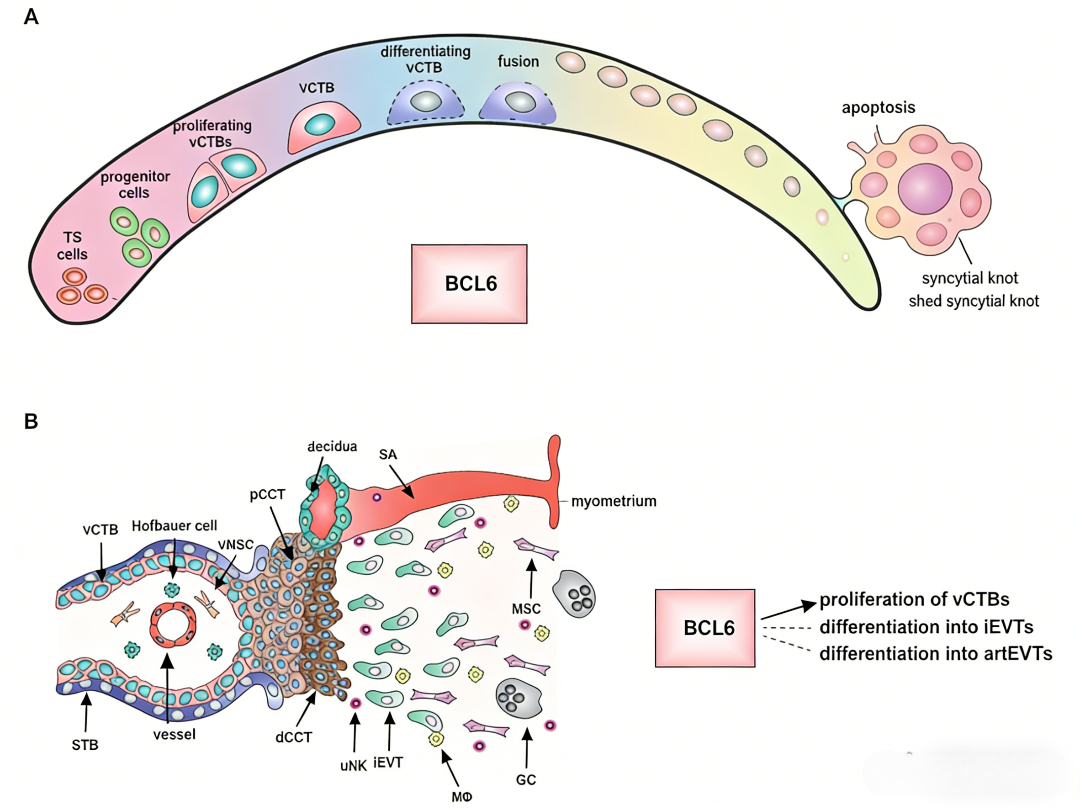
BCL6 exhibits dynamic expression patterns in human placental tissues. During early pregnancy, it shows significant expression in various trophoblast cell types, including cytotrophoblasts, syncytiotrophoblasts, and extravillous trophoblasts, with gradual downregulation as pregnancy progresses. This spatiotemporal specificity suggests BCL6 is a key regulator of early placental development.
Functionally, BCL6 exerts pleiotropic effects in trophoblasts:
1. Regulating Proliferation and Differentiation: BCL6 promotes proliferation and survival of cytotrophoblasts while inhibiting their differentiation and fusion into syncytiotrophoblasts.
2. Influencing Invasion and Migration: In extravillous trophoblasts, BCL6 may enhance migration and invasion capabilities, which are crucial for placental implantation and uterine spiral artery remodeling.
3. Potential Stem/Progenitor Cell Regulation: Emerging evidence suggests BCL6 may participate in the self-renewal and lineage differentiation fate of trophoblast stem/progenitor cells.
II. Pathological Association Between BCL6 Upregulation and Preeclampsia
Preeclamptic placentas exhibit aberrantly high BCL6 expression. Its upregulation mechanisms may involve transcriptional activation, enhanced mRNA translation, and post-translational modifications. Under pathological conditions, BCL6 overexpression disrupts the delicate balance between trophoblast proliferation and differentiation. Specifically, BCL6-mediated inhibition of syncytiotrophoblast differentiation programs may lead to placental formation defects, insufficient trophoblast invasion, and subsequent core pathophysiological changes in preeclampsia, such as placental ischemia-hypoxia and impaired maternal vascular remodeling.
III. BCL6 as a Core Mediator and Clinical Biomarker in Endometriosis
In endometriosis, factors like local inflammation and hypoxic microenvironments can stabilize BCL6 upregulation in ectopic and eutopic endometria. Elevated BCL6 modulates multiple downstream signaling pathways, affecting endometrial cell proliferation, apoptosis, migration, invasion, and fibrosis, directly contributing to ectopic lesion formation and maintenance. Its mediated impairment of endometrial receptivity is also a key mechanism of endometriosis-associated infertility.
This discovery holds significant clinical translational value: BCL6 detection in endometrial tissues has been validated as a valuable non-invasive diagnostic adjunct for endometriosis. Moreover, its expression levels in eutopic endometrium correlate strongly with poor IVF outcomes (e.g., implantation failure, miscarriage), demonstrating potential as a reproductive prognosis predictor.
IV. Research Prospects and Translational Implications
The precise molecular networks of BCL6 in reproductive systems remain incompletely elucidated. Future research should focus on:
1. Causal Relationship Clarification: Determining whether BCL6 upregulation drives preeclampsia and endometriosis or is a secondary consequence of disease microenvironments (chronic inflammation, oxidative stress).
2. Mechanistic Dissection: Utilizing novel models like trophoblast stem cells and endometrial organoids, combined with CRISPR/Cas9 gene editing, to precisely identify BCL6's direct targets and signaling networks in trophoblast and endometrial epithelial/stromal cell fate determination.
3. Targeted Intervention Exploration: Investigating small-molecule BCL6 inhibitors (including novel strategies like PROTAC degraders) for potential applications in regulating placental function, improving endometrial receptivity, and treating related reproductive disorders.
V. Summary
In conclusion, BCL6—a multifunctional factor central to both oncology and reproductive biology—plays essential roles in placental development and endometrial homeostasis. Its aberrant upregulation in preeclampsia and endometriosis represents a critical pathological link and offers novel diagnostic and therapeutic avenues. This research paradigm also profoundly reveals that life development, reproduction, and tumor diseases share highly conserved core regulatory hubs.
VI. Which Vendors Provide BCL6/CRBN PROTAC Kits?
Nanjing UA-Bio Technology Co., Ltd. has independently developed the "Human BCL6/CRBN PROTAC Binding Kit" (Catalog No.: UA086021), a high-performance in vitro detection platform specifically designed for cutting-edge proteolysis-targeting chimera research. This kit enables researchers to directly investigate the core mechanism of PROTAC molecules—efficient induction of "target-PROTAC-E3 ligase" ternary complex formation—providing a precise and reliable starting point for drug discovery in tumor immunology and hematologic cancer therapeutics.
| Core Product Advantages |
|---|
| High Specificity and Degradation Efficiency: The kit's core component is a meticulously designed and synthesized human BCL6/CRBN bifunctional PROTAC molecule. With high-affinity binding to BCL6 at one end and precise recruitment of CRBN E3 ubiquitin ligase at the other, it forms stable ternary complexes to effectively guide BCL6 ubiquitination and proteasomal degradation. Rigorous in vitro validation demonstrates superior targeted degradation efficiency and specificity across multiple cell models. |
| Exceptional Reagent Stability and Batch Consistency: Advanced manufacturing processes and strict quality control ensure high chemical purity, excellent solution stability, and outstanding batch-to-batch consistency, guaranteeing reproducible and reliable experimental results. |
| Flexible Compatibility and Comprehensive Solutions: Beyond the core PROTAC molecule, the kit includes recommended buffer systems and protocols compatible with diverse cellular functional assays (e.g., Western Blot for degradation efficiency), proliferation/phenotypic analyses, and molecular interaction studies (SPR, ITC, AlphaScreen/LISA platforms). It offers an integrated solution from binding validation to functional research. |
| Expert Technical Support: Detailed product manuals cover PROTAC physicochemical properties, recommended concentrations, preliminary validation data, cell treatment guidelines, and precautions. Our technical team provides professional consultation for experimental design and optimization. |
Nanjing UA-Bio Technology Co., Ltd. is committed to delivering innovative, high-efficiency, and high-quality core reagents and solutions for protein science, drug discovery, and cell signaling research. For detailed specifications, validation data, or application support regarding the "Human BCL6/CRBN PROTAC Binding Kit" (Catalog No.: UA086021), please contact us anytime.
This article is reviewed and published by the technical expert team of UA
Disclaimer: This article partially utilizes artificial intelligence assistance in its creation. If any content involves copyright or intellectual property issues, please let us know and we promise to verify and remove it as soon as possible.
Purchase recombinant protein, choose 
UA protein focuses on providing various protein reagents, raw materials, and services required for drug research and development, cell therapy, gene therapy, and basic scientific research, including drug target proteins, immune checkpoint proteins, cytokines, tool enzymes, customized protein expression, and full-length transmembrane protein development. Nanjing Univ is committed to providing customers with high-quality products and professional services, and building a High-tech Biological Enterprise with International Competitiveness.







 Business license (three certificates in one)