Immunotherapy target CD40/CD40L: pathway mechanisms, functions, and kit development applications


CD40 (TNFRSF5) is a type I transmembrane glycoprotein with a molecular weight of approximately 48 kDa.
- Recent Advances
- Product Information
I. Fundamental Biological Characteristics of CD40/CD40L
1.1 Molecular Properties and Expression Profile of CD40
CD40 (TNFRSF5) is a type I transmembrane glycoprotein with a molecular weight of approximately 48 kDa. It is constitutively expressed not only on antigen-presenting cells such as B cells, dendritic cells (DCs), monocytes/macrophages, but also widely present on non-immune cells including platelets, endothelial cells, fibroblasts, and smooth muscle cells. Notably, CD40 is aberrantly expressed on the surface of various B-cell lymphomas, bladder cancers, and ovarian cancer cells, providing direct rationale for its use as a therapeutic target.
1.2 Molecular Properties and Expression Regulation of CD40L
The natural ligand of CD40, CD40L (CD154, TNFSF5), is a 39 kDa type II transmembrane protein. Its expression is highly inducible and primarily restricted to hematopoietic system cells such as activated CD4+ T cells, platelets, activated B cells, and NK cells. Under specific pathological conditions, endothelial cells and smooth muscle cells may also weakly express CD40L.
1.3 General Signaling Mechanisms of the TNF Receptor Superfamily
TNF-R-SF signaling initiation depends on ligand-induced receptor trimerization. Natural trivalent TNF-SF ligands drive the assembly of spatially separated receptor monomers into functional trimeric signaling complexes by binding to them. This precise spatial aggregation forms the structural basis for initiating downstream signaling cascades.
II. Signal Transduction Pathways and Immunological Functions of CD40/CD40L
2.1 Diverse Downstream Signaling Networks
Upon binding of CD40 to CD40L, its intracellular domain recruits various adaptor proteins such as TNF receptor-associated factors (TRAFs) and NF-κB activator 1 (Act1), thereby activating complex and cell-type-specific downstream pathways:
- TRAF6: Primarily activates the JAK/Stat3 pathway.
- TRAF1/2: Induces the MKK/p38/ERK1/2 MAPK signaling pathway.
- Act1 and TRAF3: Cooperatively activate NF-κB (including classical and non-classical pathways), JNK, and PI3K/AKT signaling, and can amplify MAPK signals.
2.2 Core Role in Adaptive Immune Initiation
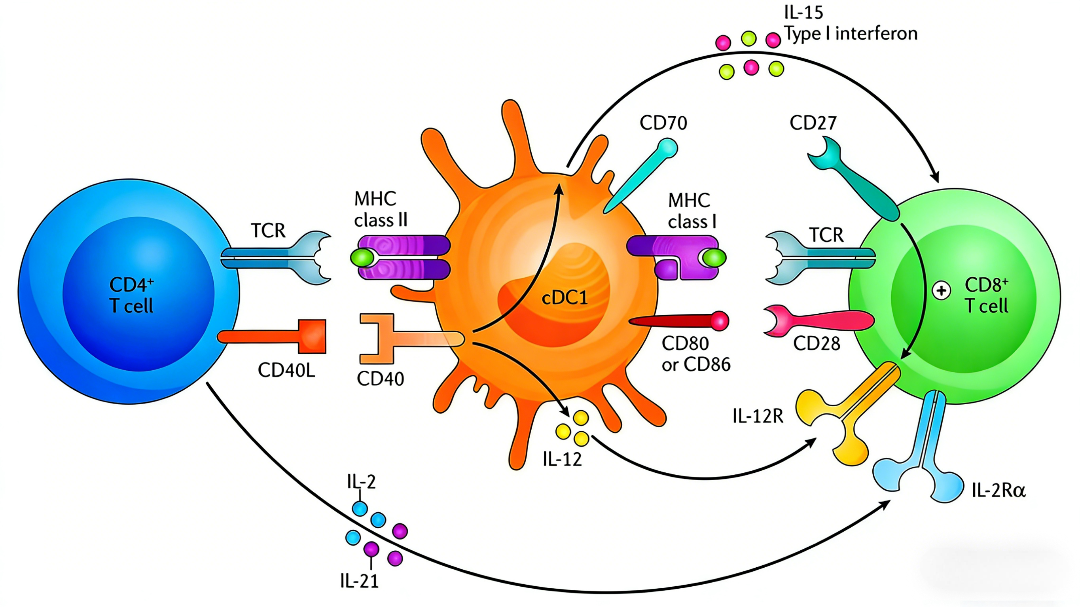
The CD40/CD40L axis is a key switch for DC "licensing" and effective T cell activation:
- DC Maturation and Functional Activation: Activated CD4+ T cells bind to CD40 on DCs via surface CD40L, triggering DC maturation. This process upregulates the expression of MHC I/II molecules, co-stimulatory molecules (CD80/CD86), and cytokines (e.g., IL-12), significantly enhancing their antigen presentation and cross-presentation capabilities.
- CD8+ T Cell Activation: DCs "licensed" by CD40 signaling can efficiently initiate antigen-specific CD8+ T cells, promoting their differentiation into cytotoxic effector T lymphocytes.
- Macrophage Polarization and Stromal Remodeling: CD40 signaling can drive macrophages toward a pro-inflammatory M1 phenotype and enhance their anti-tumor activity and ability to disrupt tumor stroma.
III. Kit Development and Therapeutic Strategies Based on the CD40/CD40L Pathway
Therapeutic strategies targeting this pathway are primarily divided into agonist antibody-based and CD40L ligand-based approaches. The development of related kits aims to precisely regulate the activity of this signaling axis.
3.1 CD40 Agonist Antibody Kits
These kits provide high-affinity, highly specific anti-CD40 monoclonal antibodies for in vitro research or in vivo therapy. Their mechanism of action is to mimic CD40L function by directly crosslinking and activating CD40 on APCs. Optimized antibodies reduce toxicity to non-target cells such as hepatocytes and exhibit improved pharmacokinetic properties.
3.2 Engineered CD40L in Novel Cell Therapies
Integrating CD40L signaling into adoptive cell therapy is an important strategy to enhance its efficacy. Related construction kits can be used to prepare genetically engineered cells expressing CD40L.
- Strategy 1: CAR-T Cells Displaying CD40L
Through genetic engineering (e.g., using P2A self-cleaving peptides), CD19-CAR-T or other targeted CAR-T cells can be modified to stably express membrane-bound CD40L. This modification enables CAR-T cells to activate DCs and macrophages in the tumor microenvironment via autocrine or paracrine CD40L while recognizing and killing tumor cells, triggering endogenous anti-tumor immune responses, preventing antigen escape, and establishing long-term immune memory.
- Strategy 2: CAR-T Cells Secreting CD40 Agonists
A more advanced strategy involves designing CAR-T cells capable of secreting soluble CD40 agonists (e.g., single-chain antibody fragments, scFv). For example, mesothelin (Meso)-targeted CAR-T cells can be engineered to simultaneously secrete anti-CD40 agonist antibodies. This "autocrine" mode provides sustained, controllable CD40 activation signals in the local microenvironment of CAR-T cells, more safely and effectively reshaping the immune microenvironment and enhancing CAR-T cell infiltration and persistence.
IV. Summary and Outlook
The CD40/CD40L pathway is a central hub of immune activation, and its agonist strategies demonstrate immense potential in tumor immunotherapy. Various kits developed based on this pathway (from agonist antibodies to genetic engineering vectors) not only provide powerful tools for basic immunology research but also drive the development of novel combination therapies. Future generations of reagents and therapies targeting the intensity, spatiotemporal specificity, and cell-type-selective regulation of CD40 signaling are expected to further address current bottlenecks in immunotherapy, enabling safer and more effective clinical translation.
V. Which Manufacturers Provide CD40/CD40L Kits?
Nanjing UA-Bio Technology Co., Ltd. (UA-Bio) has independently developed the "Human CD40/CD40L Binding Kit" (Catalog No.: UA086020), a highly sensitive in vitro detection platform specifically designed for studying immune cell co-stimulatory signaling pathways and related drug development. This kit aims to help researchers accurately and efficiently detect the specific binding activity between CD40 and its ligand CD40L, providing stable and reliable one-stop solutions for antibody screening, efficacy evaluation, and mechanistic research in fields such as autoimmune diseases and tumor immunotherapy.
| Core Advantages of the Product |
|---|
| High Purity and High Bioactivity: The kit provides rigorously validated high-purity human CD40 protein and its ligand CD40L. Both exhibit correct folding conformations and full biological activity, enabling high-affinity specific binding that replicates the natural state, ensuring the authenticity and reliability of interaction data. |
| Excellent Batch-to-Batch Consistency and Stability: Advanced recombinant expression and purification processes, combined with a stringent quality control system, ensure that the provided protein products exhibit exceptional purity, stability, and outstanding batch-to-batch consistency, guaranteeing the stability and reproducibility of your long-term experimental results. |
| Ready-to-Use Flexible Detection Platform: This kit is optimized based on the classic enzyme-linked immunosorbent assay (ELISA) principle, providing pre-coated strips, detection antibodies, standards, and a complete set of optimized buffers. The workflow is simple, fast, and flexible, suitable for various applications such as antibody affinity assessment, competitive inhibition assays, drug screening, and signaling pathway research. |
| Complete Solutions and Professional Support: We provide detailed and optimized experimental protocols, standard curve references, and typical data graphs to help you quickly establish your experimental system. Additionally, our professional technical team offers comprehensive support for your research design, data interpretation, and experimental optimization. |
Nanjing UA-Bio Technology Co., Ltd. is committed to providing innovative, high-quality core reagents and tools for immunology, antibody drug development, and cell signaling research. For detailed technical parameters, validation data, or specific application inquiries regarding the "Human CD40/CD40L Binding Kit" (Catalog No.: UA086020), please feel free to contact us.
This article is reviewed and published by the technical expert team of UA
Disclaimer: This article partially utilizes artificial intelligence assistance in its creation. If any content involves copyright or intellectual property issues, please let us know and we promise to verify and remove it as soon as possible.
Purchase recombinant protein, choose 
UA protein focuses on providing various protein reagents, raw materials, and services required for drug research and development, cell therapy, gene therapy, and basic scientific research, including drug target proteins, immune checkpoint proteins, cytokines, tool enzymes, customized protein expression, and full-length transmembrane protein development. Nanjing Univ is committed to providing customers with high-quality products and professional services, and building a High-tech Biological Enterprise with International Competitiveness.







 Business license (three certificates in one)