The CRBN E3 ligase in targeted protein degradation technology and its application advantages


Targeted Protein Degradation (TPD) technology is a hot field in recent drug development.
- Recent Advances
- Product Information
Targeted Protein Degradation (TPD) technology has emerged as a hot field in novel drug development in recent years. This technology utilizes the endogenous ubiquitin-proteasome system to specifically recognize and degrade disease-related target proteins, achieving high selectivity in small molecule drug design. Since its conceptual proposal, TPD technology has evolved various strategies, with Protein Degradation Targeting Chimera (PROTAC) and Molecular Glue showing particularly remarkable progress.
I. Mechanism and Advantages of PROTAC Technology
PROTAC is a bifunctional small molecule compound that connects a target protein ligand with an E3 ubiquitin ligase ligand through a linker. This molecule can simultaneously bind to both the target protein and E3 ligase, forming a ternary complex that induces polyubiquitination of the target protein, leading to its recognition and degradation by the proteasome. Compared to traditional small molecule inhibitors, PROTAC technology offers the following significant advantages:
1. Selective Degradation Capability: Enables selective degradation of specific protein isoforms or domains, eliminating not only the catalytic function of the target but also disrupting its scaffolding role.
2. High Selectivity Transformation: Converts known protein ligands into more specific degraders, enhancing target selectivity.
3. Complex Degradation Potential: Capable of degrading entire protein complexes, providing new approaches for targeting traditionally "undruggable" targets.
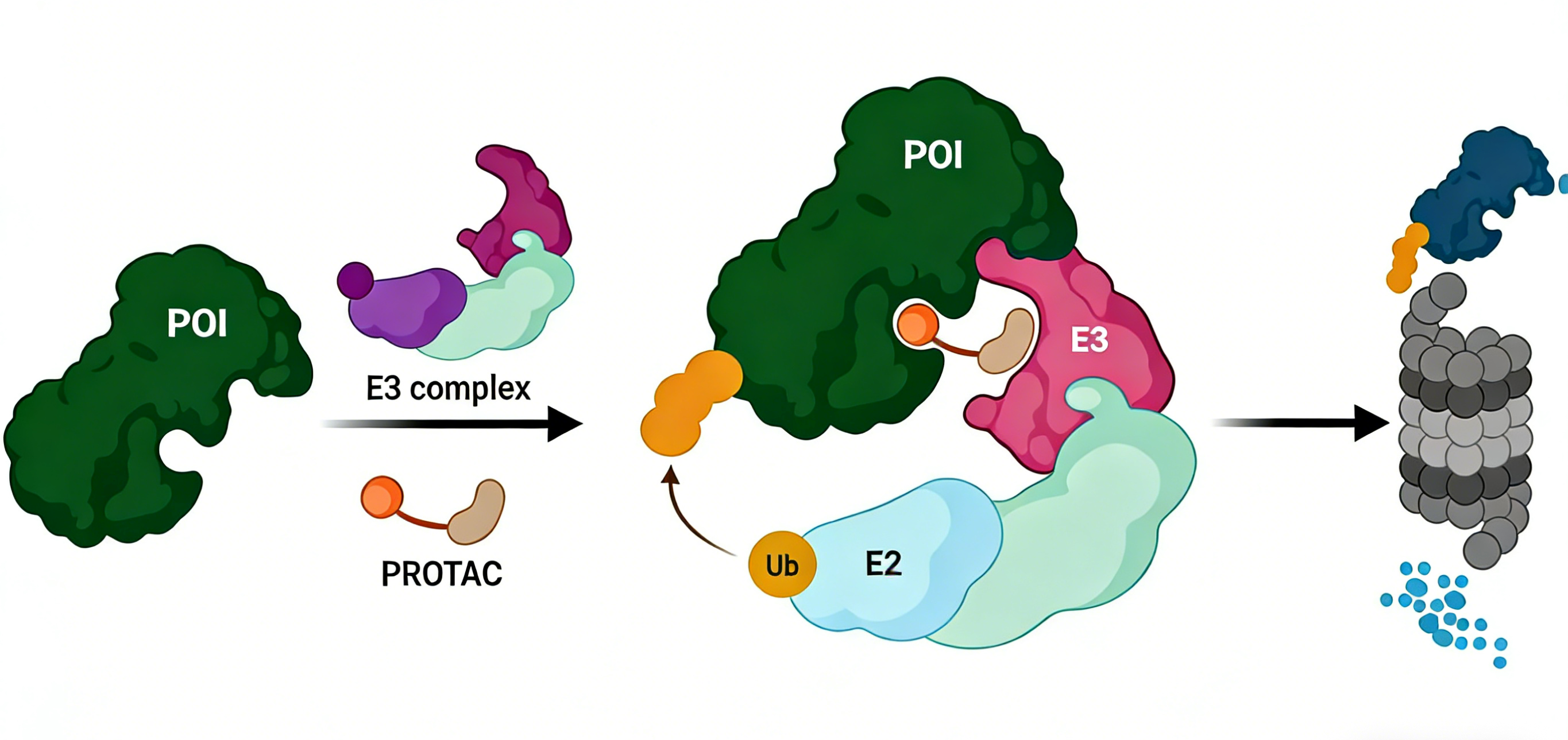
II. The Central Role of CRBN E3 Ligase in PROTAC Development
Currently, over 600 E3 ubiquitin ligases are known in humans, but fewer than 20 have been successfully applied in PROTAC development, with Cereblon (CRBN) and von Hippel-Lindau (VHL) proteins being the most common.
Compared to VHL, CRBN is widely expressed in various tissues and cell types, which somewhat limits its tissue selectivity but also endows its ligands with generally lower molecular weight and better oral bioavailability. Additionally, CRBN-based PROTACs often use thalidomide derivatives (such as lenalidomide and pomalidomide) as ligands. These ligands have well-defined chemical properties and excellent druggability, making them one of the most commonly used E3 ligase ligands in current PROTAC drug development.
III. The Critical Role of CRBN Knockout Cell Lines in TPD Research
In TPD technology research, especially for validating CRBN-dependent degraders (such as VAV1/CRBN PROTAC), constructing CRBN knockout cell lines is essential. These cell lines can:
1. Verify Degradation Specificity: Through control experiments, confirm whether the degradation of the target protein depends on the CRBN-mediated ubiquitination pathway.
2. Assess Off-Target Effects: Rule out the possibility of compounds acting through non-CRBN-dependent mechanisms, ensuring targeted degradation.
3. Support Mechanism Studies: Provide an ideal in vitro model for in-depth research into the binding mode of degraders, ternary complex formation, and degradation kinetics.
IV. Conclusion
In summary, CRBN, as a core E3 ligase, plays a pivotal role in the development of PROTAC technology. Using CRBN knockout cell lines for rigorous functional validation is an indispensable step in advancing the research of CRBN-dependent degraders (such as the probe molecules related to the VAV1/CRBN PROTAC kit), facilitating the discovery and optimization of highly selective, orally available targeted protein degradation drugs.
V. Which Manufacturers Provide VAV1/CRBN PROTAC Kits?
Nanjing UA-Bio Technology Co., Ltd. (UA-Bio) has independently developed the "Human VAV1/CRBN PROTAC Binding Kit" (Catalog No.: UA086022), a high-performance in vitro detection platform specifically designed for cutting-edge research in protein degradation targeting chimeras. This kit aims to help researchers directly observe the core mechanism of PROTAC molecules—efficiently inducing the formation of the "target-PROTAC-E3 ligase" ternary complex—providing a precise and reliable starting point for drug discovery in tumor immunology and hematologic cancer treatment.
| Core Advantages of the Product |
|---|
| High Specificity and Efficient Degradation Activity: The core component of the kit is a carefully designed and synthesized human VAV1/CRBN bifunctional PROTAC molecule. One end of this molecule binds with high affinity to the target protein VAV1, while the other end precisely recruits the CRBN E3 ubiquitin ligase, forming a stable ternary complex that effectively guides the ubiquitination and subsequent proteasomal degradation of VAV1. Through rigorous in vitro activity validation, this product demonstrates excellent targeted degradation efficiency and specificity in various cell models. |
| Outstanding Reagent Stability and Batch-to-Batch Consistency: We employ advanced production processes and stringent quality control systems to ensure that the provided PROTAC molecules exhibit high chemical purity, excellent solution stability, and outstanding batch-to-batch consistency, providing a solid foundation for the reproducibility and reliability of your experimental results. |
| Flexible Compatibility and Comprehensive Solutions: This kit not only provides the core PROTAC active molecule but also includes recommended buffer systems and operation guidelines, making it compatible with various cellular functional experiments (such as Western Blot for degradation efficiency), cell proliferation and phenotypic analysis, and molecular interaction studies based on platforms like SPR, ITC, and AlphaScreen/LISA. It offers an integrated solution from binding validation to functional research. |
| Professional Technical Support: We provide detailed product technical manuals, covering the physicochemical properties of PROTAC molecules, recommended usage concentrations, preliminary validation data, cell experiment handling suggestions, and precautions. Our technical support team is available to offer professional consultation and support for your research design and experimental optimization. |
Nanjing UA-Bio is committed to providing innovative, efficient, and high-quality core reagents and solutions for protein science, drug development, and cell signal transduction research. For detailed technical parameters, validation data, or application support regarding the "Human VAV1/CRBN PROTAC Binding Kit" (Catalog No.: UA086022), please feel free to contact us.
This article is reviewed and published by the technical expert team of UA
Disclaimer: This article partially utilizes artificial intelligence assistance in its creation. If any content involves copyright or intellectual property issues, please let us know and we promise to verify and remove it as soon as possible.
Purchase recombinant protein, choose 
UA protein focuses on providing various protein reagents, raw materials, and services required for drug research and development, cell therapy, gene therapy, and basic scientific research, including drug target proteins, immune checkpoint proteins, cytokines, tool enzymes, customized protein expression, and full-length transmembrane protein development. Nanjing Univ is committed to providing customers with high-quality products and professional services, and building a High-tech Biological Enterprise with International Competitiveness.







 Business license (three certificates in one)