Design of Active Probes Targeting Non-Catalytic Conserved Residues of Bromodomain and Their Application in Epigenetic Research Kits


The Bromodomain (BRD) family proteins, as key epigenetic "readers" that recognize histone acetylated lysine (KAc), play a regulatory role in diseases such as cancer.
- Recent Advances
- Product Information
Abstract
Bromodomain (BRD) family proteins, as key epigenetic "readers" that recognize histone acetylated lysine (KAc), play crucial regulatory roles in diseases such as cancer and are highly promising therapeutic targets. However, developing chemical probes capable of directly capturing and analyzing their activity faces significant challenges, as most BRDs lack classical catalytic activity and their ligand-binding pockets often lack reactive amino acid residues. This study innovatively designed an active probe based on the structure of the broad-spectrum BRD inhibitor BSP, which can covalently label highly conserved residues in BRDs. The probe's labeling specificity and binding modes were systematically validated through mass spectrometry and crystallography. The successful development of this probe lays a core technical foundation for constructing the Epigeneous Bromodomain Research Kit, a tool for epigenetic mechanism research and drug discovery.
I. Target Characteristics and Probe Design Challenges
BRD proteins primarily participate in gene transcription regulation through their conserved KAc recognition pockets. Designing active probes for such proteins faces dual obstacles: 1) Their function relies on substrate recognition rather than catalytic processes, making traditional enzyme activity-based probe design strategies inapplicable; 2) The amino acid residues within the binding pockets typically lack high reactivity, making specific covalent labeling difficult. Therefore, there is an urgent need for a novel probe tool capable of directly and covalently "capturing" BRD proteins while reflecting their binding characteristics with small-molecule ligands.
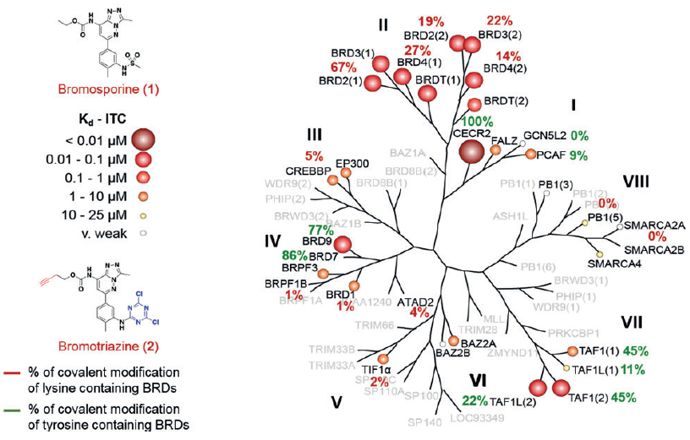
II. Design and Validation of the Active Probe BTZ
2.1 Design Strategy and Molecular Construction
This study began with the structure of BSP, a broad-spectrum BRD inhibitor. Through sequence alignment and molecular docking analysis, it was discovered that BSP's methylsulfonamide group points toward a highly conserved lysine (Lys) residue in the BRD binding pocket. Leveraging the nucleophilic properties of lysine, the research team selected dichlorotriazine, a known selective lysine-labeling electrophilic warhead, and connected it to BSP's core scaffold to synthesize the novel active probe BTZ.
2.2 In Vitro Labeling Activity Validation via Mass Spectrometry
After incubating the BTZ probe with various recombinant BRD proteins, mass spectrometry analysis successfully detected covalently labeled protein products. Quantitative analysis revealed that the BTZ probe's labeling efficiency for different BRD family members closely matched the inhibitory activity trend of its parent inhibitor BSP, confirming that the probe accurately reflects the biological characteristics of ligand-protein interactions.
III. Precise Identification of Binding Sites and Unexpected Discoveries
3.1 Specific Labeling of BRD4(1) and BRD3(2)
Through secondary mass spectrometry analysis, the research team identified the specific lysine residues covalently modified by the BTZ probe in BRD4(1) and BRD3(2), with their locations fully consistent with molecular docking predictions.
3.2 Unique 2:1 Binding Mode in BRD9
In BRD9, its KAc binding pocket lacks modifiable lysine residues nearby, yet the BTZ probe demonstrated a high modification rate of 77%. Crystal structure resolution revealed a unique intermolecular interlocking structure: one BTZ probe molecule simultaneously binds to two BRD9 protein monomers. One binding mode involves traditional non-covalent occupation of the active pocket, while the other forms a covalent bond with a tyrosine (Tyr106) residue outside the active pocket. This 2:1 stoichiometry aligns with previously reported functional BRD9 dimers. Kinetic experiments further confirmed that the BTZ probe's binding affinity for tyrosine residues surpasses that for lysine, expanding the probe's application scope.
IV. Applications in Complex Biological Systems and Kit Development Potential
4.1 Functional Derivatization and Detection
The study confirmed that recombinant BRD4(1) protein covalently labeled by the BTZ probe could successfully undergo copper-catalyzed click chemistry to attach fluorescent dyes or biotin tags. Subsequent visualization via SDS-PAGE and Western Blot demonstrated the probe's compatibility with functional modification and detection.
4.2 Target Fishing in Cell Lysates
Applying the BTZ probe to whole-protein lysates of K562 and THP-1 cells in pull-down experiments, combined with mass spectrometry identification, successfully captured and identified multiple BRD domain-containing proteins, including BRD4, BRD8, SMARCA4, and SUPT16H. This fully proves the BTZ probe's ability to specifically recognize and enrich the BRD protein family in complex biological samples.
V. Which Manufacturers Provide the Epigeneous Bromodomain Kit?
Nanjing UA-Bio Technology Co., Ltd. (UA-Bio) has independently developed the "Human Epigeneous Bromodomain Binding Kit", a high-performance in vitro screening and detection platform tailored for cutting-edge epigenetic research. This kit is designed to help researchers accurately and efficiently analyze and target the "histone reader" Bromodomain protein structural domain, providing a critical research tool for epigenetic drug discovery in fields such as oncology, inflammation, and neurological diseases.
| Core Product Advantages |
|---|
| High-Purity, High-Activity Target Proteins: The kit's core components consist of meticulously designed and purified human Epigeneous Bromodomain proteins, which possess correct spatial conformations and intact histone modification (e.g., acetylated lysine) recognition activity. This ensures the authenticity and biological relevance of ligand-molecule interactions, providing a reliable foundation for screening and validation. |
| Exceptional Reagent Stability and Consistency: Utilizing advanced recombinant expression systems and stringent quality control standards, we ensure that the provided target proteins exhibit high purity, excellent solution stability, and outstanding batch-to-batch consistency, safeguarding the reproducibility of your experimental data and the continuity of long-term research. |
| Flexible and Compatible Multiplex Detection Platform: This kit employs optimized AlphaScreen/LISA or TR-FRET detection principles (depending on configuration), offering pre-configured detection systems or core components for sensitive and rapid operation. It is adaptable to various applications, including high-throughput small-molecule inhibitor screening, compound affinity assessment, competitive binding assays, and epigenetic mechanism studies. |
| Complete Solutions and Professional Support: We provide detailed and optimized experimental protocols, standard curve references, and representative data plots to help you quickly establish a stable and reliable detection system. Additionally, our technical team offers comprehensive professional consultation and support for research design, experimental optimization, and data analysis. |
Nanjing UA-Bio Technology Co., Ltd. is committed to providing innovative, efficient, and high-quality core reagents and solutions for epigenetic research, innovative drug development, and gene expression regulation studies. For detailed technical parameters, validation data, or application support regarding the "Human Epigeneous Bromodomain Binding Kit" (Catalog No.: UA086018), please feel free to contact us.
This article is reviewed and published by the technical expert team of UA
Disclaimer: This article partially utilizes artificial intelligence assistance in its creation. If any content involves copyright or intellectual property issues, please let us know and we promise to verify and remove it as soon as possible.
Purchase recombinant protein, choose 
UA protein focuses on providing various protein reagents, raw materials, and services required for drug research and development, cell therapy, gene therapy, and basic scientific research, including drug target proteins, immune checkpoint proteins, cytokines, tool enzymes, customized protein expression, and full-length transmembrane protein development. Nanjing Univ is committed to providing customers with high-quality products and professional services, and building a High-tech Biological Enterprise with International Competitiveness.







 Business license (three certificates in one)