

Study on Novel BCL-XL Degraders Developed Based on BCL-XL/CRBN PROTAC Kits to Enhance BCL-2 Inhibitory Function


Evasion of apoptosis is a hallmark of cancer, often involving an imbalance between pro-apoptotic and anti-apoptotic proteins (such as BCL-2 family proteins).
- Recent Advances
- Product Information
Abstract
Evasion of apoptosis is a hallmark of cancer, often involving an imbalance between pro-apoptotic and anti-apoptotic proteins (e.g., BCL-2 family proteins). Upregulation of anti-apoptotic proteins BCL-XL, BCL-2, and MCL-1 promotes tumorigenesis, progression, and therapy resistance. Although small-molecule inhibitors (e.g., ABT-263) have been developed to target these proteins, their high toxicity to platelets limits clinical application. To overcome this limitation, this study designed and synthesized a series of novel proteolysis-targeting chimeras (PROTACs) based on the BCL-XL/CRBN PROTAC kit, focusing on evaluating their ability to degrade BCL-XL and enhance BCL-2 inhibition.
I. Design and Synthesis of PROTAC Molecules
Using ABT-263 as the base structure, novel PROTAC molecules (including pp1–pp8 and a pair of enantiomers, PZ703a/PZ703b) were synthesized by introducing linkers of varying lengths . These molecules aim to achieve selective degradation of BCL-XL by recruiting the CRBN E3 ubiquitin ligase. Preliminary studies focused on pp5, PZ703a, and PZ703b, comparing them with the known degrader DT2216 and inhibitor ABT-263.
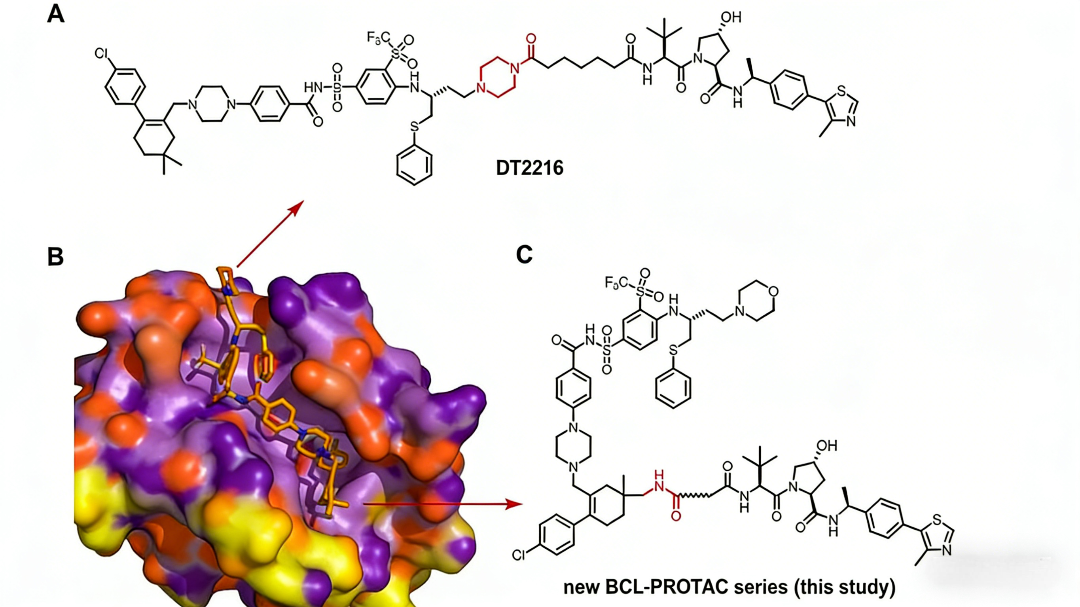
II. Evaluation of Cytotoxicity and Protein Degradation Efficacy
In MOLT-4 and RS4;11 cell lines, PZ703b exhibited approximately 2-fold stronger cytotoxicity than its enantiomer PZ703a and the non-enantiomeric mixture pp5. Western blotting analysis revealed that PZ703b effectively induced BCL-XL degradation without significantly affecting BCL-XL levels in platelets, demonstrating ~100-fold higher tumor cell selectivity compared to ABT-263 .
III. Validation of Degradation Mechanism
PZ703b induced rapid and sustained BCL-XL degradation in MOLT-4 cells, a process dependent on VHL and the proteasome pathway. Proteasome inhibitor MG-132 or VHL ligand VHL-032 blocked PZ703b-mediated degradation, confirming its PROTAC functionality. Additionally, PZ703b activated caspase-3-dependent apoptosis, an effect suppressible by the pan-caspase inhibitor QVD .
IV. Ternary Complex Formation Analysis
AlphaLISA and NanoBRET assays evaluated the ability of DT2216, PZ703a, and PZ703b to form ternary complexes with BCL-XL, BCL-2, and VCB (VHL–ElonginB–ElonginC complex). Results showed that PZ703b efficiently promoted {BCL-2:PROTAC:VCB} ternary complex assembly in vitro and in live cells, whereas DT2216 exhibited weaker functionality in cells (Figure 4). Competition assays further demonstrated that PZ703b significantly inhibited BCL-2–Bim interaction, an effect blocked by VHL-032, suggesting enhanced BCL-2 inhibition via ternary complex stabilization.
V. Conclusion
This study successfully developed the novel degrader PZ703b based on the BCL-XL/CRBN PROTAC strategy. PZ703b not only efficiently degrades BCL-XL but also enhances BCL-2 inhibition by promoting {BCL-2:PROTAC:VCB} ternary complex formation, while exhibiting low platelet toxicity. This provides a new approach for targeting BCL-2 family proteins in antitumor drug development.
VI. Which Manufacturers Provide BCL-XL/CRBN PROTAC Kits?
Nanjing UA-Biotech Co., Ltd. (UA-Bio) has independently developed the "Human BCL-XL/CRBN PROTAC Binding Kit", a high-performance in vitro detection platform designed for cutting-edge research on targeting the key apoptosis regulator BCL-XL. This kit enables researchers to dissect the molecular mechanisms of PROTAC-induced "target-PROTAC-E3 ligase" ternary complex formation, offering a precise and efficient starting point for innovative drug development in cancer therapy and overcoming drug resistance.
| Core Product Advantages |
|---|
| High Selectivity for Degradation: The kit's core component is a meticulously designed and synthesized human BCL-XL/CRBN bifunctional PROTAC molecule. With high-affinity binding to BCL-XL at one end and precise recruitment of CRBN E3 ligase at the other, it efficiently drives stable ternary complex formation, leading to specific ubiquitin-proteasome degradation of BCL-XL. Rigorous in vitro validation confirms its exceptional selectivity and degradation potential. |
| Superior Reagent Quality and Stability: Advanced synthesis techniques and strict quality control ensure high chemical purity, excellent solution stability, and outstanding batch-to-batch consistency, guaranteeing reliable and reproducible results. |
| Flexible, Integrated Solution: Beyond the core PROTAC molecule, the kit includes recommended buffer systems and protocols, compatible with functional assays (e.g., Western Blot, apoptosis analysis) and molecular interaction studies (e.g., SPR, ITC, TR-FRET), providing a complete workflow from binding validation to phenotypic research. |
| Comprehensive Technical Support: The detailed product manual covers PROTAC physicochemical properties, recommended concentrations, validation data, and precautions. Our technical team offers expert consultation for experimental design and optimization. |
Nanjing UA-Biotech Co., Ltd. is committed to providing cutting-edge, high-quality reagents and solutions for targeted cancer therapy, apoptosis research, and innovative drug development. For details on the "Human BCL-XL/CRBN PROTAC Binding Kit" (Catalog No.: UA086017), including technical specifications, validation data, or application support, please contact us.
This article is reviewed and published by the technical expert team of UA
Disclaimer: This article partially utilizes artificial intelligence assistance in its creation. If any content involves copyright or intellectual property issues, please let us know and we promise to verify and remove it as soon as possible.
Purchase recombinant protein, choose 
UA protein focuses on providing various protein reagents, raw materials, and services required for drug research and development, cell therapy, gene therapy, and basic scientific research, including drug target proteins, immune checkpoint proteins, cytokines, tool enzymes, customized protein expression, and full-length transmembrane protein development. Nanjing Univ is committed to providing customers with high-quality products and professional services, and building a High-tech Biological Enterprise with International Competitiveness.







 Business license (three certificates in one)