

Molecular Biological Characteristics and Clinical Detection Applications of Interleukin-6 (IL-6)


Interleukin-6 (IL-6) is a single-chain multifunctional cytokine composed of 212 amino acids, and its encoding gene is located on human chromosome 7.
- Recent Advances
- Product Information
1. What are the basic molecular characteristics and historical evolution of IL-6?
Interleukin-6 (IL-6) is a single-chain multifunctional cytokine composed of 212 amino acids, encoded by a gene located on human chromosome 7. Its discovery dates back to 1980 when researchers observed that fibroblasts stimulated by Poly I-C produced a factor with viral replication inhibitory activity, initially named β2 interferon. By 1986, this factor was officially unified as interleukin-6. Although named for its early discovery in leukocytes and its role in interleukocyte communication, it is now clear that IL-6 can be produced by various cell types and acts on multiple target cells, playing a key role in immune regulation, inflammatory responses, and hematopoiesis.
2. What are the important functions of IL-6 in the immune system?
As a pleiotropic cytokine, IL-6 exhibits both pro-inflammatory and anti-inflammatory properties, participating in the regulation of immune responses, acute-phase reactions, hematopoietic functions, and metabolic processes, among other critical physiological and pathological processes. In immune defense, IL-6 promotes B cell differentiation into plasma cells, stimulates T cell proliferation and differentiation, induces hepatocytes to produce acute-phase proteins, and participates in fever responses. Its dual nature is evident in that moderate IL-6 production aids in pathogen clearance and tissue repair, while sustained excessive production is closely linked to the development of various chronic inflammatory and autoimmune diseases.
3. What are the production mechanisms and regulatory pathways of IL-6?
The production of IL-6 is primarily regulated by pattern recognition receptor (PRR) signaling pathways. When exogenous pathogen-associated molecular patterns (PAMPs) are recognized by immune cells (e.g., monocytes, macrophages) through surface Toll-like receptors (TLRs) or RIG-I-like receptors, key transcription factors such as NF-κB are activated, promoting the transcription of IL-6, TNF-α, and IL-1β mRNA. Additionally, TNF-α and IL-1β themselves can further stimulate IL-6 production. Beyond immune cells, mesenchymal cells, endothelial cells, fibroblasts, and other cell types can produce IL-6 under appropriate stimulation, forming a complex cytokine network.
4. How does the IL-6 signal transduction pathway operate?
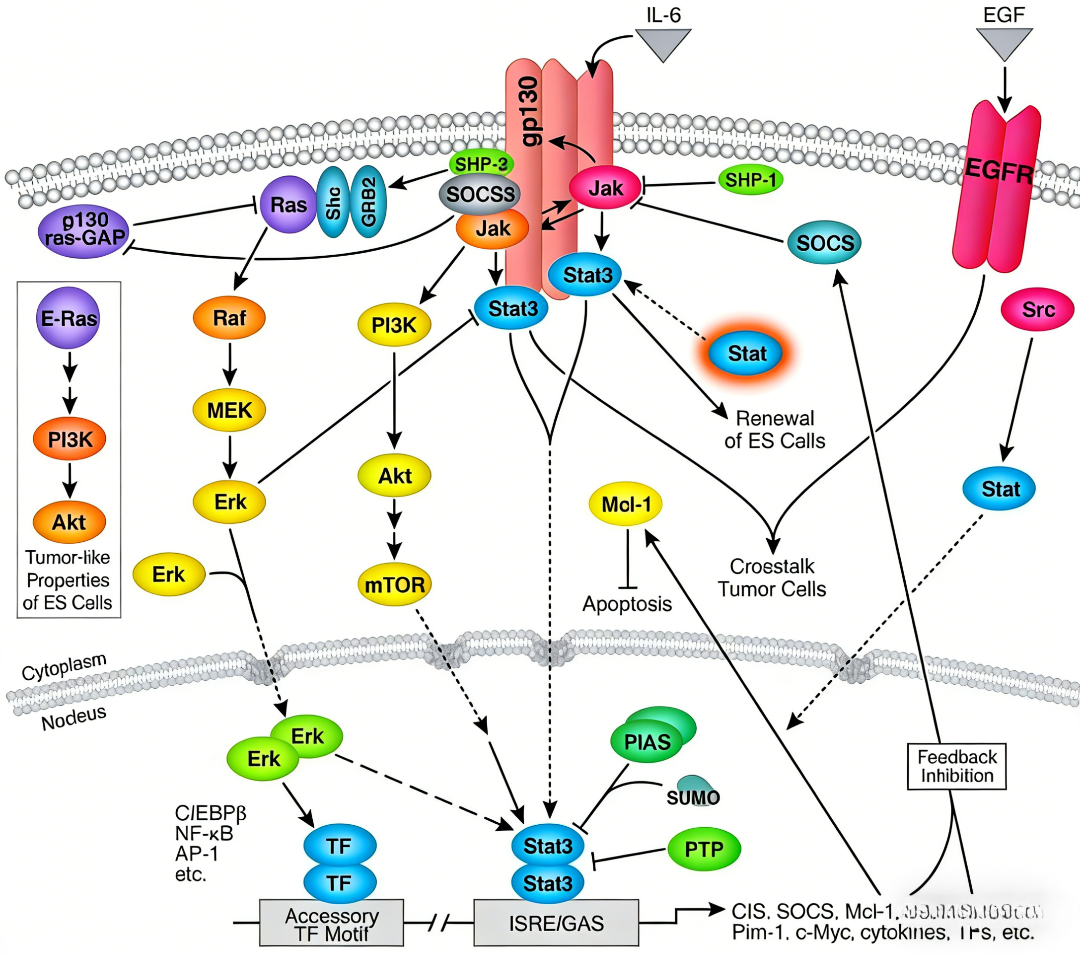
IL-6 functions through two distinct signaling pathways: the classic signaling pathway and the trans-signaling pathway. Both pathways rely on a receptor complex composed of the IL-6 receptor α subunit (IL-6R) and the signal-transducing subunit gp130.
In the classic signaling pathway, IL-6 binds to membrane-bound IL-6R on target cells, after which the complex recruits and activates gp130, initiating downstream signal transduction. Since membrane-bound IL-6R expression is mainly limited to hepatocytes, neutrophils, monocytes, and certain lymphocytes, the scope of the classic signaling pathway is relatively restricted.
In the trans-signaling pathway, IL-6 binds to soluble IL-6R (sIL-6R, produced through membrane protein hydrolysis or alternative splicing), forming a complex. This complex can bind to gp130, which is widely expressed on nearly all cell surfaces, thereby transmitting IL-6 signals to cells that do not express membrane-bound IL-6R, significantly expanding the biological scope of IL-6.
Both pathways ultimately lead to dimerization of the gp130 intracellular domain, activating JAK kinases (primarily JAK1, JAK2, and TYK2) associated with gp130. Activated JAK kinases phosphorylate STAT family proteins (particularly STAT3), causing STAT proteins to dimerize and translocate to the nucleus to regulate target gene transcription. Simultaneously, this pathway can also activate MAPK and PI3K signaling pathways.
5. What is the clinical application value of IL-6/IL-6R detection kits?
Accurate detection of IL-6 and its receptor levels holds significant clinical and research value. High-sensitivity and high-specificity IL-6/IL-6R detection kits can be used for:
1. Disease diagnosis and differentiation: Quantitative analysis of IL-6 levels in serum, plasma, or other bodily fluids aids in assessing systemic inflammatory states and assists in diagnosing Castleman disease, certain autoimmune diseases, and infectious diseases.
2. Disease monitoring and prognosis evaluation: Dynamic monitoring of IL-6 level changes can reflect disease activity, inflammatory severity, and treatment response, providing a basis for prognosis judgment.
3. Treatment guidance and efficacy monitoring: When using biologics like tocilizumab, detecting IL-6 or sIL-6R levels helps evaluate target inhibition and optimize treatment plans.
4. Safety monitoring in cell therapy: In cell immunotherapies such as CAR-T, close monitoring of IL-6 levels is crucial for early identification and warning of cytokine release syndrome (CRS).
5. Basic and translational research: In studies exploring mechanisms of inflammation, immunity, and cancer, precise quantification of IL-6 pathway activity is an essential technical component.
6. Which manufacturers provide IL-6/IL-6R detection kits?
Nanjing U-Protein independently developed the "Human IL6/IL6R Binding Kit", a precision in vitro detection tool focused on inflammatory signaling hub research. This kit is designed to accurately and efficiently detect and quantify the binding interaction between interleukin-6 (IL-6) and its specific receptor IL-6R, providing a highly reliable and standardized research solution for inflammatory diseases, autoimmune disorders, tumor immunology, and the screening and evaluation of targeted drugs (e.g., antibodies, inhibitors).
| Core Product Advantages |
|---|
| High bioactivity and native conformation: The kit provides rigorously quality-controlled, high-purity, high-activity human IL-6 protein and its receptor IL-6R. The protein products maintain correct spatial structures and full biological activity, accurately simulating the high-affinity binding of the IL-6/IL-6R pathway under physiological conditions, ensuring experimental accuracy and physiological relevance. |
| Exceptional stability and batch consistency: Utilizing advanced recombinant expression systems and precise purification processes, combined with comprehensive quality control, ensures each batch of products achieves high purity, excellent stability, and outstanding batch consistency, supporting long-term, continuous experimental research. |
| Ready-to-use flexible detection platform: Based on optimized enzyme-linked immunosorbent assay (ELISA) principles, the kit provides pre-coated strips, detection antibodies, standards, and a complete set of optimized buffer systems. The operation is simple and fast, with high sensitivity and specificity, suitable for various applications such as drug screening, affinity assays, competition experiments, and signaling mechanism studies. |
| Complete solutions and professional support: The kit includes detailed optimized protocols, standard curve examples, and result analysis guidelines to help quickly establish stable and reliable detection workflows. Our technical team offers comprehensive support for research design, experimental optimization, and data interpretation. |
Nanjing U-Protein is committed to providing high-performance, high-quality core reagents and tools for immunology, inflammation research, and innovative drug development. For detailed technical parameters, validation data, or specific application inquiries regarding the "Human IL6/IL6R Binding Kit" (Catalog No.: UA086013), please feel free to contact us.
This article is reviewed and published by the technical expert team of UA
Disclaimer: This article partially utilizes artificial intelligence assistance in its creation. If any content involves copyright or intellectual property issues, please let us know and we promise to verify and remove it as soon as possible.
Purchase recombinant protein, choose 
UA protein focuses on providing various protein reagents, raw materials, and services required for drug research and development, cell therapy, gene therapy, and basic scientific research, including drug target proteins, immune checkpoint proteins, cytokines, tool enzymes, customized protein expression, and full-length transmembrane protein development. Nanjing Univ is committed to providing customers with high-quality products and professional services, and building a High-tech Biological Enterprise with International Competitiveness.







 Business license (three certificates in one)