Research Progress on TCE and PROTAC Technologies Targeting KRAS[G12V]


KRAS[G12V], as one of the key mutation types at codon 12 of the KRAS gene, exhibits a significant distribution in various solid tumors.
- Recent Advances
1. What is the significance of KRAS[G12V] mutation in cancer therapy?
KRAS[G12V], as one of the key mutation types at codon 12 of the KRAS gene, shows significant distribution in various solid tumors. This mutation replaces glycine with valine, altering the conformation and function of the KRAS protein, keeping it persistently in the GTP-bound activated state, thereby abnormally activating downstream signaling pathways and driving tumor initiation and progression. In malignancies such as colorectal cancer, pancreatic cancer, and non-small cell lung cancer, KRAS[G12V] mutations account for a certain proportion, making it an important therapeutic target. Although KRAS has long been considered a "difficult-to-drug" target, innovative therapeutic strategies targeting its specific mutant subtypes are continuously emerging, offering new hope for related cancer patients.
2. What are the innovative applications of TCE technology in targeting KRAS[G12V]?
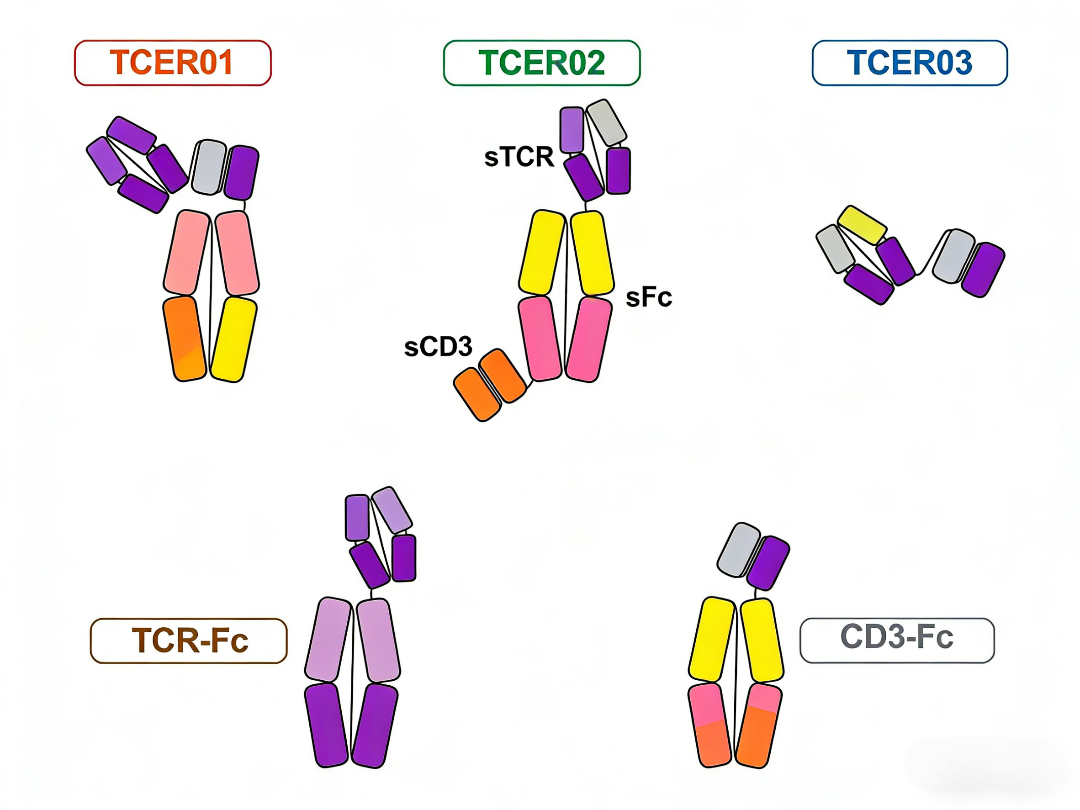
T-cell engagers (TCEs) are bispecific antibody-like molecules that simultaneously bind to the peptide-MHC complex on tumor cell surfaces and the CD3 molecule on T-cell surfaces, effectively connecting tumor cells with T cells and activating the cytotoxic function of T cells. The design of TCEs targeting KRAS[G12V] mutations typically includes two key domains: one end is an antigen recognition domain mimicking TCR, specifically recognizing the KRAS[G12V] mutant peptide bound to HLA-A*11:01; the other end is an anti-CD3 single-chain antibody fragment (scFv) for T-cell activation. This design allows TCEs to overcome the HLA restriction of traditional TCR therapies, enabling broader clinical applications.
In specific studies, through optimized screening of known TCR sequences and structural prediction and affinity evaluation using computational tools like AlphaFold 3.0, researchers successfully identified TCR recognition domains with high affinity. Further structural modifications, including optimization of Fc fragments, enhanced the stability and functional activity of TCEs. Experimental results showed that the optimized TCE molecules could effectively mediate T-cell-specific killing of tumor cells expressing KRAS[G12V]/HLA-A*11:01 complexes in vitro, manifested by significant secretion of effector molecules such as IFN-γ and granzyme B, as well as increased tumor cell lysis rates.
3. What are the unique advantages of PROTAC technology in targeting KRAS[G12V]?
Proteolysis-targeting chimeras (PROTACs) provide an innovative solution for targeting KRAS[G12V]. Unlike the immune modulation mechanism of TCEs, PROTACs induce the ubiquitin-proteasome degradation pathway to achieve complete clearance of KRAS[G12V] mutant proteins. PROTAC-based KRAS[G12V]/CRBN degraders typically consist of three parts: a KRAS[G12V] ligand, a CRBN E3 ubiquitin ligase ligand, and a linker connecting the two.
Compared to traditional competitive inhibitors, PROTAC degraders offer multiple advantages: first, they can overcome the structural limitation of KRAS proteins lacking traditional binding pockets; second, through catalytic degradation mechanisms, they achieve efficient protein clearance at sub-stoichiometric levels; third, sustained degradation of KRAS[G12V] may more effectively block its downstream signaling; finally, this strategy has the potential to overcome resistance caused by target mutations or overexpression. For KRAS[G12V] mutants lacking covalent binding sites, PROTAC technology provides an innovative approach to bypass the limitations of traditional inhibition strategies.
4. What are the important applications of KRAS[G12V]/CRBN PROTAC detection kits?
Specialized detection kits for KRAS[G12V] PROTAC degradation systems have multifaceted applications in drug development and mechanistic research:
1. Dynamic monitoring of degradation efficiency: By quantitatively measuring time-dependent changes in intracellular KRAS[G12V] protein levels after PROTAC treatment, the efficacy, optimal concentration, and degradation kinetics of different degraders can be systematically evaluated.
2. Selective validation analysis: Simultaneous detection of KRAS wild-type proteins and other mutant subtypes (e.g., G12C, G12D) allows assessment of the selectivity of PROTAC degraders for the G12V mutant, providing critical data for drug safety evaluation.
3. In-depth mechanistic analysis: By measuring ubiquitination levels, recruitment of CRBN E3 ligase complexes, and proteasome activity changes, the molecular mechanisms of PROTAC-induced KRAS[G12V] degradation can be systematically elucidated.
4. Functional validation of signaling pathways: Evaluating the impact of KRAS[G12V] degradation on key downstream signaling pathways such as MAPK and PI3K-AKT validates the biological effects and pharmacological mechanisms of degraders.
5. Systematic study of resistance mechanisms: In acquired resistance cell models, comprehensive analysis of KRAS degradation efficiency, compensatory pathway activation, and related regulatory factors helps explore molecular mechanisms of resistance.
5. Which manufacturers provide KRAS[G12V]/CRBN PROTAC detection kits?
Nanjing UA Protein independently developed the TR-FRET Human KRAS[G12V]/CRBN PROTAC Binding Kit (Catalog No.: UA086003), a high-performance detection platform based on time-resolved fluorescence energy transfer (TR-FRET) technology, specifically designed for the research and development of CRBN-class PROTAC molecules targeting KRAS G12V mutant proteins. This kit accurately and sensitively detects and quantifies the formation of ternary complexes between PROTAC-mediated KRAS[G12V] proteins and CRBN E3 ubiquitin ligases, providing an efficient, homogeneous, and reliable standardized solution for the development of protein degradation therapies targeting the KRAS G12V driver mutation, lead compound screening, and mechanistic studies.
Core Product Advantages:
| Advantage | Detailed Description |
|---|---|
| Specialized design for KRAS G12V degradation | Directly detects the efficiency of PROTAC molecules bridging KRAS[G12V] mutant proteins and CRBN E3 ligases to form ternary complexes, truly reflecting the compound's specificity for the G12V mutant and its potential to induce degradation, advancing targeted degrader development. |
| High sensitivity and low background interference | Utilizing TR-FRET detection technology with time-resolved and dual-wavelength advantages, it significantly eliminates compound autofluorescence and matrix interference, achieving high signal-to-noise ratio homogeneous detection, especially suitable for high-throughput screening and precise analysis of weak interactions. |
| Ready-to-use homogeneous workflow | The "mix-incubate-detect" homogeneous operation mode requires no washing or separation steps, simplifying procedures and enhancing experimental efficiency and data reproducibility. |
| Functionally validated protein components | The kit provides high-purity, high-activity human recombinant KRAS[G12V] mutant proteins and key components of CRBN complexes, both maintaining correct spatial conformation and biological function, ensuring physiological relevance and data reliability in ternary complex detection. |
| Exceptional stability and batch consistency | Advanced expression systems and stringent quality control processes ensure high purity, excellent long-term stability, and outstanding batch-to-batch consistency, supporting continuous drug development and comparative studies. |
| Complete solutions and professional support | We provide detailed optimized protocols, standard curve examples, and data analysis guidelines, along with specialized technical support and customized services for specific needs in KRAS G12V-targeted PROTAC development (e.g., linker optimization, degradation activity correlation analysis). |
Nanjing UA Protein is committed to providing cutting-edge, high-performance research tools and solutions for challenging targets in protein degradation, precision oncology, and innovative drug development. For detailed technical parameters, validation data, or application inquiries regarding the TR-FRET Human KRAS[G12V]/CRBN PROTAC Binding Kit (Catalog No.: UA086003), please feel free to contact us.
This article is reviewed and published by the technical expert team of UA
Disclaimer: This article partially utilizes artificial intelligence assistance in its creation. If any content involves copyright or intellectual property issues, please let us know and we promise to verify and remove it as soon as possible.
Purchase recombinant protein, choose 
UA protein focuses on providing various protein reagents, raw materials, and services required for drug research and development, cell therapy, gene therapy, and basic scientific research, including drug target proteins, immune checkpoint proteins, cytokines, tool enzymes, customized protein expression, and full-length transmembrane protein development. Nanjing Univ is committed to providing customers with high-quality products and professional services, and building a High-tech Biological Enterprise with International Competitiveness.







 Business license (three certificates in one)