The role and detection applications of BAFF protein in autoimmune diseases


Autoimmune diseases are a group of pathological conditions caused by abnormal immune system function, characterized by the attack of normal tissues and organs by autoantibodies or autoreactive lymphocytes, leading to persistent inflammation and tissue damage.
- Recent Advances
- Product Information
1. What is the relationship between autoimmune diseases and B-cell targeted therapy?
Autoimmune diseases are a group of pathological conditions caused by abnormal immune system function, characterized by autoantibodies or autoreactive lymphocytes attacking normal tissues and organs, leading to persistent inflammation and tissue damage. These diseases encompass over 100 different disorders and have become the third most common category of diseases, following cardiovascular diseases and malignancies. In the pathogenesis of autoimmune diseases, B cells play a key role as effector cells, participating in disease processes through various mechanisms such as producing autoantibodies, presenting antigens, and secreting pro-inflammatory cytokines. Therefore, developing therapeutic drugs targeting B-cell-related pathways has become a significant direction in current drug research.
2. What are the structural characteristics and biological functions of BAFF protein?
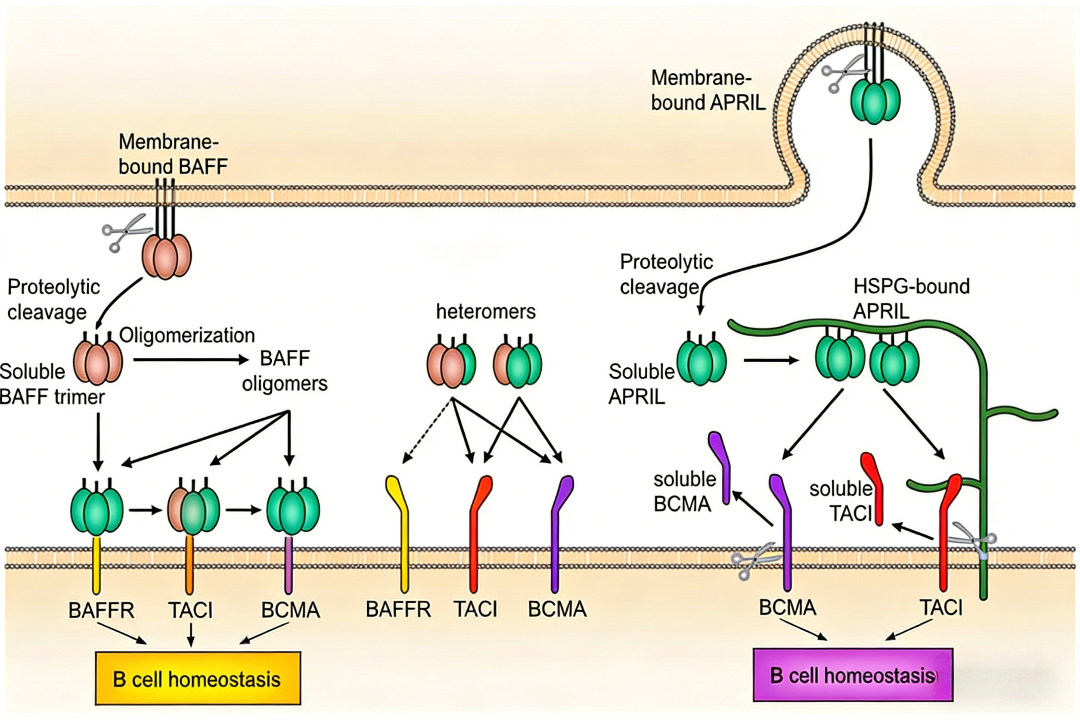
B-cell activating factor (BAFF, also known as TNFSF13B or CD257) is an important member of the tumor necrosis factor ligand superfamily. As a critical survival factor for B cells, it plays multiple regulatory roles in the immune system. This protein exists in two forms: soluble BAFF and membrane-bound BAFF, with the soluble form primarily released through proteolytic cleavage of the membrane-bound form.
Structurally, BAFF exists as a trimer and exerts its biological functions by interacting with three specific receptors: BAFF receptor (BAFF-R, TNFRSF13C), transmembrane activator and calcium modulator (TACI, TNFRSF13B), and B-cell maturation antigen (BCMA, TNFRSF17). The differential expression of these receptors in various B-cell subsets determines the specificity of BAFF signaling effects.
From a functional perspective, BAFF primarily regulates immune responses through the following pathways: promoting B-cell survival, proliferation, and maturation; regulating immunoglobulin class-switch recombination; and influencing the negative selection of autoreactive B cells. Recent studies have found that BAFF can also promote T-cell activation and differentiation, indicating its broader regulatory role in adaptive immune responses.
3. How is the BAFF signaling pathway associated with autoimmune diseases?
Clinical studies have shown that abnormal activation of the BAFF signaling pathway is closely related to the development of various autoimmune diseases. Elevated BAFF levels have been detected in the peripheral blood of patients with systemic lupus erythematosus, rheumatoid arthritis, multiple sclerosis, Sjögren's syndrome, and IgA nephropathy. These abnormally elevated BAFF levels disrupt the balance of B-cell self-tolerance, promoting the survival and proliferation of autoreactive B cells, leading to excessive production of autoantibodies and exacerbating autoimmune pathological processes.
For example, in systemic lupus erythematosus (SLE), the disease involves abnormalities in multiple immune cells and dysregulation of cytokine networks, with BAFF overexpression considered a key factor in disease progression. Elevated BAFF levels not only promote excessive B-cell activation but also affect T-cell function, forming a complex immune-inflammatory loop. Currently, therapeutic strategies targeting the BAFF pathway have become an important research direction for SLE and other autoimmune diseases.
4. What are the applications of BAFF & APRIL His Tag proteins in research?
Recombinant BAFF and APRIL proteins with histidine tags have significant applications in basic research and drug development:
Molecular mechanism research tool: High-purity His-tagged proteins can be used to study the binding kinetics and specificity of BAFF/APRIL with their receptors, elucidating the molecular mechanisms of signal transduction. Techniques such as surface plasmon resonance and isothermal titration calorimetry can precisely measure binding affinity.
Drug screening platform: In cell-based activity assays, His-tagged proteins can serve as standards to establish quantitative detection methods for screening and evaluating the activity of BAFF/APRIL inhibitors or modulators.
Diagnostic method development: As detection antigens, they can be used to develop diagnostic kits for measuring BAFF/APRIL levels or corresponding autoantibodies in serum, providing objective indicators for assessing disease activity.
Antibody drug characterization: In the development of therapeutic antibodies, His-tagged proteins can be used to evaluate antibody binding properties, neutralizing activity, and epitope specificity.
Structural biology research: His-tagged proteins can aid in protein crystallization and structural analysis, helping to elucidate the three-dimensional structure of BAFF/APRIL-receptor complexes and providing a basis for structure-based drug design.
5. Which manufacturers provide BAFF & APRIL His Tag proteins?
Nanjing YouAi Protein independently developed BAFF & APRIL Heterotrimer His Tag Protein, Human, a high-purity, high-activity recombinant heterotrimer complex. This product is carefully designed to consist of human B-cell activating factor (BAFF, also known as TNFSF13B) and a proliferation-inducing ligand (APRIL, TNFSF13) non-covalently bound, with a C-terminal His tag for purification and detection. This complex mimics the active conformation of BAFF/APRIL interacting with its receptors in the natural state, making it a key tool protein for studying B-cell immune regulation, autoimmune diseases, and antibody drug development.
Core Product Advantages:
| Advantage | Detailed Description |
|---|---|
| Native heterotrimer conformation | This product forms a BAFF-APRIL heterotrimer complex with the correct spatial structure through co-expression and co-purification technology, mimicking the active state of natural ligands. It provides a highly physiologically relevant tool for studying the binding properties and signaling pathways of BAFF/APRIL with its receptors (e.g., BCMA, TACI, BAFF-R). |
| High purity and bioactivity | Produced using a mammalian expression system and purified through multiple chromatography steps, the complex exhibits high purity (>95%) and low endotoxin levels, with validated receptor-binding activity to ensure reliability and sensitivity in functional studies. |
| Convenience of His tag | The C-terminal His tag facilitates efficient affinity purification, immobilization, and detection via nickel columns or anti-His tag antibodies, making it suitable for various experimental platforms based on the His tag system. |
| Excellent stability and batch consistency | Strict quality control and stable production processes ensure the product maintains good stability during long-term storage and repeated freeze-thaw cycles, with consistent activity and purity across batches to guarantee experimental reproducibility. |
| Broad application range | Suitable for receptor-binding assays (e.g., ELISA/SPR/BLI), cell function studies, antibody screening and characterization, immunoprecipitation, and as an immunogen for antibody development. |
Nanjing YouAi Protein is committed to providing high-quality, high-performance recombinant protein tools for immunology research, autoimmune disease drug development, and antibody therapy. For detailed technical information, activity data, or application guidance on BAFF & APRIL Heterotrimer His Tag Protein, Human (Catalog No.: UA011338), please feel free to contact us.
```This article is reviewed and published by the technical expert team of UA
Disclaimer: This article partially utilizes artificial intelligence assistance in its creation. If any content involves copyright or intellectual property issues, please let us know and we promise to verify and remove it as soon as possible.
Purchase recombinant protein, choose 
UA protein focuses on providing various protein reagents, raw materials, and services required for drug research and development, cell therapy, gene therapy, and basic scientific research, including drug target proteins, immune checkpoint proteins, cytokines, tool enzymes, customized protein expression, and full-length transmembrane protein development. Nanjing Univ is committed to providing customers with high-quality products and professional services, and building a High-tech Biological Enterprise with International Competitiveness.







 Business license (three certificates in one)